
Non-FictionInformativeEducational
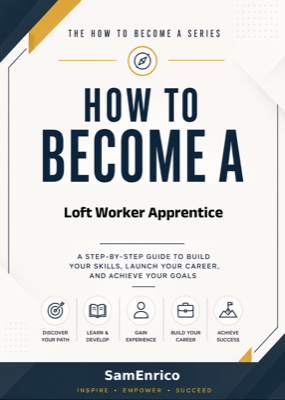
How to Become a Loft Worker Apprentice eBook
How to Become a Loft Worker Apprentice
by Winn Tisha
How to Become a Loft Worker Apprentice
Formats
Free sample
Chapter 1: The Roof Above--The first time I stood in a loft that would become someone’s bedroom, I nearly put my foot through the ceiling. I was seventeen years old, ninety-eight pounds soaking wet, and I had no business being up there. The joists were hidden under a thin layer of old plasterboard that had been brittle since the Carter administration. My mentor, a man named Terry who chewed tobacco and spoke in grunts, had pointed upward and said, “Go mark the cut for the hatch.” That was it. No instruction on where to step.
No warning about the crumbling lath and plaster below. No mention that the space between joists was a one-way ticket to the family’s living room.I took three steps before my left leg punched through to the bedroom below.The homeowner screamed. Terry laughed for a full minute. And I hung there, one leg dangling through a cloud of dust and old insulation, holding onto a rafter for dear life, wondering if I had just ended my career before it began. I hadn’t.
That was the problem. I had just started it. And that moment—the terror, the embarrassment, the dawning realization that I knew absolutely nothing—was the exact moment I became a loft worker apprentice.This book is for everyone who will have their own version of that moment. Maybe you won’t fall through a ceiling. Maybe you’ll misread a blueprint and cut sixteen rafters two inches too short.
Maybe you’ll install a staircase backwards. Maybe you’ll show up on your first day wearing the wrong boots and spend eight hours slipping on wet plywood. The specific humiliation doesn’t matter. What matters is that you survive it, learn from it, and become the kind of tradesperson who never makes that same mistake twice.Before we go any further, let me tell you what this chapter is not. This is not a sales pitch.
I am not going to tell you that becoming a loft worker is easy, or glamorous, or a shortcut to wealth. It is none of those things. What it is, however, is one of the most underrated career paths in the construction industry. While your friends are stacking debt in university lecture halls or grinding through zero-hour contracts in retail, you could be learning a trade that will pay you a living wage within two years and a skilled wage within five. You could be building spaces that change how families live in their homes.
You could be one of the few people in the modern economy who makes something real with their hands.But first, you have to understand what a loft worker actually is.The Accidental Trade Here is a strange truth: there is no official job title called “Loft Worker.” You will not find it on the government’s list of standard occupational classifications. You will not see it printed on a certificate after you complete your apprenticeship. The term is a practical shorthand for a specific hybrid role that has emerged from the booming loft conversion market. In reality, you are training to become a carpenter or joiner who specializes in loft conversions. But that specialization changes everything about how you work.A general carpenter might spend their week framing walls on a new housing estate, fitting kitchens in a renovation, or installing floor joists in an extension.
A loft worker does all of those things—but they do them in an attic. That means every task is performed in a confined space with limited headroom, awkward access, and the constant risk of damaging the finished rooms below. You will carry full sheets of plywood up a narrow staircase. You will cut rafters while kneeling on insulation. You will install windows that are tilted at the same angle as the roof.
You will build staircases that fold, twist, and retract because there is no room for a conventional flight.This is not simply carpentry in a difficult location. It is a different way of thinking about construction. Loft conversions require you to understand structural engineering, building regulations, thermal insulation, ventilation, fire safety, and soundproofing. You will work alongside electricians, plumbers, plasterers, and roofers. You will need to read architectural drawings that show existing structures and proposed changes on the same page.
You will need to know when to cut a corner and when to absolutely never cut a corner.The best way to understand the role is to look at what you will actually build.The Four Shapes of Loft Conversions Over the course of your apprenticeship, you will encounter four main types of loft conversion. Each has its own challenges, costs, and skill requirements. Learning to recognize them is your first step toward thinking like a loft worker.The Velux conversion is the simplest and the one you will probably learn first. It involves installing roof windows—typically from the Danish company Velux, though other brands exist—into the existing roof slope without changing the external shape of the roof. The work happens almost entirely inside the loft.
You strengthen the floor, add insulation, install the windows, and build partition walls. From the street, the house looks exactly the same. This is often the cheapest conversion and the least profitable for the contractor, which means you will do many of them as an apprentice. The repetition is boring but valuable. Every Velux job teaches you the fundamentals: joist spacing, window flashing, and fire-rated door installation.The dormer conversion is where things get interesting.
A dormer is a box-shaped projection that extends from the existing roof slope, creating vertical walls and a flat or pitched roof. It adds headroom and floor space. From the outside, it looks like a small room growing out of the roof. Building a dormer requires structural carpentry: cutting into the existing roof, installing new rafters, framing the dormer walls, and roofing the dormer head. You will work at height, often on scaffolding.
You will need to coordinate with roofers if you are not doing the tile or slate work yourself. This is the conversion that separates apprentices from improvers.The hip-to-gable conversion is common on semi-detached and end-of-terrace houses. A “hip” is the sloping edge where two roof planes meet at an external corner. A “gable” is the vertical triangular wall at the end of a pitched roof. Converting hip to gable means replacing the sloping hip with a vertical wall, turning a small loft into a full-width space.
This is serious structural work. You may need to install steel beams to support the remaining roof structure. You will definitely need building control approval at multiple stages. The math involved in cutting rafters for a hip roof is unforgiving. Get it wrong by five degrees and nothing fits.The Mansard conversion is the most complex and the most expensive.
Named after the seventeenth-century French architect François Mansart, a Mansard roof has two slopes on each side: a steep lower slope and a shallower upper slope. In a loft conversion context, the Mansard involves extending the rear roof slope to a near-vertical angle, often with a flat roof at the top. This maximizes floor space…
This is the end of the free sample. Get the eBook to keep going. Buy now
About this book
Details
- Author
- Winn Tisha
- Publisher
- SamEnrico
- Language
- English
- ISBN
- 9781505763959
- Genre
- Non-Fiction, Informative, Educational
- Released
- 2026-06-02
- Pages (approx.)
- 135
- Available as
- eBook, Paperback, Audiobook

Read better in the ZLOADR app
Your eBooks on your phone or tablet. Sign in with your SamEnrico account and start reading.
More by Winn Tisha
 The Spanking Alternative GuideWinn Tisha$11.99
 Validation For Postpartum MoodWinn Tisha$11.99
 ED in Older MenWinn Tisha$11.99
 The Spatial Span Training GuideWinn Tisha$11.99
 Step Two Practical SanityWinn Tisha$11.99
 The Lion Kings of Aksum: Africa's Forgotten Naval EmpireWinn Tisha$11.99
 .us Nexus Requirement GuideWinn Tisha$12.99
 PR for Nonprofit StartupsWinn Tisha$12.99
 The Breeder's Guide to Persian Rumpless ChickensWinn Tisha$11.99
 MopedsWinn Tisha$11.99
You may also like
 Hong Kong Handover 1997Dunn Johnnie$11.99
 Zumba For Postnatal Recovery CourseNeal Christian$11.99
 Zumba for BeginnersLadner Nikia$11.99
 YouTube Comment Mining GuideHumes Pandora$12.99
 Worry Box MeditationCarlin Rudy$11.99
 Workplace Stress MeditationNguyen Lynn$11.99
 Workplace Stress and Sleep RepairHawley Ivory$11.99
 Workplace Perfectionism CureDelaney Jeffry$11.99
 Workplace Injustice Anger GuideWallen Isabelle$11.99
 Work Addiction and Burnout LinkGreenwood Ester$11.99
 Women in Yoga and WellnessBeattie Galina$11.99
 Women in Stand Up ComedyChun Evangeline$11.99