
Non-FictionInformativeEducational
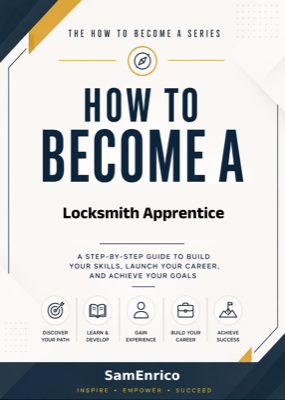
How to Become a Locksmith Apprentice eBook
How to Become a Locksmith Apprentice
How to Become a Locksmith Apprentice
Formats
Free sample
Chapter 1: The Trust Deficit--The first time I watched a master locksmith work, he didn't pick a lock. He didn't cut a key. He didn't install a deadbolt. Instead, he spent twenty minutes talking to a crying woman on her front porch while I stood in the rain holding a toolbox I wasn't yet allowed to open.Her name was Margaret. She was seventy-three years old.
She had locked herself out of her townhouse for the third time that month, and her adult son—the one who usually let her in with his spare key—had stopped answering her calls because he was "tired of her forgetfulness." She wasn't forgetful. She was showing early signs of dementia, and her son was in denial. The locksmith, a grizzled fifty-eight-year-old named Frank who smelled like cigarette smoke and coffee, didn't just open her door. He called her son, had a quiet conversation that I couldn't fully hear, and then installed a push-button combination lock on her side door at no charge. He left a voicemail for Adult Protective Services on his way to the next call."That," Frank said as he lit a cigarette in his van, "is ninety percent of this job.
The other ten percent is the mechanical stuff you're here to learn."I thought he was exaggerating. He wasn't.If you picked up this book because you want to learn how to pick locks, how to rekey a Schlage deadbolt, or how to program a transponder key for a 2018 Honda Civic, you will find all of that in later chapters. But if you skip this chapter—if you treat it as soft material before the "real" content—you will fail as a locksmith. Not because you lack mechanical skill, but because no master locksmith will apprentice you, no customer will trust you, and no court will defend you when you inevitably open a door you shouldn't have.This chapter is about the thing that every successful locksmith understands and every failed locksmith ignores: trust is your only inventory.The First Lesson: You Are Not a Hero There is a romantic image of locksmithing that circulates on You Tube and in heist movies. A quiet figure crouches in front of a door, tension wrench in one hand, hook pick in the other.
A series of clicks. The door swings open. The hero slips inside.That is fiction. Real locksmithing is mostly driving, mostly listening, and occasionally turning a wrench. The dramatic moments—the lockouts at 2 AM, the safe cracks, the emergency calls from battered women fleeing their homes—are real, but they are not glamorous.
They are heavy. They carry liability that can ruin your life if you make the wrong call.Consider the legal reality. In all fifty states, performing locksmith services without proper authorization is a crime. The specific charge varies—trespass, criminal mischief, burglary tools possession, even burglary itself if you open a door for someone who does not have the right to enter. The locksmith who opens the wrong door does not get a warning.
They get arrested, prosecuted, and often convicted, because juries do not understand the nuance of "I thought the customer was telling the truth."This is why the first question any professional locksmith asks is never "what kind of lock is it?" It is always "can you prove you live here?"The second question—the one they ask themselves silently—is "would I bet my license on this person?"The Locksmith's Code: An Unwritten Constitution There is no single governing body that licenses locksmiths nationwide. (We will discuss state licensing requirements in detail later in this chapter.) However, there is an unwritten code of conduct that every reputable locksmith follows. It is taught by mentors to apprentices, passed down through generations of the trade, and it exists because the consequences of ignoring it are catastrophic.The code has four pillars. Learn them now. Memorize them.
Write them on the inside cover of this book if you need to.Pillar One: Verify before you violate. Never open a lock, cut a key, or bypass a security device without verifying that the person requesting the service has legal authority to grant access. Verification is not a single step; it is a protocol. Photo identification matching the address. Mail from inside the property.
A neighbor who recognizes the person. For rental properties, a lease agreement or a phone call to the property manager using a published number—not the number the customer gives you. For businesses, a business card, a uniform, and a supervisor who can confirm identity over the phone. If any of these are missing, you do not proceed. You apologize, you explain the policy, and you leave.Pillar Two: Confidentiality is absolute.
Everything you see, hear, and learn about a client's security is privileged information. The master key system for the local hospital. The combination to the safe in the law office. The fact that the elderly woman on Maple Street hides a spare key under the ceramic frog. You do not discuss these things with anyone—not your spouse, not your friends, not other locksmiths in a private Facebook group.
A lock is only as secure as the number of people who know how to bypass it. Your silence is part of the security system.Pillar Three: Preserve life safety above all. The NFPA 101 Life Safety Code (which we will reference multiple times throughout this book) exists for one reason: people must be able to get out of a building in an emergency. You never install a lock or modify an existing lock in a way that prevents egress. No double-cylinder deadbolts in residential bedrooms unless there is a thumb-turn inside.
No padlocks on fire exit doors. No electronic locks that fail-secure (lock when power is lost) on doors that serve as emergency exits. If a client asks you to violate life safety codes, you refuse. You explain why. If they insist, you walk away from the job.Pillar Four: Know when to say no.
This is the hardest pillar because it costs you money. You say no to customers who cannot prove ownership. You say no to customers who want you to "look the other way" on building codes. You say no to customers who ask you to leave a lock unlocked after opening it (a common scam tactic). You say no to any job that exceeds your competence—and as an apprentice, almost every job exceeds your competence for the first six months.
Saying no preserves your license, your freedom, and your reputation. Saying yes to the wrong job can end your career before it starts.The Background Check Paradox: Why Your Past Matters Before we go further, we need to address the elephant in the room. A significant percentage of people who want to become locksmiths have a criminal record. This is not a stereotype; it is a statistical reality of the trade. Locksmithing attracts people who are mechanically inclined, who are curious about security systems, and who—for some—developed that curiosity in ways that intersected with the criminal justice system.Here is the truth: a criminal record does not automatically disqualify you from becoming a locksmith.
But the type of criminal record matters enormously.Low-risk offenses that generally do not disqualify you:Minor misdemeanors (trespassing, disorderly conduct, minor…
This is the end of the free sample. Get the eBook to keep going. Buy now
About this book
Details
- Author
- Tierney Tatiana
- Publisher
- SamEnrico
- Language
- English
- ISBN
- 9781505763720
- Genre
- Non-Fiction, Informative, Educational
- Released
- 2026-05-08
- Pages (approx.)
- 148
- Available as
- eBook, Paperback, Audiobook

Read better in the ZLOADR app
Your eBooks on your phone or tablet. Sign in with your SamEnrico account and start reading.
More by Tierney Tatiana
 Retail Therapy AlternativesTierney Tatiana$11.99
 The Shift Worker Nap GuideTierney Tatiana$11.99
 Shelby's Lost DaughterTierney Tatiana$11.99
 Podcasting Your Legacy CourseTierney Tatiana$11.99
 Body Scan for LonelinessTierney Tatiana$11.99
 The Lion of Lagos: How Hakeem Olajuwon Brought Basketball to AfricaTierney Tatiana$11.99
 Bubble URL Parameters GuideTierney Tatiana$12.99
 Government Employee Promotion CaseTierney Tatiana$12.99
 Understanding Varicella Virus Antenatal InfectionTierney Tatiana$17.99
 Lead Infrastructure EngineerTierney Tatiana$11.99
You may also like
 Hong Kong Handover 1997Dunn Johnnie$11.99
 Zumba For Postnatal Recovery CourseNeal Christian$11.99
 Zumba for BeginnersLadner Nikia$11.99
 YouTube Comment Mining GuideHumes Pandora$12.99
 Worry Box MeditationCarlin Rudy$11.99
 Workplace Stress MeditationNguyen Lynn$11.99
 Workplace Stress and Sleep RepairHawley Ivory$11.99
 Workplace Perfectionism CureDelaney Jeffry$11.99
 Workplace Injustice Anger GuideWallen Isabelle$11.99
 Work Addiction and Burnout LinkGreenwood Ester$11.99
 Women in Yoga and WellnessBeattie Galina$11.99
 Women in Stand Up ComedyChun Evangeline$11.99