
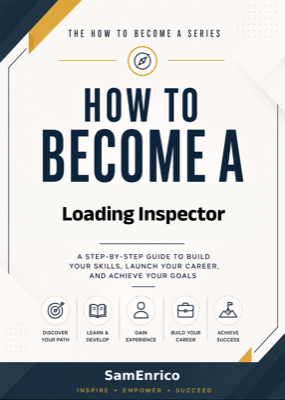
How to Become a Loading Inspector eBook
How to Become a Loading Inspector
How to Become a Loading Inspector
Formats
Free sample
Chapter 1: The Unseen Catastrophe--The first time I watched a forty-thousand-pound steel coil punch through the front wall of a trailer and obliterate the cab of a semi-truck, I was standing fifty feet away at a truck stop in Ohio. The driver, a man named Earl with thirty years of experience, had just finished his pre-trip inspection. He checked his brakes, his lights, his tires. He kicked the tires, an old habit from his military days. He logged into his electronic logging device.
He did everything right. Except for one thing. He had assumed the load was secure.The coil had been strapped down with four chains. On paper, that was enough. But two of the chains were grade seventy when they should have been grade one hundred.
One had a hidden crack in the ratchet mechanism. And the dunnage—the wooden blocking meant to stop the coil from rolling—was wet, compressed, and had lost its friction. When Earl hit the brakes to avoid a sudden slowdown, the coil did not stop. It did not even slow down. It moved forward with the force of a small elephant charging at full speed.
The chains snapped like rubber bands. The coil punched through the bulkhead, crushed the back of the cab, and pushed Earl's seat forward six inches. He survived because his seat bracket bent rather than broke. He retired three weeks later. He will never drive again.That day, I learned something that no training manual ever taught me.
The difference between a load that stays put and a load that becomes a missile is not about following a checklist. It is about seeing what others miss. It is about understanding that every strap, every chain, every piece of wood, and every driver's assumption is a variable in an equation that can kill. This chapter will teach you to solve that equation.What you are about to read is not a dry regulatory manual. It is the foundation of becoming a Loading Inspector—a professional who stands between a secure load and a catastrophe.
Whether you want to inspect trucks on the highway, rail cars on the tracks, cargo in the belly of an aircraft, or pallets in a warehouse, the principles are the same. You must develop a mindset that treats every load as a potential failure. You must become a skeptic of good intentions and a believer in physics.The Invisible Profession Loading inspection is one of the most overlooked careers in the logistics industry. The general public has no idea it exists. Most drivers barely understand it.
And yet, every day, millions of tons of cargo travel across highways, railways, runways, and shipping lanes, held in place by nothing more than a few pieces of metal and the judgment of an inspector who signed off on the load.According to the Federal Motor Carrier Safety Administration (FMCSA), improper load securement is a contributing factor in over twenty-five thousand truck crashes annually in the United States alone. That is nearly seventy crashes every single day. And those are only the ones that get reported. Many more incidents—shifted loads that damage cargo, overloaded axles that cause premature tire failure, improperly balanced trailers that sway dangerously—never make it into the statistics because no one gets hurt. But the costs are real.
Damaged cargo costs shippers billions of dollars each year. Delayed loads cost carriers their reputations. And human lives cost more than any insurance policy can cover.The person who prevents all of that is the Loading Inspector. Sometimes called a cargo inspector, load verifier, transportation inspector, or securement auditor, this role exists in every corner of the logistics world. In trucking, the inspector might work at a weigh station, a distribution center, or a port.
In rail, the inspector walks the length of a train, checking tie-downs and clearance measurements. In aviation, the inspector works on the tarmac, calculating weight and balance with precision measured in fractions of an inch. In the military, the Airdrop Load Inspector Certification (ALIC) is a specialized credential that allows an inspector to sign off on loads that will be dropped from aircraft at altitude.Yet despite its importance, loading inspection is rarely taught in schools. There is no college degree in load securement. There are no formal apprenticeships in the traditional sense.
Most inspectors learn on the job, often from senior drivers or warehouse managers who themselves learned from someone else. That means the quality of inspection varies wildly from one location to another. Some facilities have rigorous, checklist-driven processes. Others have a guy with a flashlight who glances at the straps and waves the truck through.This book exists to change that. It consolidates best practices from the US Army, the International Civil Aviation Organization (ICAO), the FMCSA, the Occupational Safety and Health Administration (OSHA), and decades of accident investigations into a single, actionable system.
By the time you finish this chapter, you will understand what separates a competent inspector from an excellent one. By the time you finish the book, you will have the knowledge to pursue certification, build a career, and potentially save lives.The Fundamental Shift: From Laborer to High-Reliability Professional Let me tell you about a concept borrowed from nuclear aircraft carriers. The United States Navy operates nuclear-powered carriers with crews of over five thousand people. On the flight deck, aircraft take off and land every forty-five seconds. A single mistake—a misfueled jet, a loose panel, a miscommunicated order—can cause an explosion that kills dozens.
Yet these carriers operate for years without catastrophic failure. The secret is something called High-Reliability Theory.High-reliability organizations are those that operate in complex, high-risk environments yet manage to avoid failure over long periods. They share five characteristics: a preoccupation with failure (they expect things to go wrong), a reluctance to simplify (they do not take shortcuts), sensitivity to operations (they pay attention to the front lines), a commitment to resilience (they recover quickly), and deference to expertise (the person with the most knowledge, not the highest rank, makes decisions).As a Loading Inspector, you must internalize these characteristics. You must become a high-reliability professional. That means you cannot think of your job as checking boxes.
You cannot think of a passed inspection as a success. You must think of every inspection as a close call that did not happen yet. The load that passes today might have been one pothole away from failure. The driver who smiles and thanks you might have missed a cracked chain link. The warehouse manager who rushes you to sign off might be willing to accept risk that you are not.This mindset is not natural.
It is trained. And the training begins with a simple reframing: you are not inspecting a load. You are auditing a system. That system includes the cargo, the securement hardware, the vehicle, the driver, the route, the weather, and the regulations. Any one of those components can fail.
Your job is to find the weak points before they find you.Let me give you an example. A typical driver will inspect a load and think, "There are four straps. They look tight. Good to go." A high-reliability inspector…
This is the end of the free sample. Get the eBook to keep going. Buy now
About this book
Details
- Author
- Condon Sherril
- Publisher
- SamEnrico
- Language
- English
- ISBN
- 9781505762570
- Genre
- Non-Fiction, Informative, Educational
- Released
- 2026-04-26
- Pages (approx.)
- 128
- Available as
- eBook, Paperback, Audiobook

Read better in the ZLOADR app
Your eBooks on your phone or tablet. Sign in with your SamEnrico account and start reading.
More by Condon Sherril
 Community Cleanup SponsorshipCondon Sherril$11.99
 Street Musician BiographyCondon Sherril$11.99
 Canva Brand Identity for BakeriesCondon Sherril$11.99
 Smoking Cessation Bullet JournalCondon Sherril$11.99
 The Day the Dollar Died: How a Single Bank Run Toppled a NationCondon Sherril$11.99
 Learn to Play the Bass TrumpetCondon Sherril$11.99
 Forensic ExaminerCondon Sherril$11.99
 AI for Contract Data ValidationCondon Sherril$12.99