
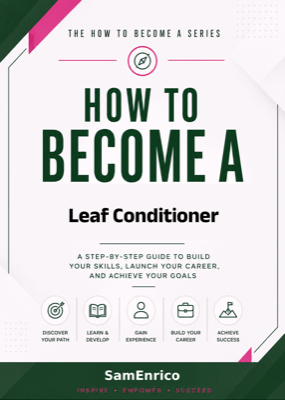
How to Become a Leaf Conditioner eBook
How to Become a Leaf Conditioner
How to Become a Leaf Conditioner
Formats
Free sample
Chapter 1: The Thousand-Orchid Funeral--– It was a Tuesday when I killed them all.Not with a bang, not with a flood, not with any dramatic disaster that would make for a good story at a horticulture conference. No, I killed one thousand Phalaenopsis orchids with the slow, methodical precision of someone who thought he knew exactly what he was doing. And that, as I would come to learn, was the most dangerous kind of plant killer there is.The year was 2007. I was twenty-three years old, freshly graduated with a degree in plant science, and utterly convinced that my four years of textbook education had prepared me for anything the botanical world could throw my way. I had memorized the Krebs cycle.
I could recite the taxonomic classification of any common houseplant from memory. I had written a thesis on the effects of nitrogen-to-phosphorus ratios in hydroponic lettuce production that my advisor had called "thorough" and "competent" – two words that, in academia, are the kiss of faint praise.But I had never really listened to a plant.The job came through a friend of a friend. A botanical garden in the Pacific Northwest had invested heavily in an ambitious orchid exhibition – a thousand specimens imported from Southeast Asia, each one a living jewel of evolutionary perfection. They needed a temporary caretaker for six weeks while the head horticulturist was on medical leave. The pay was laughable.
The prestige, however, was not. This was my chance to prove myself.I still remember walking into the greenhouse for the first time. The air was thick and warm, nearly tropical, carrying the sweet, almost fungal scent of healthy orchid roots. Racks upon racks of Phalaenopsis stretched in every direction – white blooms, pink blooms, the rare yellow hybrids that cost more than my monthly rent. Their leaves were thick and waxy, the deep green of healthy chlorophyll, each one a solar panel perfectly calibrated for low-light conditions.
They were, by any objective measure, thriving.I pulled out my notebook and began my protocol.The Mistakes of a Young Man with a Degree My approach was, in retrospect, horrifying in its arrogance. I had been trained to see plants as systems – inputs and outputs, water and nutrients, light and temperature. The orchid collection became a spreadsheet in my mind. I calculated optimal irrigation schedules based on evapotranspiration formulas. I adjusted the greenhouse's humidistat to theoretical perfection.
I mixed fertilizer solutions to the precise parts-per-million recommended in the literature.What I did not do was look at the leaves.Oh, I glanced at them, certainly. I noted their color in my reports – "foliage appears robust, turgor pressure adequate, no visible necrosis." But I was not reading them. I was not seeing the subtle shifts in hue that whispered of impending disaster. The slight curling at the leaf margins that should have screamed "something is wrong." The almost imperceptible softening of the tissue that was the first cry for help.The first warning sign came on day twelve.I was performing my morning inspection when I noticed it: a single leaf on a single orchid near the back of the greenhouse had turned slightly yellow. Just slightly.
The kind of yellow that could easily be dismissed as natural senescence, the oldest leaf on the plant finally giving way to new growth. I made a note of it in my log and moved on.The next day, three more leaves on three different plants showed the same symptom. Then ten. Then twenty.By day eighteen, nearly two hundred orchids had developed chlorotic leaves – that pale, sickly yellow that indicates a plant starving for something essential. I panicked.
I tested the soil p H. I tested the nutrient solution. I tested the water quality, the light levels, the air circulation, the temperature gradient across the greenhouse. Every test came back within acceptable parameters.So I did what any young, overconfident horticulturist would do: I doubled down.I increased the fertilizer concentration, convinced that a nutrient deficiency was the culprit. I adjusted the irrigation schedule, certain that the plants were either overwatered or underwatered – I was not yet sure which.
I moved the affected plants closer to the light source, then farther away, then back again. In my desperation, I was throwing everything I had at the problem without stopping to ask what the leaves were telling me.By day twenty-four, the yellowing had progressed to necrosis. Brown, crispy edges crept inward from the leaf margins like a slow-motion fire. The oldest leaves were beginning to drop entirely. The flowers – those gorgeous, long-lasting blooms that make Phalaenopsis the most popular orchid in the world – were wilting and falling, their petals turning translucent and then brown.I called my mentor, a grizzled old horticulturist named Miriam who had forgotten more about plants than I would ever know.
I described the symptoms. I listed my test results. I recited my interventions.She listened in silence, then asked one question: "What do the roots look like?"I had not checked the roots.The Underground Truth That night, I pulled an orchid from its pot. The roots – normally thick, silvery-green, and firm – were soft, brown, and mushy. Root rot.
Advanced, systemic, probably irreversible root rot. I pulled another. Same story. And another. All of them.I had been watering the orchids on a fixed schedule, following the textbook recommendation of "once per week" for Phalaenopsis in bark medium.
But the greenhouse's humidity levels – which I had set to "optimal" for the foliage – had been keeping the bark perpetually damp. The roots never dried out. They had been drowning slowly, suffocating in the airless, waterlogged environment I had created, and the leaves had been trying to tell me for nearly a month.The yellowing was the first message: "We cannot take up nutrients because our roots are dying."The soft, curling margins were the second: "Turgor pressure is failing because the vascular system is compromised."The necrotic edges were the third: "We are actively dying, and you are not listening."I had been treating the leaves as the problem when they were merely the messengers. I had sprayed fungicides, adjusted lights, changed fertilizers – everything except the one thing that mattered: checking the roots and understanding why the leaves were suffering.The head horticulturist returned to find a greenhouse of corpses. One thousand orchids, reduced to compost.
My career in botanical gardens ended before it properly began.But something else began that day. Something that would take years to name and even longer to master.The Birth of the Leaf Conditioner In the months that followed my disgrace, I did not abandon plants. I could not. Despite the humiliation, despite the financial ruin, despite the very reasonable suggestion from my parents that I consider a career in something with less "rot potential" (accounting was their suggestion), I was drawn back to the greenhouse again and again. But I returned as a different person – one who had been humbled by a thousand silent teachers.I took a job at a small nursery, the kind of place where the owner wore the same stained flannel shirt every day and could diagnose a plant problem from fifty yards away with a…
This is the end of the free sample. Get the eBook to keep going. Buy now
About this book
Details
- Author
- Coughlin Ceola
- Publisher
- SamEnrico
- Language
- English
- ISBN
- 9781505758863
- Genre
- Non-Fiction, Informative, Educational
- Released
- 2026-05-02
- Pages (approx.)
- 146
- Available as
- eBook, Paperback, Audiobook

Read better in the ZLOADR app
Your eBooks on your phone or tablet. Sign in with your SamEnrico account and start reading.
More by Coughlin Ceola
 Letting Go Of Old Identity GuideCoughlin Ceola$11.99
 The Assertive Anger MethodCoughlin Ceola$11.99
 US Submarine Patrol ReportsCoughlin Ceola$11.99
 Writing Legacy GuideCoughlin Ceola$11.99
 The Children's Dream Interpreter GuideCoughlin Ceola$11.99
 The Bone Collectors of Botany Bay: A Colonial Cult’s Dark ExperimentCoughlin Ceola$11.99
 Risk Transfer Climate GuideCoughlin Ceola$12.99
 IRA Beneficiary DistributionCoughlin Ceola$12.99
 Writing AssistantCoughlin Ceola$11.99