
Non-FictionInformativeEducational
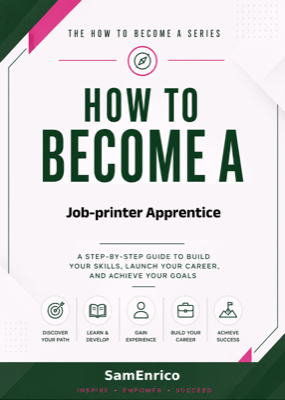
How to Become a Job-printer Apprentice eBook
How to Become a Job-printer Apprentice
How to Become a Job-printer Apprentice
Formats
Free sample
Chapter 1: The Ghost in the Press...--–- The first lie you will hear about the printing industry is that it is dying. The second lie is that it is boring. The third, and most dangerous, is that a machine can do everything a human can do, only faster and cheaper, so why bother learning the trade at all? These three lies have done more damage to the skilled labor force than any recession, any offshoring wave, or any technological disruption. They have convinced an entire generation that touching physical things for a living is somehow beneath them.
They have emptied trade schools, shuttered apprenticeship programs, and created a talent vacuum so severe that employers in the printing industry are now desperate—genuinely, almost pathetically desperate—for young people who can tell the difference between cyan and navy blue.This book exists because of that desperation. Not to exploit it, but to hand it to you like a key.Let me paint a scene that contradicts everything you think you know. Somewhere in the American Midwest, in a building that looks like any other industrial warehouse, a twenty-two-year-old woman stands in front of a machine that cost more than your childhood home. She is not wearing a paper hat or a grease-stained apron. She is wearing a clean polo shirt, safety glasses, and hearing protection that connects wirelessly to her phone.
In her hand is a tablet displaying real-time color density readings from the last five hundred sheets that raced through the press at fifteen thousand impressions per hour. She notices a drift—a minuscule shift toward magenta that the customer would never see but that the quality standard explicitly forbids. She taps three icons on the tablet. The press adjusts its ink keys automatically. The drift disappears.
She logs the correction in a cloud-based system that will generate a report for the morning shift. Then she walks to the back of the press, where a stack of freshly printed booklets cascades into a conveyor belt that leads to a robotic binder. She picks up a single sheet, holds it under a standardized light booth, and smiles. The color matches the proof perfectly.That woman is a job-printer apprentice. She started eighteen months ago knowing nothing.
Today, she earns more than her college-graduate friends who answer emails in open-plan offices while complaining about their student loans. By the time she completes her apprenticeship, she will have zero debt, a portable skill set that no artificial intelligence can replicate, and the quiet satisfaction of having made something real.This chapter is about why that future is available to you, why almost nobody is telling you about it, and why the timing has never been better to ignore the lies and walk into a print shop.The Corpse That Refuses to Die Let us begin with the lie about death. It is true that the number of commercial printing establishments has declined in the United States and Europe since the peak of the 1990s. It is true that newspapers have collapsed, that magazines are thinner than they used to be, and that your grandmother’s letter-writing habit has been replaced by email. These facts are not in dispute.
What is in dispute—what the doom-sayers conveniently omit—is what happened to the printing industry that remained.The decline was not an extinction event. It was a consolidation event.In 1995, there were roughly forty thousand commercial printing establishments in the United States, many of them small shops with one or two presses, catering to local businesses that needed letterhead and business cards. By 2024, that number had fallen below twenty-five thousand. A thirty-seven percent drop sounds catastrophic until you examine the survivors. The shops that closed were the weak ones—under-capitalized, technologically backward, over-reliant on products that digitization made obsolete.
The shops that survived are larger, more efficient, and dramatically more profitable. They consolidated market share. They invested in automation. And they are now competing for a shrinking pool of skilled labor at the exact moment when demand for certain printed products is actually growing.What products? Let me give you three that you interact with every single day without thinking about them.First: packaging.
That cardboard box that arrived from Amazon. That clamshell container holding your takeout. That vacuum-sealed bag inside your cereal box. The flexible film wrapping your cheese. The corrugated display at the end of the grocery aisle.
All of it is printed. All of it requires skilled operators to set up and run the presses that produce it. The global packaging printing market was valued at approximately three hundred and fifty billion dollars in 2023, and it is projected to grow at four to five percent annually for the foreseeable future. Humans are not going to stop buying things in boxes. E-commerce has only increased the demand for printed packaging.
Every time you click "buy now," you create work for a flexographic printer somewhere.Second: labels. Every bottle of shampoo, every can of soup, every jar of peanut butter, every pharmaceutical vial, every shipping label slapped onto every package—all of them are printed, usually on narrow-web presses running at breathtaking speeds. The label industry has grown steadily for decades because brands understand that the label is the last piece of marketing the consumer sees before purchase. A poorly printed label makes the product look cheap. A beautifully printed label justifies a premium price.
Companies will pay for that.Third: short-run, on-demand books and marketing materials. Remember when publishers would print ten thousand copies of a novel, warehouse them, and hope they sold? Those days are over. Modern digital presses allow a publisher to print fifty copies, ship them, and print more only if demand materializes. No warehousing.
No pulping. No capital tied up in unsold inventory. This is called print-on-demand, and it has saved the book industry from the fate of the music industry. The same logic applies to marketing collateral: brochures, flyers, direct mail pieces that are increasingly personalized with variable data printing. A company can now mail ten thousand different postcards, each with the recipient's name, a personalized offer based on their purchase history, and a unique QR code—all printed in a single continuous run without stopping the press.The printing industry did not die.
It transformed. And in that transformation, it shed the romantic but inefficient image of the lone printer in an apron and emerged as a high-tech manufacturing sector where the combination of mechanical know-how and digital literacy commands real wages.The Boredom Trap The second lie is that printing is boring. This lie persists because most people’s only exposure to the craft is watching a laser printer spit out black-and-white pages in an office cubicle. That is like judging the culinary arts by a vending machine sandwich. Real job printing is nothing like that.Job printing—also known as commercial printing, trade printing, or general commercial printing—refers to the production of a wide variety of printed materials customized for individual customers.
A single print shop might produce business cards for a law firm in the morning, four-color brochures for a real estate agency before lunch, two hundred copies of a self-published…
This is the end of the free sample. Get the eBook to keep going. Buy now
About this book
Details
- Author
- Hartley Chante
- Publisher
- SamEnrico
- Language
- English
- ISBN
- 9781505748987
- Genre
- Non-Fiction, Informative, Educational
- Released
- 2026-06-03
- Pages (approx.)
- 126
- Available as
- eBook, Paperback, Audiobook

Read better in the ZLOADR app
Your eBooks on your phone or tablet. Sign in with your SamEnrico account and start reading.
More by Hartley Chante
 Academic Stress for First Gen Students GuideHartley Chante$11.99
 Escobar Drug Lord AccountantHartley Chante$11.99
 Circadian Rhythm And DetoxificationHartley Chante$11.99
 Antwerp Heist Safe Deposit BoxHartley Chante$11.99
 Stress and Panic Disorder Physical EffectsHartley Chante$11.99
 Quetzalcoatl’s Feathered Rebellion: The Plumed Serpent’s FallHartley Chante$11.99
 Frozen Secrets: The Lost Franklin Expedition's Final CluesHartley Chante$11.99
 Understanding Fetal Aminopterin SyndromeHartley Chante$17.99
 Cloud-Based Business Plan PrimerHartley Chante$12.99
 Escalation Protocol GuideHartley Chante$12.99
 Shopify POS Retail ManagementHartley Chante$11.99
You may also like
 Hong Kong Handover 1997Dunn Johnnie$11.99
 Zumba For Postnatal Recovery CourseNeal Christian$11.99
 Zumba for BeginnersLadner Nikia$11.99
 YouTube Comment Mining GuideHumes Pandora$12.99
 Worry Box MeditationCarlin Rudy$11.99
 Workplace Stress MeditationNguyen Lynn$11.99
 Workplace Stress and Sleep RepairHawley Ivory$11.99
 Workplace Perfectionism CureDelaney Jeffry$11.99
 Workplace Injustice Anger GuideWallen Isabelle$11.99
 Work Addiction and Burnout LinkGreenwood Ester$11.99
 Women in Yoga and WellnessBeattie Galina$11.99
 Women in Stand Up ComedyChun Evangeline$11.99