
Non-FictionInformativeEducational
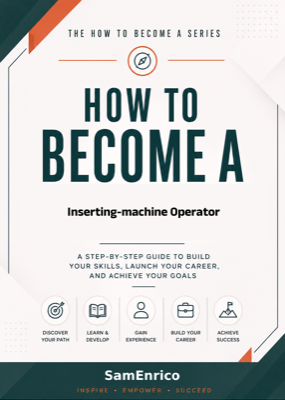
How to Become a Inserting-machine Operator eBook
How to Become a Inserting-machine Operator
How to Become a Inserting-machine Operator
Formats
Free sample
Chapter 1: The Invisible Goldmine--–- Every day, a truck backs up to a loading dock in an unassuming industrial park. Inside, a machine the size of a small car whirs to life, feeding blank sheets of paper through a series of rollers, fold plates, and vacuum belts. Twenty thousand times per hour, a completed envelope drops into a stack. Inside that envelope might be a credit card, a life insurance policy, a paycheck, or a ballot. Someone ran that machine.
Someone got paid to run it. Someone learned how to do it in weeks, not years, without taking on a penny of student debt. That someone could be you.This chapter is about unlearning everything you think you know about blue-collar work. It is about seeing the invisible industry that surrounds you every single day—the envelopes in your mailbox, the bills on your kitchen table, the catalogs you toss in recycling, the packages on your porch. None of it appears by magic.
Every piece of paper that travels through the mail stream passes through a machine called an inserter, and every inserter requires a human being to operate it. That human being earns a living wage, often with benefits, and rarely worries about their job being outsourced or automated away. The inserter is the automation. The operator is the one who commands it.The Three Industries You Didn't Know You Were Part Of Inserting machines are not niche equipment used by a handful of specialty shops. They are the backbone of three massive industries that touch virtually every American household.
Understanding these industries is the first step toward seeing yourself inside them.The first industry is direct mail. Every piece of unsolicited mail you receive—credit card offers, insurance quotes, political flyers, retail catalogs, fundraising appeals—was produced on an inserter. The direct mail industry generates over $50 billion in annual revenue in the United States alone. It employs hundreds of thousands of people, from graphic designers to postal logistics coordinators. And at the center of every direct mail operation sits a bank of inserting machines, running ten to twenty hours per day, converting raw paper into finished mailpieces.
Direct mail persists despite the rise of email because it works. Response rates for direct mail consistently outperform digital channels, especially for financial services, healthcare, and nonprofit fundraising. That means the machines keep running.The second industry is transactional documents. Your monthly bank statement. Your utility bill.
Your credit card statement. Your mortgage coupon book. Your insurance renewal packet. These are not marketing pieces; they are legal documents required by regulation. Banks are required to send them.
Utility companies are required to send them. Healthcare providers are required to send them. And they must be accurate. A misinserted credit card statement—one customer's bill going into another customer's envelope—is not just a customer service problem. It is a potential regulatory violation and a lawsuit waiting to happen.
Transactional document production is high-stakes, high-volume, and recession-resistant. People do not stop paying bills during economic downturns. In fact, during the 2008 financial crisis, transactional mail volume increased as banks and mortgage servicers sent more notices, more disclosures, and more legal correspondence. The inserter operator who can run transaction work with near-perfect accuracy is worth their weight in envelopes.The third industry is e-commerce fulfillment. When you order a product online and it arrives in a box, that box likely contains a packing slip.
That packing slip was printed, folded, and inserted into an envelope or poly bag by an inserter. While much of e-commerce fulfillment is dominated by massive automated systems, small to medium-sized warehouses and fulfillment centers still rely on tabletop and floor-model inserters to handle their documentation. More importantly, the rise of "hybrid mail"—where digital documents are printed locally and then inserted for last-mile delivery—has created new demand for inserter operators in logistics hubs across the country.Each of these industries operates on thin margins. Every second of downtime costs money. Every piece of wasted paper eats into profit.
Every misinserted envelope damages customer trust and invites regulatory scrutiny. That is why skilled inserter operators are not just tolerated; they are recruited. They are retained. They are promoted.The Numbers That Matter: Wages, Outlook, and Opportunity Let us talk about money, because that is why you are reading this book. You are not looking for a hobby.
You are looking for a career that pays your bills, supports your family, and gives you a sense of purpose. Here are the numbers you need to know, drawn from Bureau of Labor Statistics data, industry salary surveys, and job postings from major employers.An entry-level Material Handler or Assistant Operator typically earns between $15 and $18 per hour. That translates to $31,000 to $37,000 annually for a standard 40-hour week. However, most entry-level roles in this industry offer overtime. A single five-hour overtime shift at time-and-a-half adds $112 to $135 to a weekly paycheck.
Over a year, that can push earnings above $45,000.After six to twelve months of experience, an operator running their own machine earns between $22 and $28 per hour. That is $45,000 to $58,000 annually before overtime. With typical overtime—two to five extra hours per week—annual earnings land between $55,000 and $70,000. This is the sweet spot of the career. You are no longer the new person.
You know the machine. You know the common jams. You know when to push for speed and when to slow down for quality. You are trusted to run jobs on your own.Lead operators and shift supervisors earn between $30 and $35 per hour, or $62,000 to $72,000 annually. With overtime, many lead operators clear $80,000.
Some, in high-volume plants with mandatory weekend shifts, earn over $90,000. That is competitive with many white-collar roles that require a four-year degree and five years of experience.The job outlook is strong. The Bureau of Labor Statistics projects 5 to 7 percent growth for mail machine operators through 2031, which is about as fast as the average for all occupations. But that national figure hides local variation. In metropolitan areas with major mailing hubs—Dallas, Chicago, Atlanta, Philadelphia, Los Angeles—demand for skilled operators is significantly higher.
Some plants report that job postings for experienced operators receive only two or three qualified applicants. The competition is not for the jobs; it is for the workers.Career progression follows a clear ladder. You can see it in front of you from day one:Material Handler (0-6 months): Feeds raw materials, clears jams under supervision, learns the workflow.Assistant Operator (6-12 months): Runs the machine during low-complexity jobs, assists with make-ready, handles quality checks.Inserting-Machine Operator (1-3 years): Runs the machine independently, performs setup and troubleshooting, trains assistants.Lead Operator (3-5 years): Oversees multiple machines, handles complex jobs, coordinates with maintenance technicians.Shift Supervisor (5-7 years): Manages a team of operators, schedules production, reports to plant management.Plant Manager (7-10+ years): Runs the entire mailing operation, manages budgets, interfaces with clients.Alternative paths exist. Some operators move laterally into Field Service Engineering, traveling to client sites to repair and maintain inserters. These roles pay $70,000 to $90,000 plus a company vehicle and expenses.
Others move into Plant Maintenance, specializing in the mechanical and electrical systems of inserting equipment. Senior maintenance technicians earn $75,000 to $95,000.No four-year degree…
This is the end of the free sample. Get the eBook to keep going. Buy now
About this book
Details
- Author
- Aguilera Spring
- Publisher
- SamEnrico
- Language
- English
- ISBN
- 9781505743265
- Genre
- Non-Fiction, Informative, Educational
- Released
- 2026-06-02
- Pages (approx.)
- 146
- Available as
- eBook, Paperback, Audiobook

Read better in the ZLOADR app
Your eBooks on your phone or tablet. Sign in with your SamEnrico account and start reading.
More by Aguilera Spring
 Weight Loss Podcast GuideAguilera Spring$11.99
 Bulgarian Labor MigrationAguilera Spring$11.99
 Gaming Addiction WorkbookAguilera Spring$11.99
 Collaborative Sketch noting CourseAguilera Spring$11.99
 Chaos and Clutter Anger LinkAguilera Spring$11.99
 Echoes of the Cosmic Dawn: The Voyager Golden Record's Silent MessageAguilera Spring$11.99
 The Phantom of the Bay: The Hunt for the 'Gentleman Bandit'Aguilera Spring$11.99
 Understanding Chromosome 8, Partial TrisomyAguilera Spring$17.99
 Penpot Figma Alternative GuideAguilera Spring$12.99
 Food and Beverage BuyersAguilera Spring$12.99
 Tech Associate InstallAguilera Spring$11.99
You may also like
 Hong Kong Handover 1997Dunn Johnnie$11.99
 Zumba For Postnatal Recovery CourseNeal Christian$11.99
 Zumba for BeginnersLadner Nikia$11.99
 YouTube Comment Mining GuideHumes Pandora$12.99
 Worry Box MeditationCarlin Rudy$11.99
 Workplace Stress MeditationNguyen Lynn$11.99
 Workplace Stress and Sleep RepairHawley Ivory$11.99
 Workplace Perfectionism CureDelaney Jeffry$11.99
 Workplace Injustice Anger GuideWallen Isabelle$11.99
 Work Addiction and Burnout LinkGreenwood Ester$11.99
 Women in Yoga and WellnessBeattie Galina$11.99
 Women in Stand Up ComedyChun Evangeline$11.99