
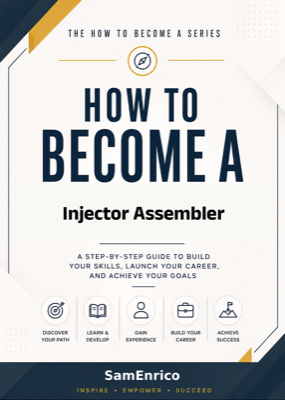
How to Become a Injector Assembler eBook
How to Become a Injector Assembler
by Fry Yoko
How to Become a Injector Assembler
Formats
Free sample
Chapter 1: The Invisible Guardians...--–- The first time I held a fuel injector, I almost dropped it. Not because it was heavy—it weighed less than a coffee mug. Not because it was slippery—my gloves had a fresh nitrile grip. I almost dropped it because I had just been told that this small, unremarkable cylinder of steel contained more precise engineering than the engine it would soon be bolted into, and that if I so much as scratched one of its internal surfaces, I could destroy a $30,000 engine and nobody would ever know it was my fault.The training supervisor, a woman named Carmen who had been assembling injectors for nineteen years, watched me fumble. She didn’t smile.
She didn’t offer encouragement. She said: "That thing in your hand is the difference between a truck that runs for 500,000 miles and a truck that catches fire on the interstate. Get comfortable with that."I got comfortable. But I never forgot what she meant.Welcome to the world of fuel injector assembly. It is a world you have almost certainly never seen, never thought about, and probably did not know existed.
It is a world of cleanrooms so sterile that a single hair falling from your head can ruin a day’s work. It is a world of tolerances measured in microns—millionths of a meter—where the difference between a perfect injector and a failed one is invisible to the naked eye. It is a world where the people doing the work are almost invisible themselves, hidden inside manufacturing plants and rebuild shops, their labor unknown to the millions of drivers who start their cars every morning and never give a single thought to the tiny device that turned liquid fuel into controlled combustion.This book is about those people. More specifically, this book is about becoming one of them.Why This Book Exists Before we go any further, let me tell you what this book is not. It is not a generic manufacturing guide.
It is not a collection of job search tips with a few technical details thrown in. It is not a repair manual for mechanics who want to fix broken injectors on a bench in a dirty garage. There are other books for those purposes, and some of them are quite good. But they miss the essential truth of this profession: injector assembly is not repair. It is not maintenance.
It is creation.When you assemble a fuel injector, you are building a device that must contain pressures high enough to cut through steel. You are assembling components that move distances measured in fractions of a human hair, at speeds measured in milliseconds, repeating that motion millions of times over the life of the engine. You are creating a seal that must hold against 2,000 bar of pressure—that is roughly 29,000 pounds per square inch, or the weight of a fully loaded cement truck pressing down on every square inch of surface area. And you are doing all of this with your hands, using tools that have not fundamentally changed in decades, in an environment designed to keep out particles smaller than a red blood cell.This is not a job for people who want to be told what to do and then do it mindlessly. This is a craft.
It requires patience, discipline, attention to detail, and a particular kind of satisfaction that comes from invisible perfection—from knowing that you did something exactly right even though nobody will ever see your work or thank you for it.I wrote this book because that craft is disappearing. Not because the work is going away—fuel injectors will be needed for decades to come, even as electric vehicles gain market share. Heavy trucks, ships, generators, agricultural equipment, construction machinery, and military vehicles will burn diesel and gasoline for the foreseeable future. But the people who know how to assemble these devices with precision are aging out of the workforce. Training programs are scarce.
Apprenticeships are informal. And the knowledge of how to do this work—really do it, at the highest level—exists mostly in the heads of a few thousand people scattered across the globe.This book is my attempt to capture that knowledge before it scatters any further.What You Will Learn By the time you finish this book, you will understand every component of a modern fuel injector: the valve body, the armature assembly, the solenoid, the nozzle, the dozens of tiny seals, springs, and shims that make the whole thing work. You will learn how to handle these components without damaging them, how to assemble them in the correct sequence, and how to verify that your work meets specifications. You will learn about the tools of the trade—torque drivers, micrometers, optical comparators, ultrasonic cleaners, and a hundred other devices that transform raw components into finished products. You will learn about the cleanroom protocols that separate injector assembly from ordinary manufacturing, and you will learn why a single speck of dust can turn a $500 injector into scrap metal.You will also learn about the career.
Where the jobs are. What they pay. How to get hired. How to advance from entry-level assembler to lead technician to quality engineer or shop owner. What certifications matter and which ones are just resume padding.
How to talk to recruiters, how to pass hands-on tests, and how to negotiate your salary.But mostly, you will learn how to do the work. This is a practical book. It assumes you want to build things, not just read about them. The chapters that follow are structured like a training curriculum, each one building on the last, with clear instructions, warnings about common mistakes, and checklists for verifying your work. If you follow along, you will not just know about injector assembly.
You will be able to do it.A Brief History of the Device in Your Hand To understand why injector assembly is so demanding, you need to understand what injectors used to be and what they have become.The Mechanical Era (1890s–1990s)The first fuel injectors were crude devices compared to what we use today. They were purely mechanical: a spring-loaded plunger, a nozzle with one or two holes, and a simple on-off valve. Fuel pressure was relatively low—maybe 100 to 300 bar. Tolerances were loose by modern standards: 0.01mm was considered precise. You could assemble these injectors with ordinary hand tools in a reasonably clean workshop.
If you made a mistake, the injector might run poorly, but it probably wouldn't destroy the engine.These injectors are still around, mostly in older vehicles and some small engines. But they are dinosaurs. If your goal is to work on them, you do not need this book. You need a Haynes manual and a set of basic wrenches.The Electronic Era (1990s–2010s)Everything changed with the introduction of electronically controlled injectors. Instead of being opened by fuel pressure alone, these injectors used solenoids—electromagnets—to control the valve.
An engine computer (the ECU) could now tell the injector exactly when to open, how long to stay open, and in some cases, how far to open. This…
This is the end of the free sample. Get the eBook to keep going. Buy now
About this book
Details
- Author
- Fry Yoko
- Publisher
- SamEnrico
- Language
- English
- ISBN
- 9781505742886
- Genre
- Non-Fiction, Informative, Educational
- Released
- 2026-05-02
- Pages (approx.)
- 144
- Available as
- eBook, Paperback, Audiobook

Read better in the ZLOADR app
Your eBooks on your phone or tablet. Sign in with your SamEnrico account and start reading.
More by Fry Yoko
 HIIT Cardio Endurance GuideFry Yoko$11.99
 Survey Data Normalization with AIFry Yoko$11.99
 Lean Startup CreativityFry Yoko$11.99
 MBSR Daily Mindfulness HabitsFry Yoko$11.99
 OCD And Substance Use DisorderFry Yoko$11.99
 Neon Nocturne: The Rise and Fall of Tokyo’s Illegal Rave SceneFry Yoko$11.99
 The Celestial Navigator: How a 16th-Century Polynesian Voyager Charted the CosmosFry Yoko$11.99
 Understanding Cannabis WithdrawalFry Yoko$17.99
 Groundnut HarvestingFry Yoko$11.99
 Dutch Master Degree Investment GuideFry Yoko$12.99
 Methodological Expertise Without PubsFry Yoko$12.99