
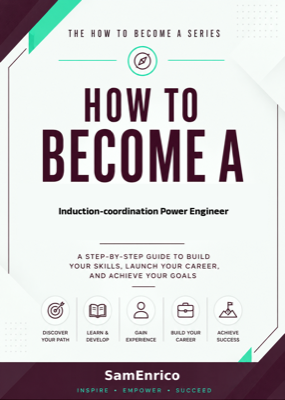
How to Become a Induction-coordination Power Engineer Paperback
How to Become a Induction-coordination Power Engin
How to Become a Induction-coordination Power Engineer
Formats
Free sample
Chapter 1: The Ten-Million-Dollar Mistake--– The phone rang at 2:17 AM. On the other end was a plant manager whose voice carried the unique strain of someone watching millions of dollars evaporate in real time. “The whole south end is dark,” he said. “We’ve got twelve hundred tons of partially cured plastic hardening inside our extruders. If we don’t get power back in forty-five minutes, we’re cutting it out with jackhammers.” He paused.
“Your relay coordination study from last year said this couldn’t happen.”That engineer, we’ll call him Marcus, had done everything by the book. He had built a proper one-line diagram. He had collected nameplate data from every motor. He had run the coordination study in ETAP, verified selectivity between every pair of devices, and stamped the report with his Professional Engineer seal. The client had paid fifty thousand dollars for that study.
And now, at 2:17 AM, Marcus was learning what no textbook had taught him: induction motors do not read coordination studies.The problem that night was not a short circuit, not a ground fault, not a locked rotor. It was something far more subtle. A 750 HP induced-draft fan motor had started normally, drawing 4,800 amps for eleven seconds before settling into its running load of 480 amps. But at the same moment, six other motors across the same bus were also starting their cycles, staggered by fifteen-second intervals to limit voltage drop. The cumulative effect of all seven starting currents—each one a perfectly legitimate operating condition—had pushed the feeder breaker’s instantaneous element over its threshold.
The breaker opened. The bus de-energized. The extruders stopped. And Marcus learned that coordination is not about making devices work correctly in isolation. It is about making them work correctly when everything else is trying to fool them.Why This Chapter Must Come First Before you learn how to size overload relays, before you calculate available fault current, before you even open a copy of IEEE Buff Book, you need to understand one thing: induction motors lie to protective devices.
They lie during starting, when they draw five to ten times their full load current and pretend to be short circuits. They lie during voltage sags, when their current spikes and pretends to be an overload. They lie during phase loss, when they continue running while drawing destructive unbalanced currents that look nothing like the symmetrical waveforms your relays expect. The entire discipline of induction-coordination engineering exists because motors are pathological liars, and your job is to teach protective devices to see through the deception.This chapter does not contain relay setting tables. It does not contain torque-speed curves.
It contains something more valuable: the mental framework that separates engineers who produce coordination studies from engineers who keep factories running at 2:17 AM. By the time you finish these pages, you will understand why most coordination studies are technically correct and operationally useless. You will understand why the top ten percent of induction-coordination engineers earn twice what the bottom fifty percent earn. And you will decide whether you want to be a technician who pushes buttons in ETAP or an engineer who truly understands the material.The Anatomy of a Coordination Failure Let us dissect Marcus’s failure in detail, because it contains every mistake that new induction-coordination engineers make. The facility was a specialty chemical plant with forty-seven induction motors ranging from 15 HP to 1,250 HP.
Marcus had performed a standard coordination study: he collected device data, built a model, ran short-circuit calculations, and plotted time-current curves. His report showed that every downstream device coordinated with every upstream…
This is the end of the free sample. Get the Paperback to keep going. Buy now
About this book
Details
- Author
- Kelsey Twanda
- Publisher
- SamEnrico
- Language
- English
- ISBN
- 9781505741605
- Genre
- Non-Fiction, Informative, Educational
- Released
- 2026-05-02
- Pages (approx.)
- 157
- Available as
- eBook, Paperback, Audiobook

Read better in the ZLOADR app
Your eBooks on your phone or tablet. Sign in with your SamEnrico account and start reading.
More by Kelsey Twanda
 Burnout Prevention for ProfessionalsKelsey Twanda$11.99
 Asynchronous Creative CollaborationKelsey Twanda$11.99
 Gacy's Criminal Record Before KillingsKelsey Twanda$11.99
 Antwerp Heist Accomplice NetworkKelsey Twanda$11.99
 Retirement Assets Minor ChildrenKelsey Twanda$11.99
 Legal Case Memory MethodKelsey Twanda$11.99
 Periodic Leg Movement GuideKelsey Twanda$11.99
 Nicotine And Anxiety WorkbookKelsey Twanda$11.99
 Fibroid Menstrual ManagementKelsey Twanda$11.99
 Whispers of the Vanishing: The Last Speakers of the World’s Most Endangered LanguagesKelsey Twanda$11.99
 Into the Frozen Abyss: Exploring the Arctic's Hidden DepthsKelsey Twanda$11.99
 The Raven’s Gambit: How Coyote Outwitted the ThunderbirdsKelsey Twanda$11.99