
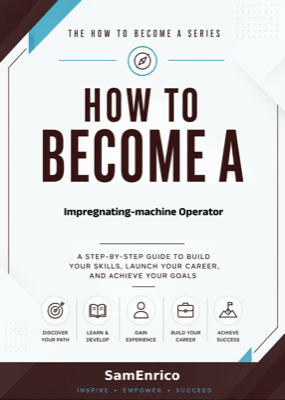
How to Become a Impregnating-machine Operator eBook
How to Become a Impregnating-machine Operator
How to Become a Impregnating-machine Operator
Formats
Free sample
Chapter 1: The Billion-Dollar Bubble--–- On a Tuesday morning in October 2017, a 262-foot wind turbine blade in the North Sea snapped at 73 percent of its expected lifetime. The fracture surface, later examined under electron microscopes at a materials laboratory in Hamburg, revealed a culprit smaller than a grain of salt: a single microscopic void where resin had failed to fill the gap between two layers of fiberglass. That void, no wider than a human hair, had allowed moisture to seep in over several years of North Sea storms. When winter came, the water froze, expanded, and cracked the blade from the inside out. By the time the crack reached the surface, it was too late.
The blade failed catastrophically, sending millions of dollars of composite material tumbling into the sea.The total cost of that invisible bubble: $47 million in lost energy production during the three months the turbine was down, $12 million for the replacement blade and the specialized crane vessel required to install it, $8 million in engineering investigations and litigation, and an incalculable cost in reputation for the manufacturer. The operator who had run the impregnation machine that day—a well-meaning, hardworking person just like you—never knew he had created a catastrophe. He had followed every step of his written training. He had checked the boxes on his quality form. He had done exactly what he was told.
But his training had been incomplete. No one had taught him why voids form, how to recognize the subtle signs of trouble before they become defects, or what to do when the resin behaves differently than expected. So he did nothing wrong—and a $67 million failure happened anyway.This is the strange, hidden world of impregnation. It is a career that almost no one grows up wanting, yet it underpins the modern world more than almost any other manufacturing job you have never heard of. Every electric car on the road, every wind turbine generating carbon-free power, every medical MRI machine that peers inside the human body without surgery, every fighter jet that defends the skies, and every industrial motor that keeps factories running around the clock—all of them depend on a process most engineers barely understand and the general public has never heard of.
That process is impregnation: the art and science of forcing liquid resin, varnish, or epoxy into every microscopic pore, gap, and crevice of a porous material so that it becomes solid, sealed, electrically invincible, and structurally sound for decades of hard service.This book is the training you never received. Whether you are a high school graduate looking for a career that pays six figures without four years of college debt and mountains of student loans, a factory worker tired of dead-end assembly line jobs where you do the same thing every day without learning anything new, or a technical college student who wants to understand what your textbooks omit because your instructors have never actually run a production machine, you have found the right place. By the time you finish these twelve chapters, you will know more about impregnation than most engineers with twenty years of experience—because you will have learned not just the formulas and specifications, but the practical, hands-on reality of how resin flows, how voids form, and how to stop them.More importantly, you will know exactly how to walk into a manufacturing plant, talk to the production manager, point to a machine, and convince them to hire you at a skilled rate. That rate typically starts between $22 and $30 per hour for entry-level operators who have done their homework. Within two years, you can be earning $35-45 per hour.
Within five years, with the right certifications and experience, you can exceed $100,000 annually. All without a four-year degree.But first, you need to understand what you are getting into—and why the work you are about to learn matters so much more than anyone has ever told you.The Most Important Manufacturing Job Nobody Talks About Walk through any industrial facility that builds electric motors, transformers, or composite parts for aerospace or wind energy. You will see machinists cutting metal with CNC equipment that hums and whirs. You will see assemblers fitting components together with pneumatic tools that hiss and clatter. You will see quality inspectors testing finished products with meters and gauges.
What you will rarely see, because it happens inside sealed chambers and behind safety shields with warning lights, is the impregnation station. Yet that station—often tucked into a corner of the factory floor, sometimes in a separate room because of ventilation requirements—determines the lifespan of every product that passes through it.Consider the electric motor. A typical industrial motor contains miles of copper wire wound into tight bundles called stator windings. Between each strand of wire, between each layer of winding, and between the windings and the metal core, there are microscopic gaps—thousands of them in a single motor. If those gaps remain filled with air, the motor will fail.
Not in ten years, as the warranty might promise, but often in ten weeks. Why? Because air is an insulator, yes, but it is an unstable and unreliable one. When high voltage passes through windings surrounded by air-filled gaps, it creates corona discharge: tiny electrical sparks that jump across the air pockets. Those sparks generate ozone, which attacks the organic insulation on the copper wires.
They generate heat, which accelerates chemical degradation. And worst of all, they create a feedback loop: the sparks carbonize the insulation, carbon is conductive, and the conductive carbon makes the sparks worse. Once that process starts, it accelerates until the motor shorts out, burns up, or both—often spectacularly, with smoke, flames, and the acrid smell of burning copper and varnish filling the shop.Impregnation stops that process before it can start. When you fill those microscopic air gaps with varnish or epoxy resin, you create a solid, void-free insulation system that has no starting point for corona. The resin bridges between wires, bonds to the metal core, and creates a monolithic structure that can withstand not just voltage stress but also vibration, thermal cycling from cold starts to full load, and decades of service.
A properly impregnated motor—your motor, the one you run on the impregnation machine—can outlast the equipment it powers.Or consider composite materials: fiberglass, carbon fiber, or Kevlar fabrics layered together to create structures that are lighter than aluminum and stronger than steel. Without impregnation, those layers are just dry cloth—they have no strength, no stiffness, no integrity. The resin that binds them must penetrate every fiber bundle, every weave intersection, every microscopic channel between individual filaments. If any void remains anywhere in that structure, that void becomes a stress concentrator. Under load—whether that load is the aerodynamic forces on a wind turbine blade, the pressure differential on an aircraft fuselage, or the weight of a patient on a medical imaging bed—the material will begin to fail at that void.
The layers will delaminate, peeling apart like a deck of cards. Cracks will propagate. And eventually, the part will break.The operator running the impregnation machine is the person who decides, moment…
This is the end of the free sample. Get the eBook to keep going. Buy now
About this book
Details
- Author
- Bautista Alisa
- Publisher
- SamEnrico
- Language
- English
- ISBN
- 9781505741063
- Genre
- Non-Fiction, Informative, Educational
- Released
- 2026-04-26
- Pages (approx.)
- 130
- Available as
- eBook, Paperback, Audiobook

Read better in the ZLOADR app
Your eBooks on your phone or tablet. Sign in with your SamEnrico account and start reading.
More by Bautista Alisa
 Caregiver Stress Physical SymptomsBautista Alisa$11.99
 Self Hypnosis for Irritable BowelBautista Alisa$11.99
 Seed vs Series A TermsBautista Alisa$11.99
 Late Night ExitBautista Alisa$11.99
 The Pediatric ER Doctor StressBautista Alisa$11.99
 Hayloft Hay Bale RestBautista Alisa$11.99
 Security Deposit Management GuideBautista Alisa$11.99
 MBSR for Work Life BalanceBautista Alisa$11.99
 Your Inner Critic TamedBautista Alisa$11.99
 The Last Broadcast: The Final Hours of Radio SawaBautista Alisa$11.99
 The Battle of Khalkhin Gol: The Sky War That Saved StalinBautista Alisa$11.99
 Neon Mirage: The AI That Redefined DemocracyBautista Alisa$11.99