
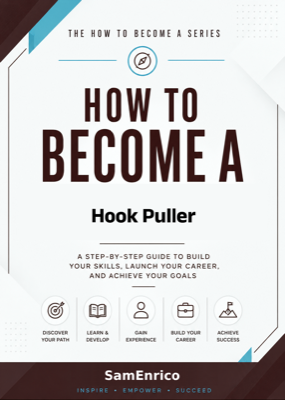
How to Become a Hook Puller eBook
How to Become a Hook Puller
by Jacob Leann
How to Become a Hook Puller
Formats
Free sample
Chapter 1: The Rusty Key--–- The mechanic’s hands were the first thing I noticed. Not because they were clean—they weren’t. They were stained with grease, etched with small scars, and wrapped around a tool that looked like it had been forged in a century I didn’t recognize. It was a gear puller. Three curved jaws, a central threaded spindle, and a frame that had been dropped so many times it had developed a permanent lean.
He was using it to extract a seized bearing from the axle of a 1972 Ford F-250. The bearing had been rusted in place for what looked like decades. I had watched him for twenty minutes, waiting for the violence. The hammering. The swearing.
The kind of brute force that reality television had taught me to expect from anyone who worked with their hands.But it never came.Instead, he did something almost imperceptible. He turned the spindle. A quarter rotation. Then another. He stopped.
He placed his palm flat against the frame, feeling for something I couldn’t see. Then he turned the spindle again. Another quarter rotation. And then, with a sound that was less a crack and more a sigh, the bearing popped loose. It didn’t fly across the garage.
It didn’t resist. It simply released. The mechanic looked at me, wiped his hands on a rag that was more grease than cloth, and said something I have never forgotten: “You don’t fight the rust. You find the seam. Then you pull.”That was twelve years ago.
I was twenty-four years old, freshly fired from my third startup, and convinced that the problem with every product I had ever built was that I wasn’t working hard enough. I thought success was a matter of force. More features. More notifications. More emails.
More ads. More everything. I was pushing. Pushing hard. And nothing was moving.The mechanic, whose name was Frank, didn’t know anything about software.
He didn’t know about user retention or engagement metrics or growth hacking. But he understood something that most founders, product managers, and marketers never learn: pushing is a confession of failure. When you push, you are admitting that the thing you want doesn’t want to come to you. When you push, you are fighting friction with friction. When you push, you are treating your user like a seized bearing—something to be hammered until it breaks or budges.The hook puller does none of these things.The hook puller finds the seam.The Push Economy and Its Discontents Let me tell you something uncomfortable about the world you live in.
Every single day, you are pushed. Not physically, but psychically. Your phone pushes notifications. Your email pushes newsletters you never signed up for. Your social media feeds push content from people you don’t remember following.
Your favorite apps push updates, reminders, alerts, and badges. By some estimates, the average smartphone user receives two hundred and forty push notifications per day. That is ten per waking hour. That is one every six minutes. And what do you do with most of them?You ignore them.
You swipe them away. You mute them. You delete the apps that send too many. You have developed what psychologists call push fatigue—a learned immunity to interruption. Your brain has built a filter so efficient that you can watch a thirty-second advertisement and, one second later, have absolutely no memory of what it was selling.
This is not a failure of your attention. This is a victory of your survival instinct. You have learned that most pushes are threats to your time, not gifts to your life.And yet, the business world continues to push harder. The average company sends fourteen emails per customer per week. The average e-commerce site has twenty-three exit-intent pop-ups (I counted).
The average mobile app sends six welcome notifications in the first hour after download. This is madness. It is the definition of insanity: doing the same thing over and over and expecting a different result. Except the result is not different. The result is worse.
Push fatigue compounds. Each push makes the next push less effective. The curve is exponential in the wrong direction.I have sat in boardrooms where otherwise intelligent people argued that the solution to low engagement was more notifications. “We just need to find the right time of day,” they would say. Or “We just need to personalize the copy.” Or “We just need to add emojis.” These are the conversations of people who have mistaken activity for progress.
They are turning the spindle harder, not smarter. They are fighting the rust.Here is what Frank taught me in that garage, translated from the language of grease to the language of growth: The opposite of push is not pull. The opposite of push is permission. And permission is not something you demand. It is something you earn.
It is something you are given, freely and repeatedly, by a user who has decided—without coercion, without manipulation, without a dark pattern in sight—that your product is worth their time.That is the first and most important distinction of this book. A pusher interrupts. A hook puller invites. A pusher says “LOOK AT ME.” A hook puller says “I see you.” A pusher measures success by volume (opens, clicks, impressions). A hook puller measures success by voluntary return (retention, delight, ritual).
A pusher builds products that users tolerate. A hook puller builds products that users choose.Which one are you building?The Mechanical Puller: A Masterclass in Applied Patience Before we can understand the psychology of the hook puller, we must understand the mechanics. This is not a digression. This is the foundation of everything that follows. The gear puller that Frank used is a device of almost absurd simplicity.
It has three physical components, each of which maps directly to a psychological function in the products you build every day.Component One: The Jaws The jaws are the curved arms that wrap around the object to be extracted. They are adjustable. They are designed to grip without crushing. They are the point of contact between the tool and the target. If the jaws are too loose, the puller slips and damages the surrounding material.
If the jaws are too tight, the puller deforms the bearing. The mechanic must calibrate the jaws precisely—enough grip to hold, not enough grip to harm.In product design, the jaws are triggers. Triggers are the points of contact between your product and your user’s attention. They are the notifications, the emails, the badges, the reminders, the advertisements, the social shares, the word-of-mouth referrals—everything that brings a user back to your product. A well-calibrated trigger grips the user’s attention without crushing their patience.
A loose trigger is ignored. A tight trigger is resented. The hook puller calibrates triggers with the same precision that Frank used to set his jaws.Component Two: The Spindle The spindle is the threaded screw that runs through the center of the frame. When turned, it applies rotational force to the bearing. The spindle does not hammer.
It does not yank. It rotates. Slowly. Methodically. Each turn increases the force incrementally.…
This is the end of the free sample. Get the eBook to keep going. Buy now
About this book
Details
- Author
- Jacob Leann
- Publisher
- SamEnrico
- Language
- English
- ISBN
- 9781505736434
- Genre
- Non-Fiction, Informative, Educational
- Released
- 2026-04-25
- Pages (approx.)
- 132
- Available as
- eBook, Paperback, Audiobook

Read better in the ZLOADR app
Your eBooks on your phone or tablet. Sign in with your SamEnrico account and start reading.
More by Jacob Leann
 Functional Analysis for ProductsJacob Leann$11.99
 Anki For GRE VerbalJacob Leann$11.99
 Zumba Choreography MasterclassJacob Leann$11.99
 The High Functioning AlcoholicJacob Leann$11.99
 Australian Outback WalkaboutJacob Leann$11.99
 Forgiving a BullyJacob Leann$11.99
 Mindfulness for Decision MakingJacob Leann$11.99
 Distraction Management for ProgrammersJacob Leann$11.99
 Whispers in the Sawdust: The Curse of the Black PineJacob Leann$11.99
 The Trollwife’s Lament: A Nordic Mountain BalladJacob Leann$11.99
 How to Produce Radiology Equipment and AccessoriesJacob Leann$11.99
 How to Produce an Entertainment CenterJacob Leann$11.99