
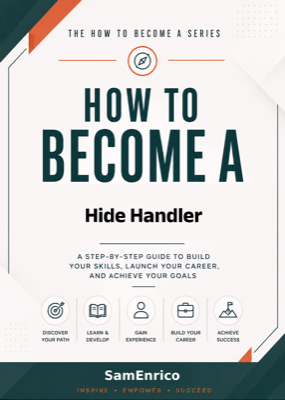
How to Become a Hide Handler Paperback
How to Become a Hide Handler
by Whelan Esta
How to Become a Hide Handler
Formats
Free sample
Chapter 1: The Living Fabric--– The first time I held a fresh hide, still warm from the animal, I made a mistake that nearly cost me the entire thing. I had driven two hours to a small slaughterhouse in rural Wisconsin after a hunter on Facebook Marketplace posted, “Free deer hide – you haul.” I arrived with a plastic tote, a naive smile, and absolutely no understanding of what I was touching. The hide was heavy – maybe fifteen pounds – and it felt alive in a way I hadn’t expected. The flesh side was wet, slick, and warm. The hair side was surprisingly soft.
I folded it in half, dropped it in the tote, and drove home with the windows down because the smell was already beginning to turn. By the time I got to my garage, the hide had been dead for nearly five hours. It had spent two of those hours balled up in a warm plastic tote, which is essentially a perfect bacterial incubator. The next morning, the hair was slipping out in clumps. The flesh side had turned green in spots.
The smell was no longer “gamey” – it was the sweet, sickly odor of putrefaction. I had lost that hide before I ever began.That failure taught me something no book had told me: a hide is not a static thing. It is a living fabric that begins to decay the moment the animal’s heart stops. And the race to preserve it – to transform it from a perishable organ into a durable material – starts in the first hour. This chapter is about understanding what you are actually handling before you ever pick up a knife, a bucket of salt, or a tanning chemical.
Because if you don’t understand the hide itself, you will lose it. Every time.The Strange Biology of a Byproduct To become a hide handler, you must first abandon the way most people think about leather. Most people see a leather jacket or a belt and think of it as a finished product, like plastic or metal. But leather is not manufactured from raw materials in the way steel is smelted from ore. Leather is transformed from a once-living organ – the skin – which is the largest organ of any mammal.
And that organ has a structure that is both remarkably durable and surprisingly fragile.The hide you will handle – whether from a cow, deer, goat, pig, or sheep – is composed primarily of a protein called collagen. Collagen is the most abundant protein in the animal kingdom. It is what gives skin its strength, tendons their ability to transmit force, and bones their flexibility under stress. Under a microscope, collagen looks like a three-dimensional net. Individual collagen molecules are triple helices – three polypeptide chains wound around each other like a rope.
These molecules then assemble into fibrils, and fibrils assemble into fibers, and fibers weave together into a dense, felt-like matrix. That matrix is what you will feel when you run your hand over a finished piece of leather. That matrix is what you will either preserve or destroy.Here is the critical fact that separates successful hide handlers from failed ones: Collagen is water-soluble when it is raw. In its fresh, untanned state, collagen fibers are held together by hydrogen bonds and electrostatic forces – relatively weak connections that can be broken by heat, by p H extremes, or by bacterial enzymes. When a hide putrefies, bacteria secrete proteases – enzymes that cut collagen molecules like scissors.
Once those cuts happen, the hide loses its tensile strength permanently. Tanning is the process of creating new, stronger chemical…
This is the end of the free sample. Get the Paperback to keep going. Buy now
About this book
Details
- Author
- Whelan Esta
- Publisher
- SamEnrico
- Language
- English
- ISBN
- 9781505735147
- Genre
- Non-Fiction, Informative, Educational
- Released
- 2026-05-02
- Pages (approx.)
- 128
- Available as
- eBook, Paperback, Audiobook

Read better in the ZLOADR app
Your eBooks on your phone or tablet. Sign in with your SamEnrico account and start reading.
More by Whelan Esta
 Step Five Choosing a ConfidantWhelan Esta$11.99
 The Remote All Hands GuideWhelan Esta$11.99
 Body Scan for RehabilitationWhelan Esta$11.99
 Stress and Pregnancy LossWhelan Esta$11.99
 The Great Calcutta Rugby Heist: How a Forgotten Team Stole the GameWhelan Esta$11.99
 How to Produce Body SOAPWhelan Esta$11.99
 Marketing TranscreationWhelan Esta$12.99
 Cannabis Dispensary Agent (state training)Whelan Esta$11.99