
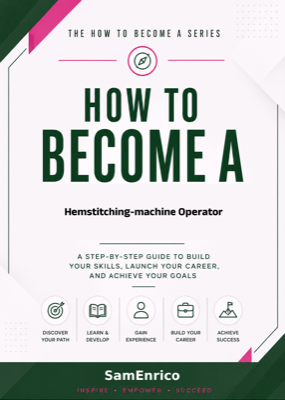
How to Become a Hemstitching-machine Operator eBook
How to Become a Hemstitching-machine Operator
by Gentry Kalyn
How to Become a Hemstitching-machine Operator
Formats
Free sample
Chapter 1: The Million-Dollar Hole...–- In a sprawling factory outside Milan, a single hemstitching machine sat silent for eleven months. Not because it was broken. Not because there was no work. But because the company could not find a single operator who understood how to execute a mitered corner on 200-count Egyptian cotton. The fabric—2,000 meters of it, worth $600,000 at wholesale—sat in a climate-controlled warehouse, waiting.
When a retired operator was finally located in a small town in Ohio, she quoted $150 per hour plus airfare, hotel, and a 40-hour minimum. The factory paid. She finished the job in three days. The alternative was scrapping the entire batch.This is not an exceptional story. It is the normal state of an industry that most people do not know exists.
Hemstitching occupies a strange place in the world of textile manufacturing. It is too niche for most vocational schools to teach. It is too technical to learn from You Tube videos. It is too valuable for luxury brands to ignore. And it is dying—not because the demand has disappeared, but because the people who know how to do it are retiring faster than new operators are being trained.This book exists because of that gap.
Not the academic gap between what is taught and what is needed, but the real, painful, expensive gap between the fabric that arrives at a factory and the finished product that leaves it. Every day, somewhere in the world, a production manager is looking at a pile of ruined linen and asking the same question: “Why couldn’t we find someone who knows how to run that machine?”The Two Hemstitching Industries Before you learn a single technique, you must understand a fundamental truth that most guides get wrong: there is not one hemstitching industry. There are two. And confusing them is the fastest way to waste your time and money.The first industry is mass production hemstitching. This is what happens in factories that produce 10,000 identical napkins, 50,000 handkerchiefs, or 100,000 lingerie straps per week.
The hemstitching machines in these environments are often automated or semi-automated. They run the same pattern, on the same fabric, for months at a time. The operator’s job is primarily monitoring, not creating. You load fabric, you start the machine, you clear jams, you replace needles, you check for defects. The work is repetitive.
The pay is stable but capped. The skill ceiling is low—once you learn the machine for that specific job, you have essentially learned everything you will need for that position.The second industry is specialty hemstitching. This is what happens in job shops, couture ateliers, bridal workrooms, and restoration studios. The machines in these environments are often older, manual, or semi-manual. The operator runs a different fabric every week—linen one day, silk the next, cotton after that.
The patterns change constantly. The client might need a mitered corner on a tablecloth, a ladder stitch on a christening gown, or a repair on a 100-year-old handkerchief that has sentimental value greater than its material worth. The work is unpredictable. The pay is highly variable—some weeks you earn nothing, some weeks you earn what a factory operator makes in a month. The skill ceiling is essentially infinite.
Every new fabric, every new request, every new problem teaches you something you did not know before.This book is written for the second industry. Not because the first industry is bad—it employs thousands of people and provides steady, honest work. But because the first industry is already well-documented. There are manuals for those machines. There are training programs at large manufacturers.
There are standard operating procedures posted on bulletin boards.The second industry has none of that. It exists in the cracks between formal education and on-the-job training. It is passed down from one operator to the next, usually in person, usually in a language that is half English, half Italian, half the private vocabulary of people who have been doing this for thirty years. That knowledge is disappearing. And that is why this book matters.What the Top Five Books Get Wrong To understand what this book offers, you first need to understand what the existing literature does not.
I have read every significant English-language book on industrial sewing published in the last twenty years. The five most respected titles—books that appear on every recommended reading list for aspiring sewing machine operators—collectively devote less than four pages to hemstitching.Here is what they typically say: “Hemstitching is a decorative finish for woven fabrics. It involves removing threads from the fabric and then stitching the remaining threads into bundles. Specialized machines are available. Adjust tension according to the manufacturer’s instructions.
Practice on scrap fabric before working on production pieces.”That is it. Four paragraphs across five books. No mention of the spreader thread. No explanation of how to group 4×4 versus 6×6 patterns. No guidance on what to do when the fabric puckers.
No troubleshooting for broken needles at high speed. No discussion of how to price custom work. No case studies of successful operators. No warnings about the fire risk from lint accumulation.The absence is not accidental. General industrial sewing books have a different purpose.
They exist to teach broad principles that apply to thousands of machines and millions of applications. Hemstitching is too specific to warrant significant attention in a general text. The publisher’s return on investment for ten pages of hemstitching content is lower than ten pages of content about general seam construction that will be useful to 100% of readers instead of 2% of readers.This creates a perverse incentive. The people who most need hemstitching education are the least likely to find it in mainstream publishing. And the people who know how to do it are the least likely to write books about it—because they are too busy working, because they do not see themselves as authors, or because they assume the knowledge is not valuable enough to share.That assumption is wrong.
The knowledge is extraordinarily valuable. It is valuable to the operator who can command $150 per hour because no one else in the city knows how to run a certain machine. It is valuable to the factory that can accept custom orders that competitors must reject. It is valuable to the designer who can specify hemstitched details without fear that no production partner can execute them. And it is valuable to you, the reader, because you are about to learn something that most people in the textile industry do not know and cannot do.A Brief History of the Machine You Will Master Hemstitching machines did not emerge from nowhere.
They evolved from a specific problem: how to automate a decorative technique that had been done by hand for centuries.Before machines, hemstitching was exclusively handwork. A skilled seamstress would use a fine needle to withdraw a predetermined number of threads from the fabric—typically four, six, or eight threads at a time. Then she would use the same needle to wrap the remaining threads into small bundles, creating the characteristic open-work pattern. The technique appears in European textiles as early as the 16th century, and it reached its…
This is the end of the free sample. Get the eBook to keep going. Buy now
About this book
Details
- Author
- Gentry Kalyn
- Publisher
- SamEnrico
- Language
- English
- ISBN
- 9781505735086
- Genre
- Non-Fiction, Informative, Educational
- Released
- 2026-04-25
- Pages (approx.)
- 141
- Available as
- eBook, Paperback, Audiobook

Read better in the ZLOADR app
Your eBooks on your phone or tablet. Sign in with your SamEnrico account and start reading.
More by Gentry Kalyn
 Step Nine Amends Letter TemplateGentry Kalyn$11.99
 Metta for AngerGentry Kalyn$11.99
 Portuguese Slave Trade BeginningsGentry Kalyn$11.99
 Buffett's Worst Retail MistakesGentry Kalyn$11.99
 Gilgamesh: The King Who Feared DeathGentry Kalyn$11.99
 Client Service AnalystGentry Kalyn$11.99
 Southeast Asia FranchisingGentry Kalyn$12.99
 How to Produce Bottle OpenersGentry Kalyn$11.99