
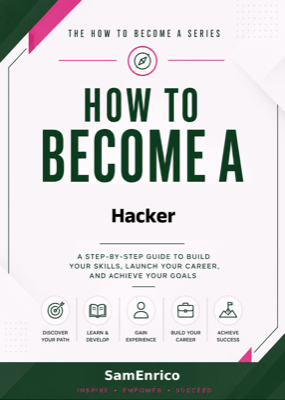
How to Become a Hacker Paperback
How to Become a Hacker
How to Become a Hacker
Formats
Free sample
Chapter 1: The Curiosity Engine...-- Every hacker I have ever met shares exactly one thing in common. It is not genius-level IQ. It is not a computer science degree from a prestigious university. It is not even particularly fast typing, despite what movies show in their ridiculous cascading green text scenes. It is an almost annoying, relentless, sometimes socially awkward curiosity.
The kind of curiosity that makes a four-year-old take apart a toaster to see where the heat comes from. The kind that makes you wonder, “What happens if I type this instead of that?” The kind that cannot accept “because that’s how it works” as an answer.This chapter is not about installing software or memorizing commands. Those come later, once the foundation is solid. This chapter is about rewiring your brain to think like a hacker before you ever touch a keyboard. Because without the right mindset, the tools are just noise.
With it, even a broken laptop and a public library Wi-Fi connection become weapons of discovery.Let me tell you about the first time I understood this.I was maybe fourteen years old, sitting in a boring computer lab after school. My school, like many others, had installed a filtering system to block “unauthorized” websites. Games. Social media. Anything fun.
The filter was supposed to be unbreakable. The school had paid a lot of money for it, and the IT administrator liked to boast about how secure it was.I was not trying to be a hacker. I was just bored.I noticed that when I typed a web address that was blocked, the filter showed a bright red page that said “ACCESS DENIED” in bold letters. But I also noticed something strange. The red page came from an internal IP address, not from the actual internet.
And the URL in my browser had changed from what I typed to something entirely different.I wondered: what if I typed a website that did not exist? The filter did not block that. It showed a normal 404 error from the browser itself, not the red page.So then I wondered: what if I typed a website that did exist, but I added something weird to the end of the address? Like a space? Or a dot?
Or an extra slash? Something that would make the address technically different but still resolve to the same place.I tried it. I typed the address of a blocked game site. Then I added a single dot at the end. Then I pressed Enter.The red page did not appear.The game loaded.I did not know it at the time, but I had just performed my first hack.
I had not broken any laws. I had not cracked a password. I had not used any tools. I had simply asked a question that no one else had asked: what does the filter actually check, and what does it ignore? The filter checked for exact domain names.
It did not check for domain names with a trailing dot. That tiny mismatch was the crack in the armor. I did not have to be smart. I only had to be curious enough to try something that seemed pointless.That is the hacker mindset. And that is what this chapter will install in you before we build a single virtual machine or run a single scan.The Myth of the Genius Hacker Hollywood has sold us a dangerous lie.
The lie is that hackers are either socially broken geniuses who type a thousand words per minute while three monitors display Matrix-style code, or…
This is the end of the free sample. Get the Paperback to keep going. Buy now
About this book
Details
- Author
- Simpkins Larita
- Publisher
- SamEnrico
- Language
- English
- ISBN
- 9781505772524
- Genre
- Non-Fiction, Informative, Educational
- Released
- 2026-04-25
- Pages (approx.)
- 151
- Available as
- eBook, Paperback, Audiobook

Read better in the ZLOADR app
Your eBooks on your phone or tablet. Sign in with your SamEnrico account and start reading.
More by Simpkins Larita
 The Bad News Delivery GuideSimpkins Larita$11.99
 Body Scan for Chemo BrainSimpkins Larita$11.99
 Revenue Positioning MatrixSimpkins Larita$11.99
 Kandake Warrior QueensSimpkins Larita$11.99
 Gratitude Music TherapySimpkins Larita$11.99
 Creative Confidence for LeadersSimpkins Larita$11.99
 Pippin Lead PlayerSimpkins Larita$11.99
 Self Esteem for TradespeopleSimpkins Larita$11.99
 Xochiquetzal and Tezcatlipoca: A Love Forged in Fire and FlowersSimpkins Larita$11.99
 The Shanghai Siege: The Hostage Crisis That Defined China's Legal RevolutionSimpkins Larita$11.99
 A Collector's Handbook to the Sunbeam VogueSimpkins Larita$11.99
 Failover and Backup Number BlueprintSimpkins Larita$12.99