
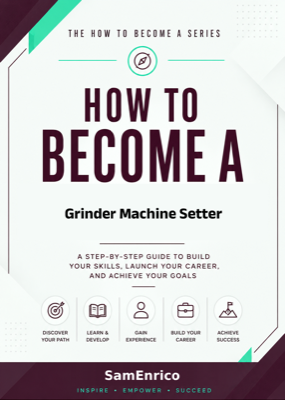
How to Become a Grinder Machine Setter eBook
How to Become a Grinder Machine Setter
by Canales Edie
How to Become a Grinder Machine Setter
Formats
Free sample
Chapter 1: Beyond the Green Button--The first time I watched a $4,000 titanium aerospace bracket turn into a smoking, unusable pile of scrap, it wasn’t because the machine malfunctioned. It wasn’t because the wheel exploded, the coolant failed, or the power flickered. It was because the operator standing in front of that brand-new CNC grinder had spent three years doing exactly what he was told: load the part, close the door, press the green button, and repeat. When the finish started to degrade on part number forty-seven, he didn’t notice until the automated gauge flagged it. By then, fifteen parts were already out of tolerance.
The shop lost a client. The operator lost his promotion. And the setter who had to stay until midnight to re-run the job? That setter gained a permanent reminder of the single most important truth in precision grinding: there is a vast, career-defining difference between pushing buttons and owning a process.If you are reading this book, you are likely already standing in front of a grinder. Maybe you have been an operator for six months, or six years.
You know how to load parts, check dimensions with a micrometer, and call the setter when something sounds wrong. But you have started to notice that the setters get paid more. They get better shifts. They don’t wait for permission to make adjustments. They walk onto the floor, listen to a machine for ten seconds, and announce, “The wheel needs dressing,” or “The coolant nozzle is misaligned.” They seem to speak a language that you haven’t learned yet.That language is not magic.
It is not a secret guarded by old-timers who refuse to share their knowledge. It is a learnable, systematic approach to understanding grinding as a complete process. Becoming a grinder machine setter means shifting your identity from someone who operates equipment to someone who configures, optimizes, and troubleshoots that equipment. It means trading the green button for the responsibility of making the green button work correctly for everyone else.This chapter is your first step across that line. We will define exactly what a setter is and how the role differs from an operator.
We will map out a clear career ladder from your current position to senior leadership roles that pay $75,000 or more annually. You will learn the single most valuable mental habit you can develop—a skill that industrial psychologists call Active Learning, but that experienced setters simply call “keeping your eyes and ears open.” And you will read real case studies of operators who made the leap, and a few who didn’t, so you can see the path before you walk it.By the end of this chapter, you will not yet know how to dress a wheel or read a GD&T callout. Those skills come in later chapters. But you will know who you need to become. And you will understand that the technical skills in this book are useless without the mindset that this chapter exists to build.
Let us begin.The Operator vs. The Setter: Two Different Worlds The easiest way to understand the gap between operator and setter is to watch each person start a shift. The operator walks in, grabs the work instructions, checks that the previous run left enough parts in the bin, and presses the start button. The setter walks in ten minutes earlier, reads the maintenance log, checks the wheel for wear, verifies coolant concentration, runs a test part, measures it, and then decides whether the machine is ready to run.These are not just different behaviors. They are different philosophies of work.What an Operator Does An operator’s job is fundamentally reactive.
The operator follows a sequence of steps written by someone else. If the machine is running well, the operator keeps it running. If a part comes out bad, the operator flags it and calls the setter or supervisor. The operator is measured on quantity—how many good parts per hour—and is rarely expected to diagnose problems, only to report them.This is honest, necessary work. No shop can run without good operators.
But it is also a role with a ceiling. The operator’s knowledge is narrow: how to load this specific part on this specific machine. Change the part, change the material, or change the grinder, and the operator starts over from zero.What a Setter Does A setter’s job is proactive. The setter configures the machine for a new job, selects the correct wheel, establishes feeds and speeds, dresses the wheel to the right geometry, verifies workholding, and runs the first article inspection. Once the machine is running production, the setter monitors the process—listening, measuring, feeling—and makes small adjustments before problems become scrap.The setter is measured on uptime, quality, and efficiency.
When the setter has done the job correctly, the operator has an easy shift. The setter’s knowledge is broad: wheel science, blueprint reading, metrology, workholding, machine hydraulics, and problem-solving. Change the part or the machine, and the setter adapts because the underlying principles are the same.Think of it this way: an operator drives the car. A setter tunes the engine, aligns the wheels, sets the tire pressure, and then teaches the driver how to handle a curve. Both are essential.
But only one of them can build a career that leads to supervision, programming, or engineering.The Financial Difference Let’s put numbers on this distinction because money matters. According to the U.S. Bureau of Labor Statistics and multiple industry salary surveys from 2023-2025:Grinding machine operator (entry to mid-level): 32,000to32,000 to 32,000to45,000 per year Grinding machine setter (certified, 2-5 years experience): 45,000to45,000 to 45,000to62,000 per year Senior setter / lead technician (5-10 years): 62,000to62,000 to 62,000to78,000 per year CNC grinding programmer (with setter background): 70,000to70,000 to 70,000to92,000 per year Quality supervisor or manufacturing engineer (ten-plus years): 85,000to85,000 to 85,000to120,000 per year In the United Kingdom, the numbers translate to approximately £28,000 for operators, £36,000-£45,000 for setters, and £50,000-£70,000 for senior roles. The pattern is the same everywhere: setters earn roughly 30-50% more than operators doing similar work, and the gap widens as careers progress.But the financial difference is not the most important one. The most important difference is control.
Setters have autonomy. They are trusted to make decisions. They are consulted when things go wrong. They are the first people management calls when a new machine arrives or a difficult job comes in. That autonomy is worth more than the paycheck.The Unified Career Ladder: Where You Are and Where You Are Going One of the inconsistencies that frustrates aspiring setters is that different shops use different titles.
A “setup technician” in one factory might be a “lead operator” in another. To cut through the confusion, this book presents a unified career ladder that applies across most manufacturing environments. You will see this ladder referenced throughout the book, especially in Chapter 12, where we discuss certification and advancement.Level 1: Machine Operator Experience: 0 to 2 years Typical wage: 32,000−32,000 - 32,000−42,000Key responsibilities: Loading parts, pressing start, basic quality checks, calling the setter when problems arise.Knowledge required: Basic safety, simple measurement, following written…
This is the end of the free sample. Get the eBook to keep going. Buy now
About this book
Details
- Author
- Canales Edie
- Publisher
- SamEnrico
- Language
- English
- ISBN
- 9781505771558
- Genre
- Non-Fiction, Informative, Educational
- Released
- 2026-05-02
- Pages (approx.)
- 147
- Available as
- eBook, Paperback, Audiobook

Read better in the ZLOADR app
Your eBooks on your phone or tablet. Sign in with your SamEnrico account and start reading.
More by Canales Edie
 Anapanasati For Anxiety ReliefCanales Edie$11.99
 TIPP Skills Crisis SurvivalCanales Edie$11.99
 Antwerp Heist MerchandiseCanales Edie$11.99
 Master the Eisenhower Decision MatrixCanales Edie$11.99
 Pelvic Floor Biofeedback TrainingCanales Edie$11.99
 The Priority Brain Dump MethodCanales Edie$11.99
 Pomodoro Technique Mastery GuideCanales Edie$11.99
 Matt Kahn GuideCanales Edie$11.99
 Kehinde Wiley: Painting Royalty from the Streets to the SmithsonianCanales Edie$11.99
 Dragonfire: The Jade Spy of the Celestial CourtCanales Edie$11.99
 How to Produce Storage TanksCanales Edie$11.99
 Mastering The Art of KarateCanales Edie$11.99