
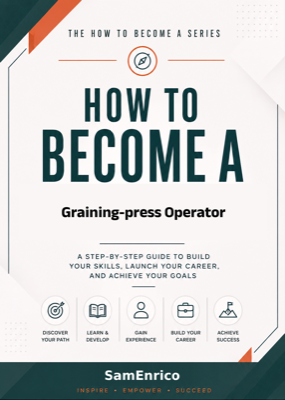
How to Become a Graining-press Operator eBook
How to Become a Graining-press Operator
How to Become a Graining-press Operator
Formats
Free sample
Chapter 1: The $80,000 Secret--– The potato chip bag in your hand cost about forty cents to manufacture. The printing on that bag—the bright logo, the ingredients list, the expiration date, the barcode—cost less than one cent. But that one cent required a machine the size of a school bus, a copper cylinder engraved with millions of microscopic cells, a blade of spring steel sharpened to a razor's edge, and an operator who knew how to make them all work together. That operator did not need a college degree. That operator did not need to know anyone in the industry.
That operator started exactly where you are right now: knowing nothing about gravure printing. Today, that operator earns seventy-five thousand dollars per year, has full health benefits, contributes to a pension, and works with their hands instead of sitting in a cubicle. That operator could be you.This chapter will introduce you to the hidden world of rotogravure printing. You will learn why this industry is not dying—it is hiding in plain sight. You will learn what gravure operators actually do, how much they earn, and whether you have what it takes to join their ranks.
By the time you finish this chapter, you will know whether this career path is right for you. And if it is, you will have a roadmap for the rest of this book.The Printing Myth That Keeps People Poor Most people believe that printing is a dying industry. They see newspapers shrinking. They watch their mail transition from paper to email. They assume that all printing is going digital.
They are wrong.Rotogravure printing is the hidden giant behind almost every high-volume packaged product you touch. That bag of potato chips? Gravure. That cereal box? Probably gravure.
That cigarette pack? Definitely gravure. That wallpaper in your bathroom? Gravure. That laminate on your kitchen counter?
Gravure. That roll of wrapping paper? Gravure. Those postage stamps? Gravure.The reason gravure survives—and thrives—is simple.
Digital printing is cheap for short runs. Flexographic printing is good for medium runs. But for long runs—millions of impressions, running for days without stopping, maintaining perfect color consistency from the first foot to the last—nothing beats rotogravure.A gravure cylinder, once engraved, can print millions of impressions before showing any wear. The same cylinder that printed your potato chip bag this morning could still be printing the same design years from now. The press runs at fifteen hundred feet per minute or faster.
The ink dries instantly. The quality is flawless.This is not a dying industry. It is a mature industry. And mature industries have a secret: the people who know how to run the machines are getting old. The average gravure operator is fifty-five years old.
Half will retire in the next decade. There are not enough young people entering the trade to replace them.That labor shortage is your opportunity.What Is a Graining-press Operator?Let us start with the terminology because it is confusing. "Graining-press" is an old term. It comes from the days when the copper cylinders were "grained" or etched by hand. Today, we call the process rotogravure, or just gravure for short.
But many factories still use the old term. If you hear "graining-press operator," "gravure press operator," or "rotogravure press operator," they are all the same job.So what does a gravure press operator actually do?The short answer: you take a roll of paper or film that weighs up to two thousand pounds, run it through a press with six to twelve printing units, each unit printing a different color, and produce a finished roll of printed material that meets the customer's exact specifications.The long answer: you are part mechanic, part chemist, and part quality inspector.You are a mechanic because you must understand the machine. You will mount engraved cylinders that weigh up to five hundred pounds. You will set the register—the alignment of colors—to tolerances measured in thousandths of an inch. You will replace doctor blades, the thin steel blades that scrape excess ink from the cylinders.
You will clear web breaks when the paper or film tears. You will splice new rolls onto old rolls while the press runs at full speed.You are a chemist because you must understand the inks and solvents. You will measure viscosity—the thickness of the ink—using a Zahn cup or an automated viscometer. You will adjust viscosity as the solvent evaporates and the temperature changes. You will troubleshoot ink problems: filling in, scumming, slow drying, ghosting.You are a quality inspector because the customer does not care how hard you worked.
The customer cares whether the print looks correct. You will measure color density with a spectrophotometer. You will monitor register with strobe lights or cameras. You will identify defects, mark them, and ensure that bad product never reaches the customer.It is a lot. But it is learnable.
Thousands of people have learned it before you. None of them were born knowing how to run a gravure press.The Money: What You Will Actually Earn Let us talk about money because that is why you are reading this book. You are not here for the love of printing. You are here because you want a good job that pays well without requiring a four-year degree.Here are the real numbers from actual gravure plants across the United States. These numbers come from union wage scales, job postings, and interviews with operators.A press helper—the entry-level position—earns fifteen to twenty dollars per hour.
That is thirty-one thousand to forty-one thousand dollars per year base, before overtime. Most gravure plants run twenty-four hours per day, six or seven days per week. You will work overtime. At time-and-a-half, a helper earning eighteen dollars per hour makes twenty-seven dollars per hour for overtime hours. Many helpers earn ten to fifteen thousand dollars per year in overtime alone.After one to two years, you become a second operator.
Second operators earn twenty to twenty-five dollars per hour. With overtime, annual earnings range from fifty thousand to sixty-five thousand dollars.After three to five years, you become a lead operator. Lead operators earn twenty-five to thirty-five dollars per hour. With overtime, annual earnings range from sixty-five thousand to eighty-five thousand dollars. Some senior operators at large plants earn more than one hundred thousand dollars per year.Beyond lead operator, you can become a production supervisor (sixty-five thousand to eighty-five thousand dollars salary), a process improvement specialist (seventy thousand to ninety thousand dollars), or a technical sales representative for a printing or ink company (eighty thousand to one hundred twenty thousand dollars with commission).These are not hypothetical numbers.
These are the wages paid by companies like Multi-Color Corporation, Fort Dearborn, Smyth Companies, and the dozens of smaller gravure printers across the country.Now compare that to the alternatives. A retail store manager earns about forty-five thousand dollars per year. A bank teller earns about thirty-five thousand dollars. A customer service representative earns about forty thousand dollars. A restaurant manager earns about fifty thousand dollars.
All of those jobs require dealing with the public, standing on your feet for eight hours, and taking abuse from…
This is the end of the free sample. Get the eBook to keep going. Buy now
About this book
Details
- Author
- Lehman Danyelle
- Publisher
- SamEnrico
- Language
- English
- ISBN
- 9781505769593
- Genre
- Non-Fiction, Informative, Educational
- Released
- 2026-05-02
- Pages (approx.)
- 105
- Available as
- eBook, Paperback, Audiobook

Read better in the ZLOADR app
Your eBooks on your phone or tablet. Sign in with your SamEnrico account and start reading.
More by Lehman Danyelle
 Meditation Consistency ReviewLehman Danyelle$11.99
 The Emotional Regulation Hope GuideLehman Danyelle$11.99
 Bike Commute OptionLehman Danyelle$11.99
 Affirmation Auto SuggestionLehman Danyelle$11.99
 Non Native Speaker PresentationsLehman Danyelle$11.99
 Business Credit Fast Track PlanLehman Danyelle$11.99
 Tommy Orange Urban NativeLehman Danyelle$11.99
 Habit Formation for GratitudeLehman Danyelle$11.99
 The Tsar's Secret Symphony: Glinka and the Birth of Russian Classical MusicLehman Danyelle$11.99
 The Great Berlin Gold Train Heist: Europe's Boldest Prohibition-Era RobberyLehman Danyelle$11.99
 Service Providers Guide to Animal FencingLehman Danyelle$11.99
 How to Produce TreadmillsLehman Danyelle$11.99