
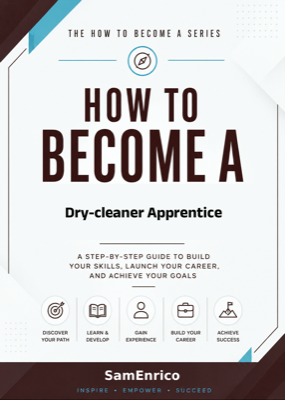
How to Become a Dry-cleaner Apprentice eBook
How to Become a Dry-cleaner Apprentice
by Judge Andera
How to Become a Dry-cleaner Apprentice
Formats
Free sample
Chapter 1: The $30 Billion Blind Spot--–- Walk into any coffee shop in America, and you will hear the same conversations: people chasing tech certifications, real estate licenses, coding bootcamps, and side hustles. They are convinced that the only paths to financial stability require a computer screen, a real estate license, or an influencer’s approval. Meanwhile, less than one mile away, a small gray building with a faded sign reading “Clean-Rite Dry Cleaners” has been quietly printing money for thirty years. The owner drives a new truck, owns the building outright, and cannot find a single reliable person willing to learn the trade. That owner will train you from zero experience, pay you while you learn, and potentially sell you the business when he retires.
But you will never see that opportunity on a job board.This is the great blind spot of the modern workforce. Dry cleaning is a $30 billion industry in the United States alone, yet it remains almost invisible to job seekers under the age of forty. According to the Drycleaning & Laundry Institute, the average dry-cleaning plant owner is fifty-eight years old, and nearly forty percent plan to retire within the next decade. Few have children interested in taking over. Fewer still have formal succession plans.
What they do have is equipment worth hundreds of thousands of dollars, established customer bases that have trusted them for decades, and a desperate need for young people willing to learn fabric chemistry, spotting boards, and steam finishing. That desperation translates directly into opportunity for anyone smart enough to walk through their door.The Stigma That Creates Your Opportunity Let us address the elephant in the room immediately. Dry cleaning does not sound glamorous. It sounds like chemicals, wrinkled polyester, and angry customers holding discolored wedding dresses. That reputation is precisely why the opportunity exists.
Everyone chases the jobs that look good on Instagram. No one chases the jobs that require standing on concrete floors for eight hours, memorizing solvent distillation cycles, and learning why perchloroethylene is being phased out in favor of hydrocarbon and Green Earth. But here is what the Instagram crowd misses: glamour does not pay bills. Skill does.Consider the numbers. The Bureau of Labor Statistics tracks dry-cleaning and laundry workers under occupation code 51-6011.
The median annual wage appears modest at roughly 28,000,butthatfigurelumpstogethereverypart−timebagger,minimum−wagecounterperson,andunsupervisedhighschoolstudent.Itdoesnotreflectwhatexperiencedspotters,certifieddrycleaners,orproductionmanagersearn.Inhigh−volumeurbanplants,aheadspotterwhocanremoveredwine,blood,andgreasewithoutdamagingdelicatefabricsearns28,000, but that figure lumps together every part-time bagger, minimum-wage counter person, and unsupervised high school student. It does not reflect what experienced spotters, certified drycleaners, or production managers earn. In high-volume urban plants, a head spotter who can remove red wine, blood, and grease without damaging delicate fabrics earns 28,000,butthatfigurelumpstogethereverypart−timebagger,minimum−wagecounterperson,andunsupervisedhighschoolstudent.Itdoesnotreflectwhatexperiencedspotters,certifieddrycleaners,orproductionmanagersearn.Inhigh−volumeurbanplants,aheadspotterwhocanremoveredwine,blood,andgreasewithoutdamagingdelicatefabricsearns45,000 to 65,000,oftenwithproductionbonusesthatpushtotalcompensationhigher.Aplantmanagerwithcertificationfromthe International Fabricare Institutecanearn65,000, often with production bonuses that push total compensation higher. A plant manager with certification from the International Fabricare Institute can earn 65,000,oftenwithproductionbonusesthatpushtotalcompensationhigher.Aplantmanagerwithcertificationfromthe International Fabricare Institutecanearn70,000 to 90,000.Aroutedriverwhotransitionsintocommercialsales,signingcontractswithhotelsandrestaurants,earns90,000. A route driver who transitions into commercial sales, signing contracts with hotels and restaurants, earns 90,000.Aroutedriverwhotransitionsintocommercialsales,signingcontractswithhotelsandrestaurants,earns70,000 to six figures through commissions.
And a franchise owner or independent shop owner who learned the trade through apprenticeship can easily earn 100,000to100,000 to 100,000to200,000 annually, with the added benefit of owning a recession-resistant business that sells for three to five times annual earnings.These numbers are not theoretical. They come from actual market data collected by the Fabricare Association of America and verified through interviews with shop owners across twelve states. The common thread among high earners is not a college degree or family connections. It is apprenticeship. Every single one of them started by walking into a dry cleaner, asking to learn, and proving they could show up on time without complaining about the smell of solvent.Why Trade Schools Are Often a Waste of Money Before we go further, we need to address a common misconception: that you need formal trade school or certification before anyone will hire you.
That is false. In fact, many trade schools for dry cleaning are expensive, outdated, and disconnected from real shop conditions. A two-week certification course at a private fabricare academy can cost 3,000to3,000 to 3,000to5,000 plus travel expenses. That course will teach you the theory behind solvent distillation, the chemistry of stain removal, and the proper way to press a suit. It will not teach you how to handle a customer who screams at you because her silk blouse shrank, how to work with a moody plant owner, or how to unclog a steam tunnel filter at 7:45 AM on a Monday.Apprenticeship flips this model entirely.
You get paid from day one. You learn on actual equipment that you will use for your entire career. You build relationships with customers who will eventually follow you if you open your own shop. And you earn credentials through documented hours rather than expensive exams. The Drycleaning & Laundry Institute offers certification pathways that require 2,000 hours of supervised work experience, not classroom time.
Every hour you spend working as an apprentice counts toward that requirement. Every stain you remove, every machine cycle you run, every complaint you resolve becomes both a skill and a credential.This is not to say that formal education has no value. It does. But it should come after you have secured an apprenticeship, not before. Work for six months, prove you are serious, and then ask your employer to cover the cost of certification courses.
Many owners will pay for your training because a certified employee increases their insurance rating, allows them to handle more delicate items, and makes their plant more marketable when they sell. Let someone else pay for your education while they pay you to learn.Real People Who Walked This Path Meet Derrick, a former warehouse worker from Cleveland who had never ironed a shirt before walking into Sun Cleaners in 2018. He was twenty-nine years old, had been laid off from a distribution center, and had two kids at home. The owner, a Korean immigrant named Mr. Park, was sixty-three and had been trying to sell his plant for three years without success.
Derrick asked for a job cleaning lint filters and tagging garments. Within six months, he was running the dry-cleaning machine. Within eighteen months, he was the head spotter. At the two-year mark, Mr. Park offered him a lease-to-own agreement on the business.
Derrick now owns Sun Cleaners, employs six people, and takes home $140,000 annually. His only previous experience was showing up every day and asking questions.Meet Jasmine, who answered a Craigslist ad for a route driver position in Phoenix. She had never driven a commercial van or talked to a hotel manager. Her first week, she delivered two hundred pounds of linens to a Marriott and noticed that the housekeeping director was frustrated with her current supplier. Jasmine asked if she could bring samples of her shop’s commercial-grade pressing.
The director tried them, switched contracts, and doubled Jasmine’s route value within sixty days. Her boss noticed and promoted her to commercial sales manager. She now earns $85,000 base plus commission, works from home three days a week, and has never run a dry-cleaning machine…
This is the end of the free sample. Get the eBook to keep going. Buy now
About this book
Details
- Author
- Judge Andera
- Publisher
- SamEnrico
- Language
- English
- ISBN
- 9781505759211
- Genre
- Non-Fiction, Informative, Educational
- Released
- 2026-05-02
- Pages (approx.)
- 135
- Available as
- eBook, Paperback, Audiobook

Read better in the ZLOADR app
Your eBooks on your phone or tablet. Sign in with your SamEnrico account and start reading.
More by Judge Andera
 Incubation For Addiction Cravings GuideJudge Andera$11.99
 The IBS and Celiac GuideJudge Andera$11.99
 Jealousy Assessment GuideJudge Andera$11.99
 Parental Anger and Moving HomesJudge Andera$11.99
 The Relapse Prevention for NicotineJudge Andera$11.99
 The Great Penguin Rescue: Operation Stormy SeasJudge Andera$11.99
 Understanding Thymic CarcinomaJudge Andera$17.99
 Safety Surveillance AssociateJudge Andera$11.99
 India Receivables Factoring GuideJudge Andera$12.99
 Discord Community ValidationJudge Andera$12.99