
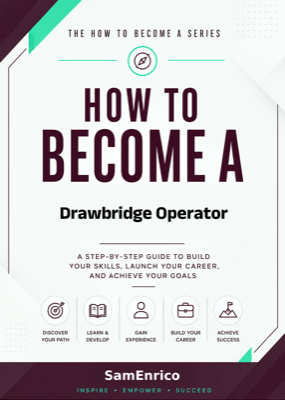
How to Become a Drawbridge Operator eBook
How to Become a Drawbridge Operator
How to Become a Drawbridge Operator
Formats
Free sample
Chapter 1: The Last Analog Job…--The fog rolled in off the water at three knots, swallowing the far shore like a whale taking krill. Inside a control house no larger than a walk-in closet, a woman named Margaret sat on a swivel stool that had been manufactured the year Neil Armstrong walked on the moon. Before her was a panel of switches, gauges, and buttons—none of them labeled, all of them worn smooth by forty years of calloused fingers. Outside her window, a 300-foot barge loaded with crushed limestone sounded its horn: one prolonged blast, the universal request for passage. Margaret set down her coffee mug, scanned left to right across the bridge deck, and flipped three switches in sequence.
Below her feet, gears older than her children began to turn. The bridge groaned, then lifted, and the barge slipped through the opening with less than six feet of clearance on either side. Margaret took a sip of coffee and wrote in the logbook: *0642 – M/V Limestone Queen, southbound, clear opening.* Then she waited for the next boat, or the next sunrise, whichever came first.This is the last analog job on earth, and it is hiring.In an age of driverless cars, AI-powered traffic management, and drones that deliver packages to your doorstep, the drawbridge operator remains stubbornly, gloriously, terrifyingly human. No algorithm can do this work. No remote camera array can replicate it.
No cost-cutting efficiency expert can automate it away. Not because the technology isn't smart enough, but because the consequences of failure are measured in human lives, and the law—written in blood and litigation—requires a person in the tower.Consider what a drawbridge operator actually does. On the surface, the job appears simple: when a boat comes, lift the bridge; when the boat passes, lower it. But this description is like saying a heart surgeon's job is to cut and sew. The reality is layered, complex, and often paradoxical.
The drawbridge operator is simultaneously a vessel traffic controller (responsible for the safe passage of everything from kayaks to container ships), a first responder (the first person to see a car go into the water or a pedestrian fall from the span), a public relations officer (the human face of the Department of Transportation to every angry driver stuck at the gates), and a janitor of heavy machinery (greasing, painting, sweeping, and listening for the sounds of impending mechanical doom). No single job description captures this range. No training program fully prepares you for it. And yet, thousands of people do this work every day, on every navigable waterway in America, from the Brooklyn Bridge to the smallest county-owned span over a drainage canal in rural Louisiana.This book exists because the top ten guides on this topic—mostly thin pamphlets and government-issued PDFs—fail to capture what the job actually requires. They tell you how to apply but not how to survive.
They list the regulations but never explain why those regulations exist. They describe the machinery in abstract terms but never teach you how to listen to a hydraulic pump the way a mechanic listens to a troubled engine. Most critically, they miss the soul of the work: the strange, meditative, high-stakes solitude of sitting alone in a tower while the world rushes past below you, waiting for a horn that may not come for hours, then acting with precision when it finally does.This chapter is called "The Last Analog Job" because that phrase captures the essential truth of this career. Analog, in the old sense, means continuous, non-digital, rooted in physical reality rather than abstract code. A drawbridge operator deals in continuous variables: the height of a mast, the speed of a current, the fatigue in a steel cable, the judgment call of whether that small dot on the radar is a fishing boat or a log.
These things cannot be reduced to ones and zeros. They require a human nervous system, a pair of eyes, and a lifetime of accumulated caution.The Foggy Dawn Problem Let me illustrate with a problem that no AI can currently solve. Imagine it is 6:45 AM on a Tuesday in March. The fog is thick enough that you cannot see the far side of the river from your control house. Your radar shows three blips: one large and slow (a barge), one medium and erratic (a pleasure boat that seems to be drifting), and one small and intermittent (could be a kayak, could be a duck, could be radar noise).
The bridge is down. A school bus is waiting at the gate on the north side with its flashers on. The southbound morning commute is beginning to stack up, and you can hear a driver laying on his horn—not the ship's horn, but the impotent rage-horn of a man who is going to be late for work. Then the barge sounds its request: one prolonged blast. What do you do?A purely algorithmic system would prioritize based on vessel size and schedule.
Barge first, then pleasure boat, then ignore the intermittent blip as noise. Open the bridge immediately. But a human operator knows things the algorithm does not. That intermittent blip might be a kayaker who capsized two minutes ago, paddling for his life. The pleasure boat might be a fishing vessel with a downed engine, drifting toward the bridge piers.
The school bus might contain a child having a seizure, with the driver desperate to reach the hospital on the other side. The algorithm cannot weigh these possibilities because it lacks context, intuition, and the ability to ask questions.The human operator picks up the VHF radio. "Barge approaching mile marker twelve, this is the bridge. Hold your position. I have possible distress traffic in the channel." Then she switches to Channel 16, the emergency hailing frequency.
"Vessel in the vicinity of the north span, this is the bridge. Do you require assistance?" And she waits. If no answer comes, she calls the Coast Guard. She does not open the bridge until she knows what that intermittent blip is, because opening the bridge means lowering the gates, trapping the school bus on the wrong side of the river, and committing to a course of action that cannot be undone for at least ten minutes.This is the foggy dawn problem. It has no perfect solution.
It only has human judgment, applied under pressure, with incomplete information, and the knowledge that if you are wrong, someone might die. That is why drawbridge operators still exist. That is why they always will.A Brief History of Moving Bridges Before we go further, a short history lesson. Humans have been building movable bridges for at least 3,000 years. The ancient Egyptians used pontoon bridges that could be pulled apart to allow boat traffic.
The Romans built wooden drawbridges at their fortified river crossings. Medieval castles featured the classic portcullis-and-drawbridge combination that still appears in every fantasy movie ever made. But the modern drawbridge—the kind you might operate—is a product of the Industrial Revolution and the golden age of canals.Three basic designs dominate American waterways today. The bascule bridge (from the French word for "seesaw") is the most…
This is the end of the free sample. Get the eBook to keep going. Buy now
About this book
Details
- Author
- Dockery Dalila
- Publisher
- SamEnrico
- Language
- English
- ISBN
- 9781505752694
- Genre
- Non-Fiction, Informative, Educational
- Released
- 2026-05-02
- Pages (approx.)
- 151
- Available as
- eBook, Paperback, Audiobook

Read better in the ZLOADR app
Your eBooks on your phone or tablet. Sign in with your SamEnrico account and start reading.
More by Dockery Dalila
 The Geo Arbitrage Banking HandbookDockery Dalila$11.99
 Fiverr Level System GuideDockery Dalila$11.99
 Aging Veterans Self Esteem GuideDockery Dalila$11.99
 The Ujjayi Breath ControlDockery Dalila$11.99
 Offering Choices De escalationDockery Dalila$11.99
 The Magnate of Makoko: The Visionary Rise of Hakeem Olusegun ObasanjoDockery Dalila$11.99
 Credit and Payment GuideDockery Dalila$12.99
 Non Resident LLC C Corp ConversionDockery Dalila$12.99
 Gazebo BuilderDockery Dalila$11.99
 Understanding Lowry–wood SyndromeDockery Dalila$17.99