
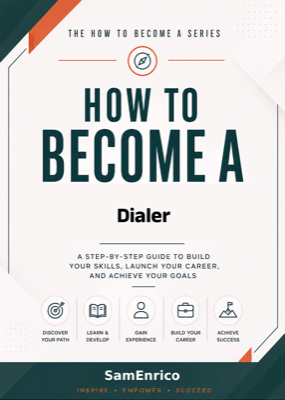
How to Become a Dialer eBook
How to Become a Dialer
by Fahey Marin
How to Become a Dialer
Formats
Free sample
Chapter 1: The 50-Dollar Desk--It was 2:47 on a Tuesday afternoon, and Mike was hiding in a supply closet.Not because he was afraid of his boss. Not because he was avoiding a difficult client. He was hiding from the phone. Specifically, a gray Cisco desk phone that sat on his cubicle desk like a concrete block. Earlier that morning, his sales manager had posted the weekly leaderboard.
Mike’s name sat at the very bottom, next to a number in red: 3,200incommissionsforthequarter.Hisrentwas3,200 in commissions for the quarter. His rent was 3,200incommissionsforthequarter.Hisrentwas1,800. He had already borrowed $400 from his dad.The person at the top of that board, a woman named Carla, had made $24,000 the same quarter. She sat fourteen feet away from Mike. Same leads.
Same product. Same phone. Same ugly gray carpet. The only difference was that Carla picked up her phone 187 times that day, and Mike had made eleven calls before retreating to the bathroom to stare at his reflection and wonder how he had ended up here.Three years earlier, Mike had graduated with a degree in marketing. He had imagined himself launching brilliant campaigns, writing clever emails, maybe even giving a TED Talk someday.
Instead, he was an SDR for a mid-tier software company, and his job description had exactly five words: dial, talk, set meeting, repeat. He hated those five words. He hated the way his chest tightened every time his finger hovered over the call button. He hated the sound of the first ring, the way it seemed to echo through his entire body.But mostly, he hated the math.Because here is the math that Mike did not understand yet, the math that would eventually save his career: 187 dials at a 9 percent connect rate equals roughly 17 conversations. Out of those 17 conversations, Carla converted 4 into meetings.
Each meeting had a 60 percent chance of becoming a demo, and each demo had a 20 percent chance of becoming a close. The math was not about charisma or intelligence or having the perfect voice. The math was about volume. The math was about picking up the phone when every fiber of your being screamed at you to do literally anything else.Carla was not smarter than Mike. She was not funnier or better looking or more articulate.
She had simply made a decision that Mike had not made yet: she had decided to become a dialer.This book is for Mike. And for you. And for everyone who has ever stared at a phone and felt their stomach drop.The Great Lie of Modern Sales Before we talk about what a dialer is, we need to talk about what a dialer is not. A dialer is not someone who waits for inbound leads to trickle in like rainwater. A dialer is not someone who spends forty‑five minutes crafting the perfect Linked In message that will be ignored by 99 percent of recipients.
A dialer is not someone who hides behind email sequences and blames “bad timing” when the quarter ends and the number on the board is still red.The great lie of modern sales—the lie that is taught in expensive boot camps and repeated by influencers with perfect lighting—is that you can “work smarter, not harder.” This lie suggests that if you just find the right hack, the right sequence, the right piece of AI software, you can skip the grunt work. You can bypass the grind. You can set meetings without the nausea of the first ring.It is a seductive lie. It is also complete nonsense.Let us look at the data. In 2023, a study of over 1.2 million cold calls across fourteen industries found that the single strongest predictor of success was not the quality of the opener (though that mattered).
It was not the seniority of the prospect. It was the number of dials attempted per day. Salespeople who averaged 75 dials or more per day set 3.4 times more meetings than those who averaged 25 dials or fewer. This correlation held true across every industry, every product type, and every experience level.Think about what that means. A mediocre opener delivered one hundred times will almost always outperform a brilliant opener delivered ten times.
A sloppy script read with nervous energy will beat a perfect script that never leaves the Google Doc. The phone does not reward perfection. The phone rewards persistence.This is not a motivational slogan. This is physics. Every phone number has a probability of answering.
Every answered call has a probability of converting to a meeting. These probabilities are not personal. They are not a reflection of your worth as a human being. They are simply numbers that can be influenced by skill—but only after you have put in the volume required for those skills to matter.Consider the following formula, which we will return to throughout this book:Dials × Connect Rate × Conversion Rate = Meetings You can increase your connect rate by calling at better times (research shows Tuesday through Thursday, 8–10 AM and 4–5:30 PM, are peak hours). You can increase your conversion rate by using better scripts, better discovery questions, and better objection handling.
But here is what no amount of skill can fix: if you multiply zero dials by any connect rate or any conversion rate, you get zero meetings.Zero.Mike, hiding in the supply closet, did not understand this yet. He thought he needed a better opener. He thought he needed more confidence. He thought he needed to read one more sales book. What he actually needed was to understand that his problem was not technique.
His problem was that he was not dialing enough for his technique to matter.The Identity Shift: From Order‑Taker to Pipeline Generator There is a moment in every dialer’s career when something shifts. It is not a dramatic Hollywood moment. There are no swelling strings, no standing ovations. It happens quietly, usually on a random Tuesday, after the hundredth dial of the morning.You dial a number. It rings.
Someone answers. And instead of feeling that familiar spike of fear, you feel something else entirely: neutrality. Maybe even mild curiosity. You are no longer invested in the outcome of this single call because you have internalized the math. You know that this call is just one of dozens today.
If this person says no, there are fifty‑three more numbers waiting in your list.That moment—the moment you stop caring about any individual call—is the moment you become a dialer.This is an identity shift, not a technique. An order‑taker waits for the phone to ring. A pipeline generator makes it ring. An order‑taker feels rejected when a prospect says no. A pipeline generator collects that “no” as data and moves on.
An order‑taker asks, “Do they like me?” A pipeline generator asks, “What did I learn from this interaction?”The difference between these two identities is not talent. It is a decision. A decision to stop treating each call like a high‑stakes audition and start treating it like a repetitive skill, the same way a basketball player treats free throws or a pianist treats scales.Mike, in the supply closet, still saw himself as a…
This is the end of the free sample. Get the eBook to keep going. Buy now
About this book
Details
- Author
- Fahey Marin
- Publisher
- SamEnrico
- Language
- English
- ISBN
- 9781505744286
- Genre
- Non-Fiction, Informative, Educational
- Released
- 2026-05-02
- Pages (approx.)
- 129
- Available as
- eBook, Paperback, Audiobook

Read better in the ZLOADR app
Your eBooks on your phone or tablet. Sign in with your SamEnrico account and start reading.
More by Fahey Marin
 Abbasid Poetry Golden AgeFahey Marin$11.99
 HGH and Vision AgingFahey Marin$11.99
 The Parent Emotional Flooding GuideFahey Marin$11.99
 The Loot Box Addiction WorkbookFahey Marin$11.99
 The Midnight Quilt Code: How Enslaved Women Wove Freedom into FabricFahey Marin$11.99
 Rum & Revolution: The Secret War of the Caribbean Spice TradeFahey Marin$11.99
 Automated Tax Preparation HandbookFahey Marin$12.99
 Coding Bootcamp Licensing LawsFahey Marin$12.99
 Understanding Bronchiolotis Obliterans Organizing Pneumonia (Boop)Fahey Marin$17.99
 Nanoimprint Lithography TechnicianFahey Marin$11.99