
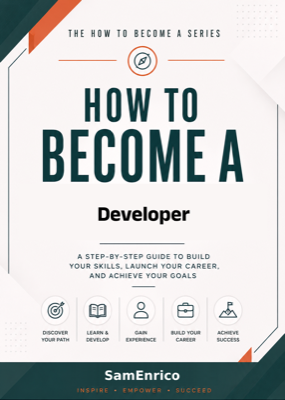
Non-FictionInformativeEducational
How to Become a Developer eBook
How to Become a Developer
by Pina Hildred
How to Become a Developer
Formats
Free sample
Chapter 1: The 90% Lie...--–- Every year, hundreds of thousands of aspiring developers do the same thing. They buy a course on Python. They grind through Java Script tutorials. They build a to-do app, a weather app, and maybe a calculator. They memorize syntax like prayer beads.
And then they apply for their first junior developer role with the quiet confidence that comes from having written ten thousand lines of code.And then nothing happens.Rejection emails trickle in. Ghosting becomes the norm. The few responses that do arrive are automated: "After careful consideration..." They never make it to the interview stage. Or worse, they make it to the technical screen, solve the problem correctly, and still get rejected. They are left staring at their Git Hub contribution graph—a lush garden of green squares—wondering what went wrong.Here is the brutal truth that no coding bootcamp advertises and no You Tube tutorial will tell you: Coding skill is not the bottleneck for 90% of aspiring developers.The problem is not that you cannot code.
The problem is that you have been taught to think like a coder when you need to think like a developer. And those are not the same thing.The Two Identical Coders Imagine two developers. Let's call them Alex and Jordan.Alex spends twelve months learning to code. They complete four online courses, build ten portfolio projects, and solve two hundred Leet Code problems. Their code is clean, efficient, and well-structured.
By any technical measure, Alex is an excellent coder.Jordan spends the same twelve months. They learn the same syntax. They solve the same algorithms. But Jordan also spends one hour each week doing something Alex never does: they learn how the software industry actually works. They study how to write a resume that beats automated filters.
They practice explaining technical concepts to non-technical people. They learn to identify which companies are hiring before those jobs are posted. They build a network of junior and senior developers who can refer them.Both Alex and Jordan apply for the same junior role at a mid-sized tech company.Alex submits a resume that lists "Proficient in Python, Java Script, React, Node.js" and links to a Git Hub repository with ten projects. The resume is generic. The Git Hub READMEs are blank.
The projects have no live demos. The automated applicant tracking system scans the resume, finds no keywords matching the job description, and drops Alex into the rejection pile before any human ever sees it.Jordan submits a resume tailored to that specific job description. The resume mirrors the exact language of the posting—"REST APIs," "agile development," "test-driven development"—without lying. The Git Hub repository has only three projects, but each has a detailed README explaining the problem solved, the technical decisions made, and a link to a live demo. Jordan also sent a brief, polite message to a recruiter at the company two weeks before applying, asking a thoughtful question about the tech stack.Jordan gets the interview.
Alex does not.Here is the painful part: Alex is the better coder. But Jordan gets the job.This is not a hypothetical. This pattern plays out thousands of times every single day in the tech industry. The best coders often lose to adequate coders who understand that software development is a business profession, not a coding competition.The Fundamental Distinction: Coder vs. Developer Let us draw a clear line in the sand.A coder writes instructions for machines.
A coder knows syntax. A coder can solve algorithmic puzzles. A coder can build a functioning application in isolation. These are valuable skills. But they are only half of the equation.A developer solves problems for people.
A developer understands that code is a means to an end, not the end itself. The end is a business outcome: faster reporting, better customer retention, reduced manual labor, increased revenue. A developer knows that a perfect solution that nobody uses is worthless, while an imperfect solution that solves a real pain point is invaluable.The distinction shows up in every part of the job:Situation Coder's Response Developer's Response A bug is discovered"I'll fix the syntax error.""Why did this bug happen? What process allowed it to reach production? How do we prevent its class of errors?"A feature request arrives"I'll write the code exactly as requested.""What problem is the stakeholder trying to solve?
Is there a simpler way? Should we push back?"A performance issue arises"I'll optimize this loop from O(n²) to O(n log n).""Is this performance issue actually affecting users? What's the business impact? Is the fix worth the time?"During an interview"Watch me solve this algorithm.""Let me walk you through how I think about problems, how I communicate when stuck, and how I collaborate with a team."The coder optimizes for code quality. The developer optimizes for outcomes.This is not to say that code quality does not matter.
It matters enormously. But code quality is a means to an outcome, not the outcome itself. A beautifully architected system that misses its launch window is a failure. A perfectly efficient algorithm that solves the wrong problem is wasted effort.The 90% Rule Here is the central thesis of this chapter, and arguably of this entire book:90% of job success in software development comes from skills outside pure coding.These skills include:Communication (written and verbal)Marketing (of yourself and your work)Negotiation (salary, scope, deadlines)Prioritization (what to build and what to ignore)Emotional intelligence (reading a room, handling feedback)Business acumen (understanding what matters to the company)Networking (building relationships before you need them)Only 10% comes from raw coding ability.Let that sink in.If you double your coding skill—if you become twice as good at writing loops, algorithms, and data structures—you improve your job prospects by roughly 10%. If you improve your marketing and communication skills by just 10%, you improve your job prospects by roughly 90%.This is not a law of physics.
It is an observation of how the hiring market actually works. Hiring managers are not grading your code like a professor. They are trying to answer one question: Will this person make my team more effective?Coding skill answers a small part of that question. The rest is answered by everything else.Why Building Portfolio Projects Is Not Enough This brings us to a critical point that confuses many aspiring developers. You have heard repeatedly that you need portfolio projects.
You have been told to fill your Git Hub with green squares. And now you are reading a chapter that seems to say portfolio projects do not matter.Let us clarify.Building a portfolio project that nobody sees is wasted effort.Building a well-documented, well-presented portfolio project that demonstrates your ability to solve real problems? That is gold.The difference is marketing. A project without a README is like a book without a cover. A project without a live demo is like a restaurant with no sign.
A project that solves a problem you invented for yourself is less impressive than a project that solves a problem someone else actually has.Consider two…
This is the end of the free sample. Get the eBook to keep going. Buy now
About this book
Details
- Author
- Pina Hildred
- Publisher
- SamEnrico
- Language
- English
- ISBN
- 9781505743357
- Genre
- Non-Fiction, Informative, Educational
- Released
- 2026-05-04
- Pages (approx.)
- 146
- Available as
- eBook, Paperback, Audiobook

Read better in the ZLOADR app
Your eBooks on your phone or tablet. Sign in with your SamEnrico account and start reading.
More by Pina Hildred
 Collaborative Mind Mapping HandbookPina Hildred$11.99
 Gaming and Anxiety ConnectionPina Hildred$11.99
 Barbadian Professional OutlookPina Hildred$11.99
 Weight Loss Affirmations GuidePina Hildred$11.99
 Caffeine Anger Sensitivity TestPina Hildred$11.99
 The Silent Diplomat: How a Deaf Woman Brokered Peace in a War ZonePina Hildred$11.99
 The Paradox of the 1969 Moon Landing: Did NASA Accidentally Time Travel?Pina Hildred$11.99
 Sprouting Broccoli HarvestingPina Hildred$11.99
 Orange Data Mining GuidePina Hildred$12.99
 Life Sciences Strategic BuyersPina Hildred$12.99
 Understanding Chromosome 8 DeletionPina Hildred$17.99
You may also like
 Hong Kong Handover 1997Dunn Johnnie$11.99
 Zumba For Postnatal Recovery CourseNeal Christian$11.99
 Zumba for BeginnersLadner Nikia$11.99
 YouTube Comment Mining GuideHumes Pandora$12.99
 Worry Box MeditationCarlin Rudy$11.99
 Workplace Stress MeditationNguyen Lynn$11.99
 Workplace Stress and Sleep RepairHawley Ivory$11.99
 Workplace Perfectionism CureDelaney Jeffry$11.99
 Workplace Injustice Anger GuideWallen Isabelle$11.99
 Work Addiction and Burnout LinkGreenwood Ester$11.99
 Women in Yoga and WellnessBeattie Galina$11.99
 Women in Stand Up ComedyChun Evangeline$11.99