
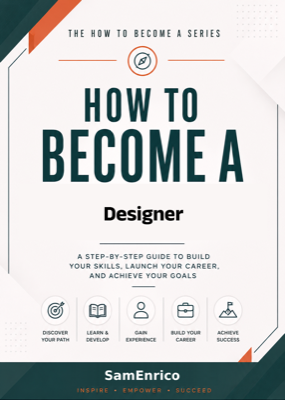
How to Become a Designer eBook
How to Become a Designer
How to Become a Designer
Formats
Free sample
Chapter 1: The Broken Ladder...--–- Every year, more than 100,000 people graduate from design programs, bootcamps, and self-directed learning paths with the same dream: to become a designer. Every year, fewer than 10,000 of them find stable, lasting work in the field within twelve months of starting their search. The other 90,000 do something else. They take adjacent jobs in marketing or project management. They settle for unpaid internships that never convert to full-time roles.
They freelance for poverty wages until their savings run out. Or they simply give up and tell themselves the story that no one likes to admit: Maybe I wasn't good enough.This is not a failure of talent. This is a failure of the path.The traditional route to becoming a designer has been broken for years, but the collapse has accelerated so dramatically in the last twenty-four months that what worked for the generation before you is now actively harmful to repeat. The old ladder—learn software, build a portfolio of polished projects, apply to junior roles, climb to senior—has been pulled up, sawed apart, and sold for scrap. In its place is a chaotic landscape where junior designers compete against artificial intelligence for production work, where bootcamps graduate thousands of identical portfolios every quarter, and where hiring managers openly admit they stop reading applications after the first fifty because every candidate looks the same.This book exists because you need a different ladder.
Not a better version of the old ladder—a fundamentally different one.The Diagnosis: Why the Old Path No Longer Works Let us start with the numbers, because numbers do not lie. According to data from the Bureau of Labor Statistics, design-related job postings for entry-level positions dropped 40 percent between 2021 and 2025. During that same period, the number of graduates from design programs—university degrees, bootcamps, certificate programs, and online courses—increased by nearly 300 percent. Basic supply and demand tells you what happened: the market flooded while the opportunities shrank.But the numbers only tell part of the story. The qualitative shift is even more alarming.The AI Inflection Point In 2022, generative AI tools like Midjourney and DALL-E were novelties—impressive party tricks that could not produce professional work.
By 2024, those same tools could generate production-ready assets, layout variations, and even complete interface mockups in seconds. By 2026, the gap between what a junior designer can produce and what AI can produce has narrowed so significantly that hiring managers have begun asking themselves a brutal question: Why would I pay a junior designer sixty thousand dollars a year to do what an AI subscription can do for six hundred dollars a month?The answer, increasingly, is that they would not. The work that used to be the junior designer's pipeline—resizing assets, formatting documents, generating color palettes, creating basic layout variations—is now fully automatable. This is not a prediction. This is already happening.
Every design agency and in-house team you might want to work for is actively evaluating which parts of the junior designer's role can be replaced by AI tools. The answer, so far, is roughly 60 to 70 percent of what a junior designer currently does.This means that the remaining 30 to 40 percent of the role must justify the entire salary. And that 30 percent looks very different from what bootcamps and design programs are teaching.The Bootcamp Factory Bootcamps emerged as a solution to a real problem: university design programs are expensive, slow, and often disconnected from industry practice. But bootcamps have created a new problem of their own: standardization. When every bootcamp teaches the same software (Figma), the same projects (redesign Spotify, recreate Airbnb, build a coffee shop app), and the same portfolio format (problem → research → solution → polished mockups), every graduate looks identical to every other graduate.Hiring managers report that they can identify a bootcamp portfolio within thirty seconds of opening it.
The layout follows predictable patterns. The case studies follow predictable arcs. The visual style follows predictable trends. There is no differentiation because there can be no differentiation—the bootcamp model depends on teaching a replicable process that works for everyone. But what works for everyone works for no one in a competitive market.One hiring manager at a mid-sized agency told me, "I once reviewed forty portfolios in a single day.
Thirty-six of them had redesigned the same music streaming app. I could not tell you a single thing that distinguished one from another. I stopped reading after the first ten." That is the curse of the bootcamp: you are not competing against the other graduates from your program. You are competing against every graduate from every program, all of whom produced approximately the same work.The Experience Paradox Then there is the cruelest trap of all: you cannot get a job without experience, and you cannot get experience without a job. Junior roles increasingly require one to two years of professional experience, which creates an impossible loop for career-switchers and new graduates.
The justification from employers is that they no longer have the capacity to train junior designers—the pace of work is too fast, the margins too thin, the AI tools too demanding of oversight. They need designers who can contribute immediately. But if no one will train junior designers, where will the next generation of senior designers come from?This is not a sustainable situation, but sustainability is not the concern of individual hiring managers. Their concern is filling a role as efficiently as possible. And efficiency increasingly favors candidates who have somehow acquired experience without having held a job—freelance work, volunteer projects, self-initiated work that mimics real-world constraints.
The designers who succeed are not the ones with the most impressive degrees or the most polished bootcamp portfolios. They are the ones who figured out how to get real experience without permission.The Reframe: Compete on What AI Cannot Do If software skills are becoming commoditized and bootcamp portfolios all look the same, what is left? What can you compete on that will actually differentiate you from the other hundred thousand people applying for the same jobs?The answer is judgment. Strategic thinking. Ethical reasoning.
Stakeholder management. Problem-framing. The ability to navigate ambiguity, make trade-offs, and advocate for users when it is unpopular. These are the skills that AI cannot replicate, that bootcamps cannot teach in ten weeks, and that hiring managers are desperate to find.Let me be specific about what I mean.Judgment Judgment is the ability to make good decisions with incomplete information. A junior designer with good judgment knows when to ask for more research and when to ship with what they have.
They know when to push back on a stakeholder request and when to accommodate it. They know when a design is good enough and when it needs another iteration. Judgment comes from practice, feedback, and reflection—not from memorizing Figma shortcuts.Problem-Framing Most designers are hired to execute solutions that someone else has already defined. The designer who can frame the problem—who can look at a vague request like "make the website better" and translate it into a specific, research-backed problem statement—is worth ten times as much as the designer who simply waits for instructions. Problem-framing is the skill…
This is the end of the free sample. Get the eBook to keep going. Buy now
About this book
Details
- Author
- Freedman Reagan
- Publisher
- SamEnrico
- Language
- English
- ISBN
- 9781505742565
- Genre
- Non-Fiction, Informative, Educational
- Released
- 2026-04-25
- Pages (approx.)
- 149
- Available as
- eBook, Paperback, Audiobook

Read better in the ZLOADR app
Your eBooks on your phone or tablet. Sign in with your SamEnrico account and start reading.
More by Freedman Reagan
 Rural Loneliness Connection GuideFreedman Reagan$11.99
 Solar Temple Château De Chambord Link HandbookFreedman Reagan$11.99
 Emotional Regulation for ParentsFreedman Reagan$11.99
 Free Creator Time Tracking StackFreedman Reagan$11.99
 Mindfulness for Creative BlocksFreedman Reagan$11.99
 The Invisible Architect: How a Secretive Tech Wife Shaped Silicon ValleyFreedman Reagan$11.99
 The Labyrinth of Light: Deciphering the Sacred Geometry of ChartresFreedman Reagan$11.99
 Channel Sales DirectorFreedman Reagan$11.99
 ESG Performance Tax Transparency GuideFreedman Reagan$12.99
 Dubai Student Support ServicesFreedman Reagan$12.99
 Understanding Cerebral ThrombosisFreedman Reagan$17.99