
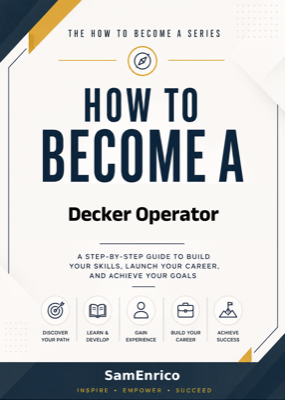
How to Become a Decker Operator eBook
How to Become a Decker Operator
by Vinson Iesha
How to Become a Decker Operator
Formats
Free sample
Chapter 1: The Millionaire Deckhand--The first time I stepped onto the deck of an operational vessel, I almost turned around and walked back down the gangway. Not because I was scared. Not because I was seasick. Because I had just done the math in my head, and I realized that the nineteen-year-old cadet showing me around – a kid with a high school diploma and a six-month certificate – was going to make more money in his first year as a Decker Operator than I had made in my best year as a college graduate with a master's degree.His name was Kyle. He was twenty years old.
He had grown up in a small town in Mississippi where the biggest employer was a poultry processing plant. He had no family connections to the maritime industry. He had never been on a ship before his training. And at that moment, he was earning $68,000 working a four-weeks-on, four-weeks-off rotation.He pointed to the bridge. “That's where I'll be standing watch tomorrow,” he said.
“After that, I've got seventy-two hours off. I'm flying to Costa Rica for a week.”I was thirty-two years old. I had two degrees, $47,000 in student loan debt, and a job that required me to ask permission before taking a vacation day. A teenager was explaining his rotation schedule to me like it was the most normal thing in the world.That was the day I started asking questions. That was the day I realized that the maritime industry – and specifically the role of the Decker Operator – is the single most overlooked, under-discussed, and misunderstood career path in the modern economy.This book is everything I learned.--The $150,000 Typo Let me tell you about a job posting that changed my entire understanding of work.I was doing research for a different project – something about blue-collar career paths that didn't require degrees – when I stumbled across a listing on a maritime job board.
The title was “Deck Operator – Offshore Supply Vessel.” The requirements were straightforward: STCW Basic Safety Training, a valid passport, the ability to pass a drug test, and a willingness to work offshore rotations.The salary range was listed as 85,000to85,000 to 85,000to150,000.I stared at the screen for a full minute. Then I checked the date to make sure I wasn't looking at an old posting from a different economic era. Then I checked the company to make sure it wasn't a scam. Then I called a friend who worked in maritime logistics and asked him if this was real.His response: “That's actually a little low for some of the Gulf vessels. I know operators who are clearing $180k with overtime.”I had spent the previous decade believing that the only paths to a six-figure income required either a professional degree, a decade of corporate climbing, or starting a successful business.
Nobody had told me about the ships. Nobody had told me that a job you can qualify for in six months could pay more than a job that requires a law degree.That job posting was not a typo. It was not an outlier. It was a representative sample of an industry that has been quietly paying life-changing wages to people who know where to look – while the rest of the world fights over remote tech jobs and gig economy scraps.--What This Book Actually Is Before we go any further, let me be clear about what you are holding.This is not an academic textbook. This is not a collection of inspirational platitudes.
This is not a romanticized adventure story about life on the high seas. This is a practical, tactical, no-nonsense career guide written for one specific purpose: to give you the exact information you need to become a working Decker Operator as quickly and efficiently as possible.I have organized this book in the order that you will actually experience the process. We start with the why – the financial case, the lifestyle realities, and the honest assessment of whether this career is right for you. Then we move to the how – the certifications, the applications, the interviews, and the first contract. Then we go deep on the skills you will need to survive and thrive as an operator.
Then we cover advancement, specialization, and the long arc of a maritime career.Every chapter includes specific, actionable information. I give you numbers. I give you timelines. I give you the names of certification providers, the exact sequence of courses, and the pitfalls that waste time and money. I have interviewed captains, chief officers, training directors, and hiring managers to get the information that is not written down anywhere else.By the time you finish this book, you will know exactly what steps to take, in what order, and approximately how long each step will take.
You will know how much money to budget for training, how to minimize that cost, and how to get hired with zero experience. You will know what to expect on your first day, your first week, and your first year.And if you decide that this career is not for you, you will know that early – before you spend time and money on training that you don't need.That is the promise of this book. Not inspiration. Information.--Who Is a Decker Operator, Really?Let me clear up the terminology confusion right now, because the maritime industry is terrible at naming things.The term “Decker Operator” is used differently depending on which company, which country, and which vessel type you are talking about. In some contexts, it means an entry-level deckhand.
In others, it means a fully qualified operator who runs cranes and cargo gear. In still others, it means an officer who stands bridge watches.Rather than try to force a single definition, this book uses a progressive model that matches the actual career arc of a maritime professional.At the beginning of your career (what this book calls the Cadet phase), you are a trainee. You are learning the vessel, the equipment, and the routines. You are supervised by more experienced operators. Your job is to show up on time, work hard, and absorb as much knowledge as possible.
You are not yet making the big money, but you are earning a salary while you learn – which is already better than almost every other form of career training.In the middle of your career (what this book calls the Operator phase), you are qualified and independent. You have passed your certification exams. You have accumulated the required sea time. You can operate deck machinery, handle cargo, stand watch, and supervise cadets. This is where the financial magic happens – typically in years three through seven of your career.At the senior level (what this book calls the Officer phase), you are a manager.
As Chief Officer, you run the deck department, manage the medical chest, handle cargo documentation, and serve as the captain's second-in-command. As Captain, you are legally and financially responsible for the vessel, the crew, and the cargo. This is where salaries go from good to life-changing.Throughout this book, I will be specific about which level I am talking about. When I say “Decker Operator” without qualification…
This is the end of the free sample. Get the eBook to keep going. Buy now
About this book
Details
- Author
- Vinson Iesha
- Publisher
- SamEnrico
- Language
- English
- ISBN
- 9781505740165
- Genre
- Non-Fiction, Informative, Educational
- Released
- 2026-05-02
- Pages (approx.)
- 141
- Available as
- eBook, Paperback, Audiobook

Read better in the ZLOADR app
Your eBooks on your phone or tablet. Sign in with your SamEnrico account and start reading.
More by Vinson Iesha
 Time Boundary MasteryVinson Iesha$11.99
 The Travel Nap StrategyVinson Iesha$11.99
 Parent Death Guilt ResolutionVinson Iesha$11.99
 Pain Meditation WorkbookVinson Iesha$11.99
 Hybrid Team ProductivityVinson Iesha$11.99
 Prescription Aid Strategy GuideVinson Iesha$11.99
 Peloton Leaderboard EnvyVinson Iesha$11.99
 Amazon A9 Algorithm GuideVinson Iesha$11.99
 Crisis Burnout PreventionVinson Iesha$11.99
 The Day the Internet Broke: The Great DNS Crash of 2016Vinson Iesha$11.99
 The Whispering Walls of the Overlook HotelVinson Iesha$11.99
 The Last Chain Breaker: The Untold Story of the Angola 3Vinson Iesha$11.99