
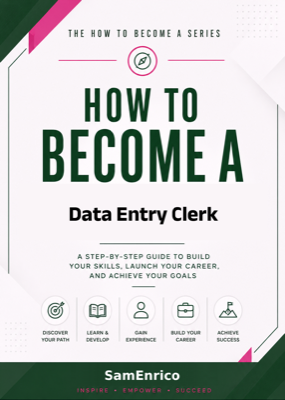
How to Become a Data Entry Clerk
How to Become a Data Entry Clerk
How to Become a Data Entry Clerk
Formats
About this book
Free sample
Chapter 1: Beyond the Keyboard...–- The first myth to dismantle is that data entry means sitting in a cubicle, staring at a screen, and mindlessly copying numbers until your eyes blur. That image is not only outdated—it was never fully accurate. Today, data entry has evolved into a sophisticated ecosystem of digital workflows, automated validations, and specialized roles that serve as the backbone of nearly every major industry. If you want to become a data entry clerk, you must first understand what that title actually means in the modern economy, how it differs from related roles, and which industry fits your natural strengths and risk tolerance. This chapter will transform your understanding from a vague notion of "typing for money" to a strategic map of the data entry landscape.The Historical Evolution: From Paper to Pixels Data entry did not begin with computers.
Before the digital revolution, armies of clerical workers processed information using typewriters, filing cabinets, carbon paper, and microfilm. Insurance companies employed hundreds of "key punch operators" who transferred handwritten claim forms onto punched cards that mainframe computers could read. Libraries maintained card catalogs where every single book required a handwritten or typed entry. Payroll departments operated banks of adding machines to calculate wages from timesheets.The transformation began in the 1980s with the proliferation of personal computers and spreadsheet software like Lotus 1-2-3 and early Excel. The 1990s brought networked databases and the rise of enterprise resource planning systems.
By the 2000s, optical character recognition and document scanning began reducing manual entry for structured documents. The 2010s introduced cloud-based data entry platforms that allowed remote work and real-time collaboration. Today, in the mid-2020s, we are witnessing the integration of artificial intelligence as an assistant rather than a replacement—AI handles the obvious entries, while human clerks focus on exceptions, quality control, and data that requires judgment.Understanding this evolution matters because it explains why the field has not disappeared despite decades of predictions about automation. Each technological wave eliminated the most repetitive sub-tasks while creating new roles that required human judgment. The key punch operator of 1970…
This is the end of the free sample. Get the eBook to keep going. Buy now
Contents
- Chapter 1
- Chapter 2
- Chapter 3
- Chapter 4
- Chapter 5
- Chapter 6
- Chapter 7
- Chapter 8
- Chapter 9
- Chapter 10
- Chapter 11
- Chapter 12
Details
- Author
- Pruett Harris
- Publisher
- SamEnrico
- Language
- English
- ISBN
- 9781505739572
- Genre
- Non-Fiction, Informative, Educational
- Released
- 2026-05-09
- Pages (approx.)
- 144
- Available as
- eBook, Paperback, Audiobook

Read better in the ZLOADR app
Your eBooks on your phone or tablet. Sign in with your SamEnrico account and start reading.
More by Pruett Harris
 Key Employee Sudden Exit Lessons Learned DatabasePruett Harris$11.99
 Press Release DistributionPruett Harris$11.99
 Pelvic Pain Meditation GuidePruett Harris$11.99
 Fiverr Brief and Mood BoardPruett Harris$11.99
 Circadian Depression GuidePruett Harris$11.99
 The Sobriety Vision Board GuidePruett Harris$11.99
 Spouse Death and PossessionsPruett Harris$11.99
 Early Termination Request LogPruett Harris$11.99
 Cold Water Face SplashPruett Harris$11.99
 The Iron and the Ink: Prussia's Administrative RevolutionPruett Harris$11.99
 Moana and Maui: The Ocean’s Binding PromisePruett Harris$11.99
 How to Produce BaritePruett Harris$11.99