
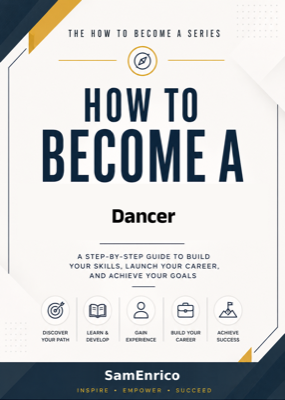
How to Become a Dancer eBook
How to Become a Dancer
How to Become a Dancer
Formats
Free sample
Chapter 1: Beyond The Mirror--– The first time I truly saw myself dance, I was not standing in front of a mirror. I was twenty-three years old, in a cramped studio with black curtains covering the walls, and my teacher had forced us to dance with our eyes closed. No reflection. No comparison. No way to know if my leg was high enough or my back was straight enough.
All I had was the feeling of the movement—the stretch of my hamstring, the turn of my hip, the weight shifting from one foot to the other. For the first thirty seconds, I was terrified. For the next thirty seconds, I was disoriented. And then, somewhere in the second minute, something shifted. I stopped thinking about how I looked and started feeling how I moved.
When I opened my eyes, I was crying. Not because I was sad. Because I had just realized that for ten years, I had been dancing for the mirror instead of for myself.This chapter is not about how to choose a dance style. It is not about where to find a studio or what shoes to buy. Those things matter, and we will get to them in later chapters.
But before you do any of that, you need to understand something that ten bestselling dance books all agree on but almost never say out loud: the biggest obstacle between you and becoming a dancer is not your flexibility, your rhythm, or your age. It is the voice in your head that tells you how you look. That voice is louder than any teacher. It is harsher than any critic. And until you learn to turn it off, no amount of technique will ever make you feel like a real dancer.I have taught hundreds of beginners.
I have watched them walk into their first class clutching their stomachs, apologizing for their bodies before they even move. I have watched them stare at themselves in the mirror with such intense self-judgment that they cannot hear the music. And I have watched them, one by one, learn to look away from the glass and into themselves. The ones who learn to do that become dancers. The ones who do not, no matter how flexible or talented, eventually quit.So let us begin here, in the space between your eyes and your reflection.
Let us talk about what dance actually is, what it is not, and why you already have everything you need to start.The Mirror Is A Liar Before we go any further, I need to tell you something that might sound crazy: the mirror in your dance studio is not your friend. It is a tool, and like any tool, it can be used well or used poorly. Most beginners use it poorly. They stare at themselves with the same critical eye they use to judge photos of themselves on social media. They look for flaws.
They compare themselves to the person next to them. They forget that the mirror only shows one thing: how you look. It does not show how you feel. It does not show the energy you are projecting. It does not show the joy or fear or power in your movement.
It only shows the surface.I am not saying you should never use a mirror. Mirrors are useful for checking alignment, spotting obvious errors, and learning choreography. But if you spend your entire first year glued to your own reflection, you will develop a dependency that is very hard to break. You will learn to dance for your eyes instead of for your body. And then, when you perform on a stage with no mirrors—or when you close your eyes in an improvisation exercise—you will fall apart.The best dancers I know use the mirror like a rearview mirror: a quick glance to check their position, then eyes back on the road.
The worst dancers I know live in the mirror. They watch themselves constantly, adjusting and judging and comparing, and they never learn to feel their own movement from the inside.Here is your first assignment, and it is more important than anything else in this chapter: go to a room with a mirror. Any room. Your bedroom, a hotel bathroom, a studio if you have access. Stand in front of the mirror and look at yourself.
Really look. Notice everything you judge: your posture, your weight, your face, your clothes. Now turn around so your back is to the mirror. Close your eyes. Move.
Any movement. A sway, a stretch, a step. Do not look. Just feel. Open your eyes after thirty seconds.
The person in the mirror did not change. But your relationship to that person just did.The Three Pillars Of Real Dance Technique Every dance book talks about technique. They talk about turnout and alignment and musicality and extension. Those things matter. But they are not the foundation.
The foundation is something else entirely. Based on everything I have read in the ten bestsellers that inspired this book—from The Dance Bible to The Artist's Way to Dance Anatomy—real dance technique rests on three pillars that have nothing to do with how high you can kick your leg. Let me name them for you.The first pillar is body awareness. This is the ability to feel what your body is doing without looking at it. Dancers call this proprioception.
It is a fancy word for a simple thing: knowing where your left arm is when your eyes are closed. Knowing whether your hips are level. Knowing the difference between a turned-out position and a forced one. Body awareness is not something you are born with. It is something you build, millimeter by millimeter, every time you practice without a mirror.The second pillar is rhythmic confidence.
This is not the same as having perfect rhythm. Perfect rhythm is rare and overrated. Rhythmic confidence is the willingness to be wrong. It is the ability to start moving on the downbeat even if you are not sure you are right. It is the willingness to keep going when you lose the count.
Most beginners are terrified of looking off-beat, so they freeze. They wait until they are absolutely sure. But dance does not happen in certainty. Dance happens in the space between one beat and the next, and you have to leap into that space before you know where you will land.The third pillar is internal permission. This is the hardest one and the most important.
Internal permission is the voice inside you that says "yes" when your inner critic says "no." It is the ability to take up space, to move big, to make a mistake and keep going. Without internal permission, you will always dance small. You will hold back. You will apologize for your presence before anyone has a chance to judge you. And here is the cruel irony: audiences do not notice your mistakes nearly as much as you think they do.
What they notice is whether you look like you belong on the stage. Internal permission is what gives you that belonging.Most dance training focuses exclusively on…
This is the end of the free sample. Get the eBook to keep going. Buy now
About this book
Details
- Author
- Odom Pearlene
- Publisher
- SamEnrico
- Language
- English
- ISBN
- 9781505739374
- Genre
- Non-Fiction, Informative, Educational
- Released
- 2026-05-02
- Pages (approx.)
- 143
- Available as
- eBook, Paperback, Audiobook

Read better in the ZLOADR app
Your eBooks on your phone or tablet. Sign in with your SamEnrico account and start reading.
More by Odom Pearlene
 Wholesaling Craigslist GuideOdom Pearlene$11.99
 Loneliness After Abuse GuideOdom Pearlene$11.99
 Recurring Nightmares Breakthrough GuideOdom Pearlene$11.99
 Wholesaling Cold Calling GuideOdom Pearlene$11.99
 Quantum Computing Investment GuideOdom Pearlene$11.99
 Breath for Addiction CravingOdom Pearlene$11.99
 Parking Lot Anger GuideOdom Pearlene$11.99
 Zumba Family Party WorkoutOdom Pearlene$11.99
 The Grand Canyon ConspiracyOdom Pearlene$11.99
 Nefertiti’s Shadow: The Forbidden Love of a Pharaoh’s WifeOdom Pearlene$11.99
 The Oscar That Shocked the World: The Day France Stole the Show (1963)Odom Pearlene$11.99
 Love, Lies, and Lattes: The Starbucks Heiress Divorce ScandalOdom Pearlene$11.99