
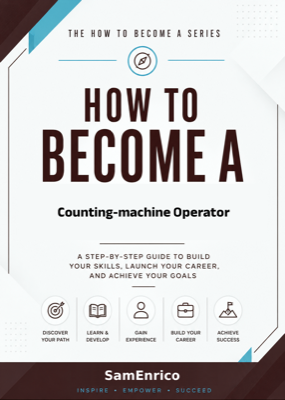
How to Become a Counting-machine Operator eBook
How to Become a Counting-machine Operator
How to Become a Counting-machine Operator
Formats
Free sample
Chapter 1: The Hidden Paycheck--– You are about to discover a job that almost nobody talks about, yet it supports a multibillion-dollar industry that touches every single dollar bill, every casino chip, every vending machine snack, and every factory part you have ever touched. This is not a job that requires a four-year degree, not a job that demands you to manage a team of unhappy employees, and not a job that will eat your evenings and weekends. This is a job where you sit at a machine, feed it items, record numbers, and go home with a clear head and a steady paycheck. But here is what most people get wrong: they think it is boring, mindless, and dead-end. They could not be more wrong.The counting-machine operator role is one of the most misunderstood positions in the modern economy.
Bank tellers think they know what you do. They do not. Warehouse managers think they could replace you with a scale. They cannot. Accountants think your job is just data entry.
They have never cleared a two-thousand-coin jam five minutes before a shift ends. This chapter will tear down every misconception, show you exactly what this job really looks like, map out the industries that are desperate for qualified operators, and give you something even more valuable: a realistic picture of where this career can take you over the next five, ten, or twenty years. By the time you finish this chapter, you will understand why counting-machine operators are the unsung backbone of cash logistics, retail inventory, and industrial manufacturing. You will also understand why employers are quietly paying more than ever for people who can do this job accurately, consistently, and without drama.The Job Nobody Sees Working Inside Every Major Industry Let us start with a simple question. When you drop a handful of quarters into a vending machine for a soda, what happens to those quarters at the end of the day?
Someone has to collect them. Someone has to count them. Someone has to verify that the count matches the sales data from the machine. That someone is a counting-machine operator. When you return a bag of loose change to a bank teller and they disappear into a back room, they are not counting those coins by hand.
They are feeding them into a high-speed coin counter operated by a trained professional. When a casino closes a table for the night, racks of chips go to a counting room where machines and operators work together to verify every single chip before the next shift begins.This job exists everywhere that physical units need to be counted accurately and quickly. Banks employ counting-machine operators to process coin deposits, strap currency, and verify incoming cash shipments. Armored carriers like Brinks and Loomis use operators to count cash before it goes into trucks and after it comes back from customer locations. Casinos run twenty-four-hour counting operations where operators work in secure rooms with multiple cameras and strict chain-of-custody procedures.
Vending companies count coins from thousands of machines across a city. Manufacturing plants count parts, screws, washers, bearings, and electronic components as they move from receiving to inventory to production lines. Retail distribution centers count returned merchandise, damaged goods, and promotional items that come back from stores.What makes this job different from data entry or accounting? Data entry is typing numbers into a computer. A counting-machine operator touches physical objects.
You load a hopper. You press buttons. You watch sensors. You clear jams. You listen to the machine change pitch when something goes wrong.
You are not sitting in a cubicle staring at a screen all day. You are working with your hands, your ears, and your eyes simultaneously. It is tactile. It is rhythmic. It is surprisingly satisfying when everything runs smoothly and just as surprisingly stressful when it does not.Accounting, on the other hand, is about ledgers, debits, credits, and financial statements.
A counting-machine operator does not need to understand depreciation or accrual accounting. You need to know how to count, how to record, and how to report discrepancies. That is it. The machine does the arithmetic. You do the loading, the monitoring, the troubleshooting, and the reconciliation.
This is not a step down from accounting. It is a completely different skill set that pays well precisely because so few people understand it.The Four Main Types of Counting Machines You Will Master Before you can picture yourself in this role, you need to understand the tools of the trade. Counting machines fall into four main categories. Each one requires slightly different techniques, but the underlying principles are the same across all of them.Coin counters are the most common entry point for new operators. These machines process loose coins by feeding them through a rotating disk that uses centrifugal force to singulate individual coins.
Sensors measure each coin’s diameter, thickness, and metallic composition to identify denomination. A typical coin counter can process three thousand coins per minute, sort mixed denominations into separate bins, and display a running total by denomination and combined value. You will find these in banks, casinos, vending companies, and any business that handles large volumes of change.Bill counters are the second major category. These machines use optical sensors, magnetic ink detection, and ultraviolet light to count and authenticate currency. A modern bill counter can process one thousand to two thousand bills per minute, detect counterfeits, sort by denomination, and even identify serial numbers for high-security applications.
Banks use these for cash vault operations. Retailers use them for deposit preparation. Casinos use them for table drop processing. You will learn how to load stacks of bills, how to recognize the sounds of a misfeed, and how to clear jams without damaging the currency.Industrial parts counters are less glamorous but equally important. These machines count screws, bolts, washers, bearings, electronic components, pills, capsules, and any other small manufactured item that comes in bulk.
Some use optical sensors to count items as they pass a detection zone. Others use weigh-scale technology, counting based on the weight of a sample and the total weight of the batch. You will learn how to calibrate for different part sizes, how to handle irregularly shaped items, and how to verify counts before sealing containers for shipment.Ticketing and coupon counters round out the category. These machines process paper products with perforations, barcodes, or magnetic strips. Entertainment venues use them to count ticket stubs.
Grocery stores use them to process coupon redemptions. You will learn how to handle fragile paper products, how to adjust feed mechanisms for different paper weights, and how to reconcile counts against electronic sales data.The original outline for this book briefly mentioned legacy ledger machines, but those have been deliberately omitted here. They are obsolete. No modern employer will ask you to operate a mechanical ledger counter from 1985. This book focuses on equipment you will actually find on a job site today.
If an employer still uses legacy equipment, the training will be specific to that machine, and the general principles you learn here will still apply, but you do not need to waste time memorizing outdated hardware diagrams.The Industries That…
This is the end of the free sample. Get the eBook to keep going. Buy now
About this book
Details
- Author
- Adcock Elisabeth
- Publisher
- SamEnrico
- Language
- English
- ISBN
- 9781505737288
- Genre
- Non-Fiction, Informative, Educational
- Released
- 2026-05-02
- Pages (approx.)
- 147
- Available as
- eBook, Paperback, Audiobook

Read better in the ZLOADR app
Your eBooks on your phone or tablet. Sign in with your SamEnrico account and start reading.
More by Adcock Elisabeth
 Flow in Surgery MedicineAdcock Elisabeth$11.99
 Canva Brand Launch ChecklistAdcock Elisabeth$11.99
 Cherry Blossom GardenAdcock Elisabeth$11.99
 The Senior Doctor Visit GuideAdcock Elisabeth$11.99
 Self Talk Rewiring CourseAdcock Elisabeth$11.99
 Self Hypnosis for Tennis ElbowAdcock Elisabeth$11.99
 Peaceful Forest Visualization GuideAdcock Elisabeth$11.99
 Digital Customer Support CommunicationAdcock Elisabeth$11.99
 The Phantom of Verdun: Pétain's Flesh GrinderAdcock Elisabeth$11.99
 The Eagle and the Fox: Scipio Africanus and the Art of Roman StrategyAdcock Elisabeth$11.99
 How to Produce Pipe Joint PrimerAdcock Elisabeth$11.99
 How to Produce Hypo-allergenic DetergentAdcock Elisabeth$11.99