
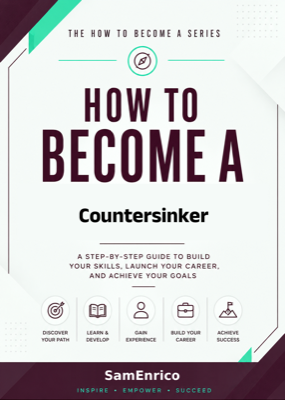
Non-FictionInformativeEducational
How to Become a Countersinker Paperback
How to Become a Countersinker
How to Become a Countersinker
Formats
Free sample
Chapter 1: The Geometry of Trust...--–- Every failed joint tells a story. Walk into any hardware store, any auto body shop, any aircraft hangar, and you will find them—the ghosts of countersinks gone wrong. They hide in plain sight: the kitchen drawer that no longer closes because a screw head sits proud by a hair's breadth. The boat trailer whose fender cracked around a fastener that was never meant to be there. The wooden chair whose rocker split when someone tried to hammer a screw flush instead of seating it properly.
These are not failures of strength or material. They are failures of geometry.This chapter is not about tools. It is not about technique. It is about understanding what a countersink actually is—not as a feature on a blueprint, but as a physical relationship between three things: a fastener, a hole, and the surface of your material. Once you understand that relationship, you will never look at a screw the same way again.
You will see the cones hidden inside every flat-head fastener, the invisible mathematics that determines whether your joint lasts fifty years or fifty days, and the single most common mistake that separates amateurs from professionals in every trade from cabinetry to aerospace.Before you countersink your first hole, you must learn to see the cone.The Three Faces of the Recess Most beginners use the word "countersink" as a catch-all for any recess that lets a screw sit below the surface. This is like calling every four-wheeled vehicle a sedan. The reality is more precise and more useful. There are three distinct types of recesses, each with its own geometry, purpose, and set of rules. Confusing them is the fastest way to ruin a workpiece.The Countersink (Conical Recess) – This is the subject of this entire book.
A countersink is a cone-shaped depression cut into the surface of a material, typically with an angle of 82 degrees (for imperial fasteners) or 90 degrees (for metric). It is designed to accept a flat-head screw, where the underside of the screw head is also a cone of the same angle. When the angles match perfectly, the screw head seats flush with the surface—or slightly below it—creating a smooth, uninterrupted plane.Think of a countersink as a nesting cone. The fastener and the hole are two cones that must mate perfectly. If they do, the clamping force distributes evenly across the entire conical interface.
If they do not—if the angles differ by even one degree—the screw makes contact at only two points: the outer rim or the inner tip. This is the "rocking chair" effect, and it is the hidden cause of countless loose joints and stripped screws.The Counterbore (Cylindrical Recess) – Often confused with a countersink, a counterbore is completely different. It is a cylindrical, flat-bottomed hole that sits above a smaller through-hole. Counterbores are designed for socket-head cap screws (those hex-drive screws with cylindrical heads) and shoulder bolts. The fastener head sits entirely below the surface, but the recess has straight walls, not tapered ones.Why does this distinction matter?
Because cutting a counterbore requires different tools (end mills or specialized counterbore cutters with pilots) and a different approach to depth control. If you use a countersink cutter to make a counterbore, you will produce a tapered hole that jams the fastener at an angle. If you use a counterbore cutter to make a countersink, you will leave a flat shoulder that prevents the screw head from seating at all. The two are not interchangeable.The Chamfer (Edge Break) – A chamfer is…
This is the end of the free sample. Get the Paperback to keep going. Buy now
About this book
Details
- Author
- Mount Senaida
- Publisher
- SamEnrico
- Language
- English
- ISBN
- 9781505737202
- Genre
- Non-Fiction, Informative, Educational
- Released
- 2026-06-02
- Pages (approx.)
- 125
- Available as
- eBook, Paperback, Audiobook

Read better in the ZLOADR app
Your eBooks on your phone or tablet. Sign in with your SamEnrico account and start reading.
More by Mount Senaida
 Late Bloomers Who Launched EmpiresMount Senaida$11.99
 Menopause Sleep Recovery PlanMount Senaida$11.99
 Work Stress Spillover ControlMount Senaida$11.99
 ABCDE for Customer ServiceMount Senaida$11.99
 The Remote Team FocusMount Senaida$11.99
 Affirmation Audio ScriptsMount Senaida$11.99
 Train Ride Through CountryMount Senaida$11.99
 Table Tennis Self HypnosisMount Senaida$11.99
 The Knight and the Frontier: The Wild Races of Early AmericaMount Senaida$11.99
 Yaks: High-altitude BovineMount Senaida$11.99
 Marketing Channel ScorecardMount Senaida$12.99
 Chinese Supplier First Order BlueprintMount Senaida$12.99
You may also like
 Hong Kong Handover 1997Dunn Johnnie$11.99
 Zumba For Postnatal Recovery CourseNeal Christian$11.99
 Zumba for BeginnersLadner Nikia$11.99
 YouTube Comment Mining GuideHumes Pandora$12.99
 Worry Box MeditationCarlin Rudy$11.99
 Workplace Stress MeditationNguyen Lynn$11.99
 Workplace Stress and Sleep RepairHawley Ivory$11.99
 Workplace Perfectionism CureDelaney Jeffry$11.99
 Workplace Injustice Anger GuideWallen Isabelle$11.99
 Work Addiction and Burnout LinkGreenwood Ester$11.99
 Women in Yoga and WellnessBeattie Galina$11.99
 Women in Stand Up ComedyChun Evangeline$11.99