
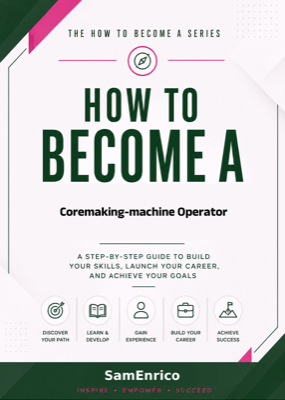
How to Become a Coremaking-machine Operator eBook
How to Become a Coremaking-machine Operator
by Hein Yu
How to Become a Coremaking-machine Operator
Formats
Free sample
Chapter 1: Beyond the Melt...--– The first thing you notice when you walk into a foundry isn't the heat. It isn't the roar of furnaces or the rhythmic hiss of hydraulic presses. It's the gravity. You feel it in your chest—a low, persistent thrum that vibrates up through the concrete floor and settles in your bones. This is a place where raw elements meet human ingenuity, where sand, fire, and metal transform into the hidden skeletons of modern civilization.
And somewhere in the middle of this orchestrated chaos stands an unlikely hero: the coremaking-machine operator.If you are reading this book, you have probably never given much thought to cores. Most people haven't. They drive cars with engine blocks that contain intricate water jackets, turn on faucets that route water through complex valve bodies, and operate machinery that relies on hollow castings—all without ever wondering how those internal cavities got there. The answer is simplicity itself: a core is a carefully shaped mass of sand, held together by chemical binders, that is placed inside a mold before molten metal is poured. The metal flows around the core, solidifies, and when the casting is shaken out, the core crumbles away, leaving behind a perfectly formed empty space.
It is a temporary object that creates a permanent feature. In the foundry world, cores are the invisible architects of internal geometry.But here is the truth that separates the casual observer from the professional: coremaking is not a side task or an afterthought. In many foundries, the core room is the bottleneck. It is the heartbeat of production. If cores are weak, castings fail.
If cores are inconsistent, dimensions drift. If the coremaking machine stops, the entire molding line starves. The person who stands at that machine—who understands its rhythms, its moods, its silent signals—holds an extraordinary amount of power. That person is you, or will be, by the time you finish this chapter.This chapter is not a dry list of definitions. It is an invitation to see the foundry through new eyes.
Before we dive into safety protocols, sand chemistry, and machine hydraulics, you need to understand one thing: the work you will do matters. Engine blocks that power semi-trucks across interstate highways. Pump housings that move water through municipal systems. Valve bodies that control the flow of oil in hydraulic equipment. All of these contain cores made by someone just like you.
By the end of this chapter, you will understand what cores are, why they exist, why the coremaking-machine operator is indispensable, and how this role can become a lifelong career. Let us begin.The Foundry: Where Civilization Takes Shape Before we can understand the core, we must understand the stage on which it performs. A foundry is a factory that produces metal castings. The process is ancient—humans have been casting metal for over five thousand years—yet it remains one of the most efficient ways to create complex, durable parts. The basic principle is simple: you make a hollow cavity (the mold), you pour molten metal into it, you wait for it to cool, and you break away the mold to reveal the finished part.
That simplicity, however, conceals an extraordinary level of craftsmanship.Modern foundries are divided into several key areas. There is the melting department, where scrap metal, alloys, and virgin ingots are loaded into furnaces that reach temperatures exceeding 2,500°F. There is the molding department, where sand or other materials are formed into the main cavity that will shape the exterior of the casting. There is the melt department, where chemistry is adjusted and temperatures are monitored. There is the cleaning and finishing department, where castings are shotblasted, ground, and inspected.
And then there is the core room—sometimes a separate department, sometimes integrated into the molding line—where cores are produced.The foundry environment is not for everyone. It is loud, hot, and dusty. The work is physical. The hours can be long. But it is also deeply satisfying.
There is a unique pride that comes from holding a casting you helped create, knowing that it will travel out into the world and become part of something larger than yourself. Foundry workers are among the most resilient, resourceful, and tight-knit communities in manufacturing. Once you earn your place among them, you carry that identity with you for life.What Is a Core, Really?Let us get specific. A core is a preformed, sand-based insert that is placed into a mold to create internal cavities, passages, or intricate geometric features that cannot be formed by the mold alone. Imagine trying to cast a hollow pipe.
If you simply poured metal into a pipe-shaped mold, you would get a solid rod, not a hollow tube. To create the hollow center, you need a core—a cylindrical shape that occupies the space where the hole should be. When the metal solidifies and the core is removed, the hole remains.That is the simplest example, but cores can be astonishingly complex. Consider an automotive engine cylinder head. It contains a maze of coolant passages, oil galleries, and intake and exhaust ports, all of which must be hollow.
A single cylinder head may require six, eight, or even a dozen separate cores, each with its own shape and function. These cores fit together like a three-dimensional puzzle inside the mold. When molten aluminum is poured around them, the result is a single, seamless component with internal geometry that would be impossible to machine from solid metal.Cores can be classified by the process used to make them. The four most common types are:Green sand cores are formed directly in the mold using the same sand mixture as the mold itself. They are simple, low-cost, and typically used for small, straightforward cavities.
However, they lack strength and are easily damaged.Shell cores are made by blowing a mixture of sand and resin-coated sand onto a heated metal core box. The heat cures a thin shell (typically 10 to 20 millimeters thick) against the surface of the core box, forming a hollow, lightweight core. Shell cores are strong, dimensionally accurate, and excellent for high-volume production.Cold box cores use a two-part resin system that is cured at room temperature by passing a catalyst gas (usually amine or SO₂) through the sand. The core box is not heated, which reduces energy costs and allows for faster cycles. Cold box cores are the workhorse of modern foundries, offering high strength, good permeability, and excellent productivity.Hot box cores are similar to shell cores but cure through a combination of heat and a thermoset resin.
The core box is heated to 200–300°C, and the sand mixture is blown in. Heat cures the resin throughout the entire cross-section of the core, not just a shell. Hot box cores are dense, strong, and resistant to metal penetration.Each of these core types requires different machine configurations, different materials, and different operating procedures. Throughout this book, we will focus primarily on cold box and hot box processes, as they represent the majority of coremaking operations in industrial foundries today. However, the principles you learn will apply broadly.Why Cores Matter: The Cost of Failure It…
This is the end of the free sample. Get the eBook to keep going. Buy now
About this book
Details
- Author
- Hein Yu
- Publisher
- SamEnrico
- Language
- English
- ISBN
- 9781505735109
- Genre
- Non-Fiction, Informative, Educational
- Released
- 2026-05-02
- Pages (approx.)
- 158
- Available as
- eBook, Paperback, Audiobook

Read better in the ZLOADR app
Your eBooks on your phone or tablet. Sign in with your SamEnrico account and start reading.
More by Hein Yu
 CBT for Lifelong Mood ManagementHein Yu$11.99
 Dutch Resistance Fighter DiaryHein Yu$11.99
 Body Scan for MSHein Yu$11.99
 Stress and Narcissistic PartnerHein Yu$11.99
 The Architect of Asian Sports: How Kanō Jigorō Built a Global LegacyHein Yu$11.99
 How to Produce Bok ChoyHein Yu$11.99
 Continuous Model ImprovementHein Yu$12.99