
Non-FictionInformativeEducational
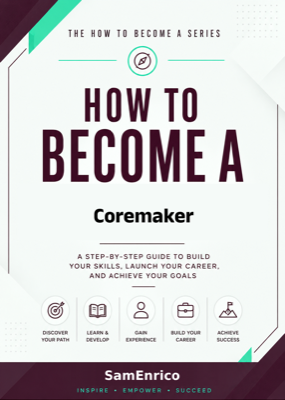
How to Become a Coremaker Paperback
How to Become a Coremaker
How to Become a Coremaker
Formats
Free sample
Chapter 1: The Invisible Bones...–- Every engine, pump, valve, and turbine that powers modern civilization contains a secret. Look at a massive diesel generator, the brake caliper on a car, or the water pump in a basement furnace. Each is a hollow shell of metal—empty inside by design. That emptiness is not an accident. It was made by a person who shaped sand into a temporary structure, placed that sand structure inside a mold, poured molten metal around it, and then destroyed the sand to reveal the finished part.
That person is a coremaker. And almost nobody knows they exist.The Hollow World Around You Consider the objects you used this morning. Your car’s engine block has internal passages for coolant and oil. Your home’s plumbing system has T-joints and elbows that are hollow all the way through. The brake rotors on your bicycle have cooling fins cast into them.
Every one of these objects required a core. Without cores, every metal part would be a solid lump. You could not have an engine—you would have a brick of iron. You could not have a pipe fitting—you would have a solid elbow-shaped paperweight. You could not have a pump—you would have a block of metal with no place for water to flow.The core is the most important part of a casting that nobody ever sees.
It is assembled into the mold, survives the brutal impact of molten metal at temperatures exceeding 2,500°F, and then is shaken out and destroyed. The coremaker’s work is literally thrown away with every finished casting. That is the paradox of this trade: the better the coremaker, the more completely their work vanishes.The Difference Between a Mold and a Core Before going any further, we need to establish a fundamental distinction. In foundry work, a mold creates the external shape of a casting. Think of a mold as the negative space around the outside of a part.
If you were casting a statue of a horse, the mold would be the hollow shape that forms the horse’s legs, torso, and head. The mold gives the part its outer boundaries.A core, by contrast, creates internal features—cavities, passages, undercuts, and complex interior geometry. That same horse statue does not need a core because it is solid. But an engine block is not solid. It has water jackets around each cylinder, oil galleries, and intake and exhaust ports.
Those hollow spaces are created by cores. A core is placed inside the mold before the metal is poured. The metal flows around the core, and when the metal solidifies, the core is removed, leaving a precise void exactly where the core used to be.This distinction matters because cores face challenges that molds do not. A mold is supported by the flask (the rigid container holding the sand) and by the surrounding mold material. A core is often suspended in mid-air inside the mold cavity, held only at its ends by core prints (recesses in the mold that support the core).
When molten metal rushes in, it tries to float, shift, or break the core. If the core moves even a fraction of an inch, the casting is scrap. If the core breaks, metal fills the void, and the internal passage becomes a solid wall. If the core vents gas poorly, the trapped gas creates blowholes in the finished casting. The core is the weak point in every casting—and the coremaker is the person who makes that weak point strong enough to survive.A Brief History of Coremaking Coremaking…
This is the end of the free sample. Get the Paperback to keep going. Buy now
About this book
Details
- Author
- Gilliam Dorene
- Publisher
- SamEnrico
- Language
- English
- ISBN
- 9781505735024
- Genre
- Non-Fiction, Informative, Educational
- Released
- 2026-05-11
- Pages (approx.)
- 130
- Available as
- eBook, Paperback, Audiobook

Read better in the ZLOADR app
Your eBooks on your phone or tablet. Sign in with your SamEnrico account and start reading.
More by Gilliam Dorene
 Overeaters Anonymous Step WorkGilliam Dorene$11.99
 Buffett's Predictive Retail TestsGilliam Dorene$11.99
 Metta for AncestorsGilliam Dorene$11.99
 Harriet Tubman Railroad RescueGilliam Dorene$11.99
 The Silent Warriors: How Female Gymnasts Secretly Shaped the 1936 OlympicsGilliam Dorene$11.99
 Franchise Tech Stack GuideGilliam Dorene$12.99
 Clutter ConsultantGilliam Dorene$11.99
 How to Produce Bowling Ball BagsGilliam Dorene$11.99
You may also like
 Hong Kong Handover 1997Dunn Johnnie$11.99
 Zumba For Postnatal Recovery CourseNeal Christian$11.99
 Zumba for BeginnersLadner Nikia$11.99
 YouTube Comment Mining GuideHumes Pandora$12.99
 Worry Box MeditationCarlin Rudy$11.99
 Workplace Stress MeditationNguyen Lynn$11.99
 Workplace Stress and Sleep RepairHawley Ivory$11.99
 Workplace Perfectionism CureDelaney Jeffry$11.99
 Workplace Injustice Anger GuideWallen Isabelle$11.99
 Work Addiction and Burnout LinkGreenwood Ester$11.99
 Women in Yoga and WellnessBeattie Galina$11.99
 Women in Stand Up ComedyChun Evangeline$11.99