
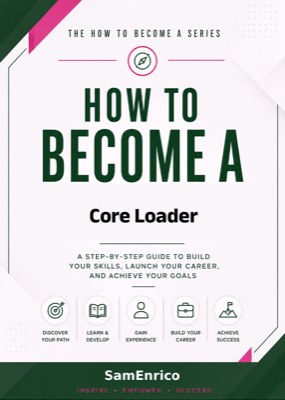
Non-FictionInformativeEducational
How to Become a Core Loader Paperback
How to Become a Core Loader
How to Become a Core Loader
Formats
Free sample
Chapter 1: The Concrete Ocean--– The first time you step onto a loading dock, you will feel insignificant. Not because the work is small—quite the opposite. You will stand at the edge of a concrete slab, forty feet wide and two hundred feet long, staring into the gaping mouth of a fifty-three-foot trailer. Behind you, a warehouse the size of four football fields hums with machinery. Above you, sodium lights buzz in the pre-dawn darkness.
And somewhere inside that trailer, waiting for you, is the first test of whether you belong in this world. The test is not about strength. It is not about speed. It is about whether you can see what others miss.The loading dock is a concrete ocean, and the trailers are ships waiting for cargo. Every day, millions of tons of freight move across these docks—food, medicine, car parts, furniture, electronics, clothing, building materials.
Without the people who load them, none of it moves. Yet the men and women who do this work are invisible to the world outside the warehouse gates. They arrive before sunrise, they leave after sunset, and in between they perform a ballet of steel, wood, and human endurance that keeps the economy breathing.This chapter is not a history lesson. It is a map of the world you are about to enter. If you want to become a core loader, you must first understand where you stand—literally and figuratively.
You must understand the landscape of industrial logistics, the difference between moving boxes and mastering the core, and the industries that will pay you a living wage to do work that cannot be outsourced to a robot. By the end of this chapter, you will see the concrete ocean for what it really is: a place of opportunity for those willing to learn its hidden geography.The Supply Chain Lie You've Been Told Most people believe the supply chain is a straight line. A factory makes something. A truck carries it to a store. You buy it.
Done. That is a lie. The real supply chain looks more like a spiderweb on caffeine. A single pallet of paper towels might travel from a mill in Wisconsin to a rail yard in Chicago, transfer to a semi-trailer bound for a distribution center in Pennsylvania, get broken down into smaller loads, reloaded onto a different trailer, and finally delivered to a grocery store in New Jersey. At every transfer point, someone loads and unloads that pallet.
And at the most critical transfer points—the distribution centers where freight is sorted, consolidated, and redirected—core loaders determine whether that pallet arrives intact, on time, or shattered into a thousand pieces.The simplified diagram that most career guides show—manufacturer → distribution center → retailer → consumer—obscures the truth. Between each arrow is a concrete dock, a forklift, and a person making split-second decisions about weight, balance, and space. That person is you, or someone you will compete against for a job. The distribution center is the heart of the supply chain, and the loading dock is its beating chamber. Every other part of logistics—procurement, inventory management, transportation planning, retail stocking—depends on the quality of the work done at that dock.Here is what the diagram does not show: the five-hour delay when a poorly loaded trailer takes twice as long to unload.
The $50,000 insurance claim when a load shifts and crushes product. The fatal accident when a loader ignored a dock lock and a trailer pulled away with a forklift inside. The supply chain is not a theory. It is a…
This is the end of the free sample. Get the Paperback to keep going. Buy now
About this book
Details
- Author
- Mackenzie Carolina
- Publisher
- SamEnrico
- Language
- English
- ISBN
- 9781505734676
- Genre
- Non-Fiction, Informative, Educational
- Released
- 2026-05-09
- Pages (approx.)
- 150
- Available as
- eBook, Paperback, Audiobook

Read better in the ZLOADR app
Your eBooks on your phone or tablet. Sign in with your SamEnrico account and start reading.
More by Mackenzie Carolina
 Stillbirth Postpartum RecoveryMackenzie Carolina$11.99
 Navigation App Anger ManagementMackenzie Carolina$11.99
 Dissociation Grounding ToolkitMackenzie Carolina$11.99
 Loving Kindness Sleep MeditationMackenzie Carolina$11.99
 Targeted Therapy For Breast CancerMackenzie Carolina$11.99
 Anticipatory Grief In PrisonMackenzie Carolina$11.99
 Influence Techniques for LawyersMackenzie Carolina$11.99
 Creative Collaboration JournalMackenzie Carolina$11.99
 The Last Flight of the Condor: Peru's Death Row Meal That Shocked a NationMackenzie Carolina$11.99
 Bladensburg’s Phantom Drums: The Haunting of the War of Spanish SuccessionMackenzie Carolina$11.99
 Dachshunds: The Sausage DogMackenzie Carolina$11.99
 How to Produce Cooking StarchMackenzie Carolina$11.99
You may also like
 Hong Kong Handover 1997Dunn Johnnie$11.99
 Zumba For Postnatal Recovery CourseNeal Christian$11.99
 Zumba for BeginnersLadner Nikia$11.99
 YouTube Comment Mining GuideHumes Pandora$12.99
 Worry Box MeditationCarlin Rudy$11.99
 Workplace Stress MeditationNguyen Lynn$11.99
 Workplace Stress and Sleep RepairHawley Ivory$11.99
 Workplace Perfectionism CureDelaney Jeffry$11.99
 Workplace Injustice Anger GuideWallen Isabelle$11.99
 Work Addiction and Burnout LinkGreenwood Ester$11.99
 Women in Yoga and WellnessBeattie Galina$11.99
 Women in Stand Up ComedyChun Evangeline$11.99