
Non-FictionInformativeEducational
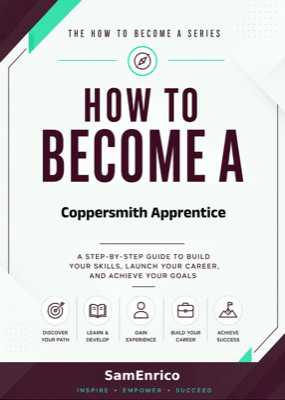
How to Become a Coppersmith Apprentice eBook
How to Become a Coppersmith Apprentice
by Spence Santo
How to Become a Coppersmith Apprentice
Formats
Free sample
Chapter 1: The Burn That Teaches--–- The first time I held a piece of copper that I had shaped with my own hands, I burned myself. Not from the metal—it had been cold for hours. I burned myself on pride. I had taken a flat, lifeless disc of reddish-brown sheet, something that looked like an oversized penny, and through nothing but hammer blows and fire, I had turned it into a bowl. A real bowl.
One that could hold water. One that would outlive me. And in that moment, standing in a dim workshop that smelled of hot metal and sweat, I understood something that no book had ever told me: copper is not a material. It is a conversation. Every hammer strike is a question.
Every anneal is a reset. And the copper always answers.This chapter is not an introduction. It is not an overview of what is to come. You will find no table of contents here, no "in this book you will learn." What you will find is the reason this trade has survived ten thousand years. You will discover why a young person in the age of automation, artificial intelligence, and global supply chains would choose to stand over a stake anvil with a hammer in hand, covered in scale and sweat, doing work that their great-great-grandparents would recognize.
And you will learn, perhaps for the first time, that the path to becoming a coppersmith apprentice begins not with a job application but with a fundamental shift in how you see the world.The Metal That Remembers Everything Let us begin with a confession. I lied to you in the preface of this book, if you read it. I said that copper is beautiful, which is true. I said it is valuable, which is also true. But I did not tell you the most important thing about copper, the thing that separates it from every other metal you might work.
Copper remembers.Steel forgets. You can bend steel, heat it, quench it, and it becomes whatever you demand. It has no opinion about its shape. Aluminum is even more accommodating—soft, forgiving, eager to please. But copper?
Copper has a memory. When you hammer it, the crystalline structure inside the metal compresses. Dislocations form, stacking up like cars in a traffic jam. The metal grows harder, more brittle, more resistant to further change. If you ignore this—if you keep hammering past the point of reason—the copper will crack.
Not tear like paper. Not snap like a twig. It will split along a grain boundary, opening a hairline fracture that ruins hours of work in an instant. And here is the thing the books do not tell you: that crack is not a mistake. It is the copper telling you that you were not listening.This property is called work hardening, and it will become the central fact of your life as a coppersmith.
Every blow of your hammer stiffens the metal. Every curve you create brings you closer to the limit. And then, just when the copper is about to break, you must do something counterintuitive: you must put it into the fire.Annealing is the process of heating copper until its internal structure resets. At approximately 1,400 degrees Fahrenheit, the copper glows a dull cherry red—not bright like the sun, but deep and ominous, like the last ember of a dying campfire. The dislocations vanish.
The grain boundaries reform. The metal becomes soft again, as malleable as wet clay. And then you quench it, plunging it into water or pickle solution, and the copper remembers nothing. It has forgotten every hammer blow. It is a blank slate, ready to be shaped again.There is a lesson here that has nothing to do with metal.
You will fail as an apprentice. You will crack your first bowl. You will overheat your first brazing joint. You will set your bench on fire—I did, twice. But unlike steel, which holds onto every mistake in permanent deformation, you get to anneal.
You get to put yourself back into the fire, reset your crystal structure, and start again. The coppersmith who never fails is the coppersmith who never tries anything difficult. The good ones? They have been annealed a thousand times.Why Copper? Why Now?If you are reading this book, someone has probably asked you why.
Why coppersmithing? Why not welding, plumbing, electrical work, or any of the other trades that offer steady pay and clear advancement? It is a fair question, and you deserve an honest answer.Coppersmithing occupies a strange and wonderful position in the world of skilled trades. It is too specialized for most vocational schools to teach. It is too physical for many white-collar refugees to attempt.
And it is too beautiful for industrial efficiency to fully replace. The result is a trade that exists in the cracks of the modern economy—small shops, custom fabricators, historic preservationists, and craft artisans who have discovered that the world is hungry for things made by hand.Consider the craft distilling boom. In the last fifteen years, the number of distilleries in the United States has grown from fewer than one hundred to over two thousand. Every one of those distilleries needs copper. The stills themselves?
Copper, because copper removes sulfides during distillation, producing a smoother spirit. The condensers? Copper. The transfer pipes? Copper.
And here is the secret that the big equipment manufacturers do not want you to know: custom copper work is expensive to order and even more expensive to repair. A coppersmith who understands distillery equipment can name their price.Or consider architecture. Copper roofing has existed for millennia, but the demand for custom copper gutters, downspouts, dormers, and decorative elements has exploded in the last twenty years. Wealthy homeowners want range hoods that look like they belong in a French chateau. Restaurants want bar tops that will develop a living patina over decades of use.
Historic buildings need craftsmen who can replicate the exact profile of a 19th-century cornice. These are not jobs for sheet metal workers who can only bend standardized profiles. These are jobs for coppersmiths.And then there is cookware. For most of human history, if you wanted a pot, you found a coppersmith. Then came cast iron, then aluminum, then Teflon, then stainless steel, each new technology promising to make the previous one obsolete.
But copper cookware never went away, because copper does something no other metal can do: it responds instantly to heat. Turn the flame up, and a copper pot heats across its entire surface in seconds, not minutes. Turn the flame down, and it cools just as fast. This is why professional chefs pay five hundred dollars for a single copper saucepan. This is why the French company Mauviel has been in business since 1830.The apprentices who enter this trade today are not competing against robots or overseas factories.
They are competing against a dwindling population of aging craftsmen who learned their skills in a different century. The average age of a master coppersmith in the United States is fifty-eight. In the United Kingdom, it is sixty-two. Within fifteen years, half of…
This is the end of the free sample. Get the eBook to keep going. Buy now
About this book
Details
- Author
- Spence Santo
- Publisher
- SamEnrico
- Language
- English
- ISBN
- 9781505734331
- Genre
- Non-Fiction, Informative, Educational
- Released
- 2026-05-06
- Pages (approx.)
- 134
- Available as
- eBook, Paperback, Audiobook

Read better in the ZLOADR app
Your eBooks on your phone or tablet. Sign in with your SamEnrico account and start reading.
More by Spence Santo
 The Suicide Concern TalkSpence Santo$11.99
 Customer Loyalty MappingSpence Santo$11.99
 Bipolar Wellness Recovery PlanSpence Santo$11.99
 The Protein Intake MetabolismSpence Santo$11.99
 Medication For Parental IrritabilitySpence Santo$11.99
 Improv for Social WorkersSpence Santo$11.99
 Gratitude for LeadersSpence Santo$11.99
 Public Speaking for Audiobook NarratorsSpence Santo$11.99
 The Timbuktu Codex: Shadows of the Golden ScholarsSpence Santo$11.99
 The Nautical Odyssey of John Cabot: Charting the New WorldSpence Santo$11.99
 How to Produce Outdoor LightingSpence Santo$11.99
 How to Produce Computer System Cooling PartsSpence Santo$11.99
You may also like
 Hong Kong Handover 1997Dunn Johnnie$11.99
 Zumba For Postnatal Recovery CourseNeal Christian$11.99
 Zumba for BeginnersLadner Nikia$11.99
 YouTube Comment Mining GuideHumes Pandora$12.99
 Worry Box MeditationCarlin Rudy$11.99
 Workplace Stress MeditationNguyen Lynn$11.99
 Workplace Stress and Sleep RepairHawley Ivory$11.99
 Workplace Perfectionism CureDelaney Jeffry$11.99
 Workplace Injustice Anger GuideWallen Isabelle$11.99
 Work Addiction and Burnout LinkGreenwood Ester$11.99
 Women in Yoga and WellnessBeattie Galina$11.99
 Women in Stand Up ComedyChun Evangeline$11.99