
Non-FictionInformativeEducational
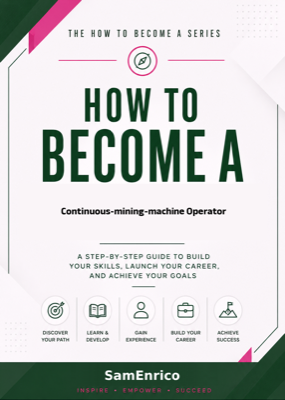
How to Become a Continuous-mining-machine Operator eBook
How to Become a Continuous-mining-machine Operator
How to Become a Continuous-mining-machine Operator
Formats
Free sample
Chapter 1: The Coal-Black Mirror...--The first time you hear a continuous miner chew into a coal seam, you will feel it in your sternum before your ears register the sound. The machine does not roar like a surface bulldozer or scream like a highway truck. It grinds—a low, gut-level vibration that travels up through the floor of the mine, through the soles of your steel-toed boots, and settles somewhere behind your ribs. That vibration is the heartbeat of underground mining. And the question this chapter answers is not whether you can learn to pull the right levers.
Anyone can learn levers. The question is whether you have the wiring—the psychological architecture—to sit in that operator's cab for twelve hours while the roof creaks above you, methane lurks in the next cut, and eight other men depend on you not to panic.This chapter is not about machinery. It is not about regulations or geology or the difference between a conical bit and a ripper tooth. Those come later. This chapter is about the space between your ears.
The mining industry has a saying, as old as the company scrip and twice as true: "You can teach a monkey to pull a lever. You cannot teach a monkey to stay calm when the mountain starts talking."We are going to build your psychological foundation brick by brick. By the end of this chapter, you will know, with uncomfortable honesty, whether you belong underground. And if you do belong, you will know exactly which mental habits will keep you alive and which ones will get you—or someone else—killed.The Near-Miss That Never Made the News Let me tell you about a man named Dale. I worked with Dale in southern West Virginia in the early 2000s.
Dale was forty-three years old, had been running a continuous miner for nineteen years, and had the kind of quiet confidence that made new hires assume he was either a genius or insane. He wasn't either. He was just a man who had learned to listen.One Tuesday afternoon, Dale was sumping the head into a longwall development section about two thousand feet from the portal. The coal was good—thick seam, low ash, no partings to speak of. The roof bolts had tested solid during the pre-shift inspection.
Dale had his left hand on the tram lever and his right hand resting on the water spray control. The scrubber was pulling dust away from his cab. Everything was textbook.Then Dale stopped.He didn't stop because the methane alarm went off. It hadn't. He didn't stop because he saw something wrong with the cutter head.
He hadn't. He stopped because he heard something that the nineteen-year-old version of him would have dismissed as nothing. The roof bolts—the long steel rods drilled into the ceiling every four feet—were not popping. They were not snapping or groaning. They were ticking.
A faint, metallic tick-tick-tick that Dale later described as "like a cheap wristwatch under a pillow."Dale killed the machine. He called "Roof check, face clear" on the radio. The roof bolter operator, a kid named Tyson who had been underground for eleven months, asked what was wrong. Dale said, "Nothing yet. Back your machine out.
We're leaving this section."Tyson hesitated. Production was ahead of schedule. The section foreman, who was not at the face but listening on the radio, came on and asked Dale to explain. Dale didn't explain. He said, "I'm pulling the crew.
Send the gas team down if you want, but I'm not cutting another foot until someone tells me why those bolts are ticking."The foreman was angry. Dale didn't care. He had the legal right to refuse unsafe work under the Mine Act, and he had used that right three times in his career. Every time, he had been proven correct. Every time, the foreman had apologized later.
This time, the foreman did not apologize, because twenty minutes after Dale pulled the crew out, a section of roof the size of a pickup truck collapsed exactly where the continuous miner had been cutting. The ticking bolts had been the sound of steel rods straining against shifting rock. If Dale had ignored the sound, if he had prioritized production over caution, the machine would have been destroyed. More importantly, Tyson the roof bolter would have been standing directly under that section of roof.Dale did not save the machine. The mine had insurance.
Dale saved a twenty-two-year-old kid who had a pregnant wife at home. And he did it because he had trained himself to listen—not just to alarms and warnings, but to the subtle, easy-to-ignore signals that the mine was speaking.That is the psychological profile of a continuous-mining-machine operator. Not a daredevil. Not a speed demon. A listener.The Three Pillars of the Underground Mind Over the course of researching this book, I interviewed forty-seven veteran CMOs, twenty-three mine superintendents, and a dozen safety trainers.
I asked them a single question: "What psychological trait separates the operators you trust from the ones you watch?" Their answers varied in wording but converged on three core attributes. I call them the Three Pillars of the Underground Mind.Pillar One: Stress Tolerance with Cautiousness, Not Recklessness The mining industry has a destructive myth that the best operators are the ones who "don't scare easy." This is wrong. The best operators scare at the right time and in the right way. They are not fearless; they are selectively fearful. They have learned to distinguish between background discomfort—the normal sounds of a machine working, the normal creak of rock settling—and genuine warning signals.Stress tolerance does not mean ignoring your fight-or-flight response.
It means training that response to activate only when actual danger is present. A CMO experiences dozens of minor stressors every shift: a hydraulic hose that feels slightly too hot, a shuttle car that takes three seconds longer than usual to return, a methane reading that flickers from 0.2% to 0.4% and back down. The operator who panics at every flicker will be exhausted by hour four and useless by hour eight. The operator who ignores every flicker will eventually ignore a real spike.The sweet spot is what psychologists call "calibrated vigilance." You maintain a low, steady baseline of alertness—not relaxed, not hypervigilant, but tuned. And when a signal breaks through that baseline, you respond immediately and methodically, without hesitation and without drama.A self-assessment tool: Think about how you react when something unexpected happens in your daily life.
Do you freeze? Do you rush? Do you get angry? Or do you stop, assess, and act? The third response is the only one that works underground.Pillar Two: Situational Awareness as a Group Sport Above ground, situational awareness is mostly about your own safety.
You watch where you walk. You check your blind spot before changing lanes. You notice the broken step on the staircase. Underground, situational awareness is communal. You are not just tracking your own position and hazards.
You are tracking the positions of eight to twelve other people, plus two or three pieces of moving equipment, plus the ventilation…
This is the end of the free sample. Get the eBook to keep going. Buy now
About this book
Details
- Author
- Winston Corrina
- Publisher
- SamEnrico
- Language
- English
- ISBN
- 9781505808452
- Genre
- Non-Fiction, Informative, Educational
- Released
- 2026-05-04
- Pages (approx.)
- 142
- Available as
- eBook, Paperback, Audiobook

Read better in the ZLOADR app
Your eBooks on your phone or tablet. Sign in with your SamEnrico account and start reading.
More by Winston Corrina
 Dairy Free Living GuideWinston Corrina$11.99
 U 505 Capture StoryWinston Corrina$11.99
 Anger for Social WorkersWinston Corrina$11.99
 Work Addiction Triggers GuideWinston Corrina$11.99
 The Logistics Tech Capital GuideWinston Corrina$11.99
 The Warrior's Mind: How 18th-Century African Warriors Mastered Mental ToughnessWinston Corrina$11.99
 Understanding Spondyloepiphyseal Dysplasia, Congenital TypeWinston Corrina$17.99
 Assistant FormationWinston Corrina$11.99
 HRV Monitoring Micro BreaksWinston Corrina$12.99
 Cooperative Governance GuideWinston Corrina$12.99
You may also like
 Hong Kong Handover 1997Dunn Johnnie$11.99
 Zumba For Postnatal Recovery CourseNeal Christian$11.99
 Zumba for BeginnersLadner Nikia$11.99
 YouTube Comment Mining GuideHumes Pandora$12.99
 Worry Box MeditationCarlin Rudy$11.99
 Workplace Stress MeditationNguyen Lynn$11.99
 Workplace Stress and Sleep RepairHawley Ivory$11.99
 Workplace Perfectionism CureDelaney Jeffry$11.99
 Workplace Injustice Anger GuideWallen Isabelle$11.99
 Work Addiction and Burnout LinkGreenwood Ester$11.99
 Women in Yoga and WellnessBeattie Galina$11.99
 Women in Stand Up ComedyChun Evangeline$11.99