
Non-FictionInformativeEducational
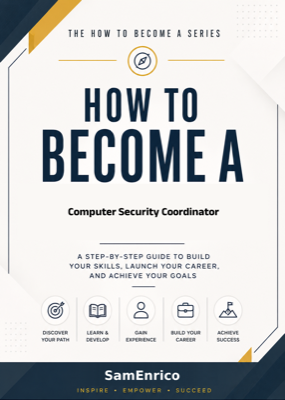
How to Become a Computer Security Coordinator eBook
How to Become a Computer Security Coordinator
by Marin Nilsa
How to Become a Computer Security Coordinator
Formats
Free sample
Chapter 1: The Conductor's Baton--Every cybersecurity job posting looks the same until you learn to read the fear between the lines.You have seen them. "Security Analyst – must monitor SIEM, respond to alerts, work nights." "Network Security Engineer – configure firewalls, manage VPNs, hunt threats." "CISO – ten years of management experience, budget oversight, board presentations." Each one promises a clear box to fit into, a ladder to climb, a tribe to join.Then there is the other posting. The one that confuses you. The one that reads like someone took a security analyst, a project manager, a policy writer, and a diplomat, threw them into a blender, and hoped for the best."Computer Security Coordinator – coordinate security activities across departments. Facilitate risk assessments.
Assist with policy development. Communicate findings to leadership. Liaise between IT and business units. Five years of experience preferred. Must be able to explain technical concepts to non-technical audiences.
Must remain calm under pressure. Must be comfortable with ambiguity."You read it twice. Three times. You have no idea what this job actually does all day. And that uncertainty is exactly why this role is the single most overlooked, underappreciated, and fastest-growing opportunity in cybersecurity today.This book exists because no one has written the playbook for you.
The analysts have their intrusion detection manuals. The engineers have their firewall configuration guides. The CISOs have their boardroom strategy bibles. But the Coordinator—the person who sits at the messy intersection of technology, policy, and human beings—has been left to figure it out alone, learning through painful mistakes, awkward silences, and the occasional public failure.That ends now.The Job That Should Not Exist (But Absolutely Does)Let me tell you about Marcus. (All names in this book are changed, but the stories are real.)Marcus was thirty-one years old when he took his first Coordinator role at a regional bank with twelve hundred employees.
He had spent four years as a help desk technician, two years as a junior network administrator, and six months as a security analyst at a managed service provider. By any objective measure, he was qualified. He held a Security+ certification. He could read a packet capture. He knew what ransomware looked like.On his first day, his new boss—the CISO, a woman named Diane who had been in security since the days of dial-up modems—sat him down and said something that terrified him."Marcus, I do not expect you to fix anything.
I expect you to make sure the right people fix things. And I expect you to tell me when they are not going to fix things, and why, and what it will cost us."Marcus nodded. He thought he understood.Three weeks later, the bank's vulnerability scanner reported a critical finding: an internet-facing server running a version of Apache with a known remote code execution exploit. The server belonged to the online banking team. Marcus opened a ticket.
He sent an email. He waited.Nothing happened.He sent a second email. He got a reply: "We'll look at it during next month's patch window."Marcus knew that was too long. An exploit for this vulnerability was already circulating on Git Hub. He escalated to his boss.
Diane asked him one question: "Did you quantify the risk?"He had not. He had only described it. "Critical. High severity. Remote code execution." Those words meant something to him, but they meant almost nothing to the online banking team, whose priority was feature releases, not security patches.Marcus spent the next afternoon learning how to translate technical severity into business impact.
He calculated that the server processed approximately two million dollars in transactions daily. A successful exploit could lead to a three-day outage based on industry recovery averages. Three days of lost transactions equaled six million dollars in direct revenue impact, not including regulatory fines and customer churn. He put that number in an email.The server was patched within four hours.That story is not about vulnerability management, though you will learn plenty about that in Chapter 8. That story is about the fundamental truth of the Coordinator role: you have no direct authority, but you have the power of translation.
Your job is not to turn the wrench. Your job is to explain, in terms that matter to each person you speak with, why the wrench needs turning and what happens if it stays still.Why "Coordinator" Is the Most Misunderstood Title in Security The word "coordinator" is a curse and a gift. It is a curse because it sounds administrative, assistant-like, and secondary. When you tell people you are a Computer Security Coordinator, some will hear "paperwork." Some will hear "meeting scheduler." Some will hear "the person who takes notes while the real security people talk."The gift is that no one knows what to expect from you, which means you get to define the role yourself.Let us be brutally honest about what this job is not.You are not a security analyst. The analyst sits inside the Security Operations Center, staring at dashboards, triaging alerts, and hunting for indicators of compromise.
The analyst lives in a world of yes/no, malicious/benign, block/allow. Their success is measured in mean time to detect and mean time to respond. A great analyst can tell you exactly what happened, when it happened, and which registry key was modified at 3:14 AM. You need to understand their work, respect their craft, and translate their findings upward. But you do not need to be them.You are not a security engineer.
The engineer builds and maintains the infrastructure: firewalls, intrusion prevention systems, endpoint detection agents, identity management platforms. The engineer lives in a world of configuration files, rule sets, and uptime percentages. Their success is measured in system availability and false positive rates. A great engineer can tell you exactly how to block a specific attack vector without breaking legitimate traffic. You need to speak their language well enough to request changes without sounding ignorant.
But you do not need to configure the firewall yourself.You are not a security manager. The manager has direct reports, conducts performance reviews, approves time off, and fights for headcount. Their success is measured in team retention, project completion, and budget adherence. A great manager can tell you exactly how to motivate an exhausted analyst or mediate a conflict between engineering and compliance. You may become a manager someday, but that is a different skill set with different responsibilities.
If you have direct reports, you are not primarily a Coordinator anymore.You are not the CISO. The Chief Information Security Officer owns the program. They set strategy, present to the board, manage the annual budget, and ultimately take the blame when things go wrong. Their success is measured in risk reduction, regulatory compliance, and insurance premiums. A great CISO can tell you exactly how to frame security as a business enabler rather than a cost center.
You will report to them or someone like them. But you are not them.So what are you?You are the conductor of an orchestra that does not know it is playing together.The violin section (IT operations) plays its own music. The brass…
This is the end of the free sample. Get the eBook to keep going. Buy now
About this book
Details
- Author
- Marin Nilsa
- Publisher
- SamEnrico
- Language
- English
- ISBN
- 9781505805321
- Genre
- Non-Fiction, Informative, Educational
- Released
- 2026-06-02
- Pages (approx.)
- 139
- Available as
- eBook, Paperback, Audiobook

Read better in the ZLOADR app
Your eBooks on your phone or tablet. Sign in with your SamEnrico account and start reading.
More by Marin Nilsa
 The Caregiver Self Compassion WorkbookMarin Nilsa$11.99
 Feeling Disrespected Trigger WorkbookMarin Nilsa$11.99
 Fertility and Alcohol GuideMarin Nilsa$11.99
 The Childhood Nightmare Replay GuideMarin Nilsa$11.99
 Anger at News and MediaMarin Nilsa$11.99
 Ironclads at Hampton Roads: The Birth of Modern Naval WarfareMarin Nilsa$11.99
 Understanding Oculodigitoesophagoduodenal SyndromeMarin Nilsa$17.99
 Business Insights ManagerMarin Nilsa$11.99
 Chinese Student Health Check GuideMarin Nilsa$12.99
 AbbVie SWOT AnalysisMarin Nilsa$12.99
You may also like
 Hong Kong Handover 1997Dunn Johnnie$11.99
 Zumba For Postnatal Recovery CourseNeal Christian$11.99
 Zumba for BeginnersLadner Nikia$11.99
 YouTube Comment Mining GuideHumes Pandora$12.99
 Worry Box MeditationCarlin Rudy$11.99
 Workplace Stress MeditationNguyen Lynn$11.99
 Workplace Stress and Sleep RepairHawley Ivory$11.99
 Workplace Perfectionism CureDelaney Jeffry$11.99
 Workplace Injustice Anger GuideWallen Isabelle$11.99
 Work Addiction and Burnout LinkGreenwood Ester$11.99
 Women in Yoga and WellnessBeattie Galina$11.99
 Women in Stand Up ComedyChun Evangeline$11.99