
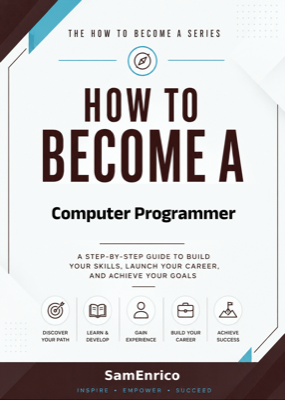
How to Become a Computer Programmer eBook
How to Become a Computer Programmer
How to Become a Computer Programmer
Formats
Free sample
Chapter 1: The Broken First Line...--–- Every aspiring programmer has written "Hello, World." It is the most lied-about sentence in the history of technical education. That simple print statement, that harmless little greeting, has convinced millions of people that they know how to program when in reality they have learned absolutely nothing except how to copy-paste from a tutorial. The cruel joke of "Hello, World" is that it works perfectly every single time. It never crashes. It never throws an exception. It never reveals the one truth that separates people who actually become programmers from people who collect certificates: programming is the art of gracefully handling things that go wrong, not celebrating things that go right.If you have ever typed print("Hello, World") and felt a tiny rush of accomplishment, you have been misled. You did not learn to program. You learned to operate a keyboard while following instructions. The real first line of code you should ever write is not a greeting. It is a scream. It is something broken, something that refuses to run, something that forces you to stare at a red error message and figure out what the machine is actually trying to tell you. This chapter is called The Broken First Line because your journey to becoming a computer programmer begins not with success, but with a beautiful, educational, humiliating failure.The Cult of Passive Learning You have been trained by the modern internet to consume information. You watch You Tube tutorials where someone types magically and everything works on the first try. You read Medium articles with neat code blocks that execute perfectly in the author's controlled environment. You take Coursera courses where the autograder tells you exactly what is wrong and often gives you the answer. This is passive learning, and it is a cult. The cult's high priests are influencers with perfect lighting and curated Git Hub repositories. The cult's sacred text is the "copy-paste this snippet" blog post. And you have been paying dues with your attention, your time, and your self-confidence.The dirty secret that no tutorial will tell you is that professional programmers spend between forty and sixty percent of their time debugging—staring at something that does not work, trying to understand why. The remaining time is spent reading documentation, arguing about naming conventions, and wondering why the deployment pipeline is red. The actual act of typing new code that works on the first try is so rare that when it happens, experienced developers become suspicious. Something is wrong. They missed a test. They forgot an edge case. The computer is lying.This chapter is an intervention. It will break you of the passive learning addiction by forcing you to do something uncomfortable: you will write code that fails on purpose, and you will learn to love the error message. By the time you finish this chapter, you will have internalized the single most important meta-skill in programming—not memorizing syntax, but learning how to learn when nothing makes sense.The XY Problem: Why You Keep Asking the Wrong Questions Before we write a single line of code, we must address the single biggest waste of time in every beginner's journey: asking for help incorrectly. The XY Problem is a communication failure so common that it has its own name in every engineering organization. It works like this. You want to accomplish X. You do not know how to do X directly, so you figure out a method Y that you think will get you to X. When Y does not work, you ask for help with Y. The people trying to help you spend hours debugging Y, only to discover that Y was never the right approach, and X could have been solved in five minutes with a completely different method.Here is a real example from a programming forum. A beginner asked, "How do I remove the last three characters from every string in a list using a loop?" Several people provided complex loop solutions. One person spent twenty minutes writing a detailed explanation of list mutation during iteration. Finally, someone asked, "What are you actually trying to do?" The beginner replied, "I have a list of filenames that end with '.txt' and I want to remove the extension." The room went silent. The correct answer was os.path.splitext() or str.replace('.txt', '') or even a simple slice if the extension length was consistent. The entire loop conversation was irrelevant because the beginner had skipped the step of stating the actual problem.The XY Problem is not a technical failure. It is a failure of problem decomposition—the skill of breaking a vague, messy situation into atomic, solvable pieces. Every time you find yourself typing a question into Stack Overflow or Chat GPT, stop. Ask yourself: "Am I asking about my actual goal X, or am I asking about my attempted solution Y?" If the answer is Y, delete the question and start over. State X. You will be shocked how often the solution becomes obvious the moment you articulate the real problem.How to Read an Error Message Like a Detective Most beginners see a red error message and feel a spike of cortisol. Their heart rate increases. They scroll past the error as fast as possible, looking for the one line of code they understand. This is exactly backwards. The error message is not your enemy. It is the most honest documentation you will ever receive. The computer is not being mean. It is telling you, with perfect precision, exactly what rule you violated. The problem is that you have not learned to read the language of errors.Let us dissect a real Python error message:text Copy Download Traceback (most recent call last):
File "calculator.py", line 5, in result = divide(10, 0) File "calculator.py", line 2, in divide return a / b Zero Division Error: division by zero This message contains four distinct pieces of information, each one critical. First, the traceback shows you the call stack—the chain of function calls that led to the crash. Read it from top to bottom. The last line is where the program died, but the lines above show you how it got there. Second, the file name and line number tell you exactly where to look. Third, the code snippet shows you the specific line that failed. Fourth, the exception type and message tell you what rule was broken. In this case, Zero Division Error means you asked the computer to do something mathematically impossible.The detective method for error messages has three steps. Step one: read the exception type and message first, not last. That is the conclusion of the investigation. Step two: trace the call stack backward from the bottom to understand the journey. Step three: look at the line of code that failed and ask "What assumptions did I make that the computer did not share?" In the division example, the assumption was that b would never be zero. The computer does not make assumptions. It executes exactly what you wrote, not what you meant.Here is your first exercise. Write a Python script that intentionally causes three different…
This is the end of the free sample. Get the eBook to keep going. Buy now
About this book
Details
- Author
- Beavers Ouida
- Publisher
- SamEnrico
- Language
- English
- ISBN
- 9781505805307
- Genre
- Non-Fiction, Informative, Educational
- Released
- 2026-04-25
- Pages (approx.)
- 116
- Available as
- eBook, Paperback, Audiobook

Read better in the ZLOADR app
Your eBooks on your phone or tablet. Sign in with your SamEnrico account and start reading.
More by Beavers Ouida
 Caregiver Burnout In TBI RecoveryBeavers Ouida$11.99
 Daily Affirmation Practice GuideBeavers Ouida$11.99
 Fertility and Caffeine GuideBeavers Ouida$11.99
 Cognitive Restructuring for Social Media RageBeavers Ouida$11.99
 Falling Dream Rescripting MethodBeavers Ouida$11.99
 The Vanishing of Hans-Jürgen Massmann: Germany's First Ransomware VictimBeavers Ouida$11.99
 Understanding Oculo-gastrointestinal Muscular DystrophyBeavers Ouida$17.99
 Studying Law in China GuideBeavers Ouida$12.99
 Novartis SWOT GuideBeavers Ouida$12.99
 Business Unit ControllerBeavers Ouida$11.99