
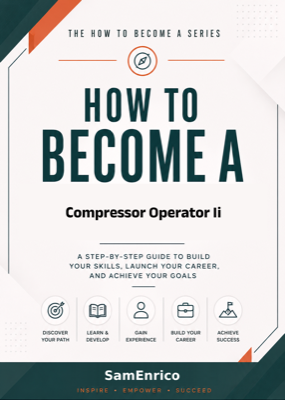
How to Become a Compressor Operator Ii eBook
How to Become a Compressor Operator Ii
by Doran Yuko
How to Become a Compressor Operator Ii
Formats
Free sample
Chapter 1: Beyond the Button--–- The first time a compressor trips in the middle of a night shift, most operators react the same way. They check the obvious—pressure, temperature, amperage—and when nothing looks immediately wrong, they hit the reset button and hope the machine stays running. That is a Level One response. It is not wrong, but it is incomplete. A Level One operator keeps the equipment running.
A Level Two operator keeps the plant profitable, safe, and predictable. The difference between those two statements is the difference between being a competent technician and being an irreplaceable asset.–- This book exists because that difference matters. Compressors are not glamorous machines. They do not attract attention like turbines or generate excitement like reactors. But in refineries, chemical plants, natural gas transmission stations, manufacturing facilities, and food processing plants, the compressor is often the single point of failure that can shut down an entire operation.
When a compressor stops, everything downstream stops. And when everything stops, money leaves the building at a staggering rate.–- Consider a mid-sized refinery processing fifty thousand barrels of crude oil per day. A hydrogen compressor failure might cost that facility $50,000 per hour in lost production, plus the cost of repairs, plus the safety risks of an unplanned shutdown, plus the regulatory consequences if the shutdown triggers a flare event or an emission exceedance. That is not an abstract number. That is a call to the plant manager at two in the morning.
That is an explanation to corporate leadership the next morning. That is a career-defining moment for the operator who was on shift.–- The question is not whether something will fail. The question is whether you will see it coming. And that is what distinguishes a Level Two operator from everyone else.The Mindset Shift That Changes Everything–- Most training programs teach operators how to start compressors, stop compressors, log readings, and respond to alarms. That is necessary, but it is not sufficient.
Those skills make you a Level One operator—someone who can follow procedures and keep the machine running under normal conditions. A Level Two operator does something fundamentally different. Instead of reacting to events, you anticipate them. Instead of responding to alarms, you understand the conditions that create alarms before they arrive. Instead of seeing individual components, you see a system where every pressure reading, every temperature trend, and every vibration spike tells a story about what is happening inside the machine.–- This mindset shift has four pillars.
First, systemic thinking—understanding that the compressor does not exist in isolation but as part of a network of pipes, valves, vessels, and processes that all interact. Second, economic awareness—knowing that every decision you make has a dollar value attached, from the cost of a premature shutdown to the savings from optimized capacity control. Third, predictive vigilance—not just logging data but knowing which data points predict which failures. Fourth, regulatory responsibility—understanding that your actions affect not just production but environmental compliance, worker safety, and legal liability.–- Let me give you a concrete example. A Level One operator sees a small increase in discharge temperature over three days.
The temperature is still within the alarm limit, so the operator notes it in the log and moves on. A Level Two operator sees the same trend and asks: Why is the temperature rising? Is the suction filter loading up? Is a cylinder valve leaking? Is the cooling water flow decreasing?
Is the compressor running too close to surge? The Level Two operator investigates the cause of the trend, not just the fact of it. And that investigation often catches a developing failure before it becomes catastrophic.–- That is the essence of this book. We will spend twelve chapters building your knowledge of compressor architecture, control systems, lubrication, vibration analysis, troubleshooting, safety procedures, energy optimization, maintenance planning, and leadership communication. But none of that technical knowledge will make you a Level Two operator if you do not first adopt the mindset that active, curious, systemic thinking is the foundation of everything else.The True Cost of Downtime–- To understand why the Level Two mindset matters, you need to understand what is at stake.
Downtime is not an inconvenience. It is a financial event with consequences that ripple through the entire organization.–- Let us break down the real cost of a compressor failure. First, direct lost production. If your compressor supplies air to a packaging line that runs at 500 units per minute, each minute of downtime costs the gross profit margin on those 500 units. For a natural gas compressor moving ten million cubic feet per day, a twelve-hour outage means five million cubic feet of gas that cannot be sold.
For a refrigeration compressor in a cold storage warehouse, a failure means product temperature rise and potential spoilage.–- Second, repair costs. Emergency repairs are always more expensive than planned maintenance. Parts that could have been ordered at standard cost now require expedited shipping. Mechanics who could have been scheduled during a planned outage now work overtime or weekend rates. And if the failure caused collateral damage—a broken valve that damages a cylinder head, a bearing failure that scars a shaft—the repair bill multiplies quickly.–- Third, safety and environmental costs.
Unplanned shutdowns often involve emergency depressurization, which may mean flaring gas, venting refrigerants, or releasing stored energy in uncontrolled ways. Each of those events carries risk of injury, regulatory fines, and reputational damage. A single reportable incident can trigger an OSHA inspection that shuts down the plant for weeks.–- Fourth, secondary effects. When a compressor fails, other equipment may be affected. A surge event in a centrifugal compressor can send pressure waves back through upstream filters and forward through downstream vessels.
A lubrication failure in a reciprocating compressor can contaminate an entire process gas stream. These secondary failures extend downtime and increase cost.–- A manufacturing plant I consulted for had a rotary screw compressor that supplied instrument air to the entire facility. The compressor was old, and the operator had noted rising discharge temperatures for two weeks but did not report them because no alarm had activated. One night, the high-temperature shutdown tripped. By the time maintenance responded, the failure had progressed to the point where the air end was destroyed.
The repair cost 40,000.Thelostproductioncost40,000. The lost production cost 40,000.Thelostproductioncost120,000. The operator was not fired, but he was moved back to a Level One role. The plant manager told me later: "He knew something was wrong. He just didn't act."–- Do not be that operator.
Know the cost of downtime at your facility. Ask your supervisor what the lost production value is per hour, per shift, per day. Write it down. Remember it. That number is not just a metric.
It is the justification for everything you do as a Level Two operator.Regulatory Frameworks You Must Know–- Ignorance of regulations is not a defense. It is a liability. As a Level Two operator, you are expected to know the rules that govern your equipment, not because you are a lawyer but because your actions determine whether your employer stays…
This is the end of the free sample. Get the eBook to keep going. Buy now
About this book
Details
- Author
- Doran Yuko
- Publisher
- SamEnrico
- Language
- English
- ISBN
- 9781505805253
- Genre
- Non-Fiction, Informative, Educational
- Released
- 2026-05-02
- Pages (approx.)
- 130
- Available as
- eBook, Paperback, Audiobook

Read better in the ZLOADR app
Your eBooks on your phone or tablet. Sign in with your SamEnrico account and start reading.
More by Doran Yuko
 Self Talk For Confidence WorkbookDoran Yuko$11.99
 Anger at Long Lines CognitiveDoran Yuko$11.99
 The Medication Management BurdenDoran Yuko$11.99
 Fertility and Sleep QualityDoran Yuko$11.99
 Naked in Public Nightmare WorkDoran Yuko$11.99
 Xochiquetzal and Tezcatlipoca: The Flower and the Smoking MirrorDoran Yuko$11.99
 Understanding Oculomelic AmyoplasiaDoran Yuko$17.99
 Celsian MiningDoran Yuko$11.99
 Studying Computer Science in ChinaDoran Yuko$12.99
 AstraZeneca SWOTDoran Yuko$12.99