
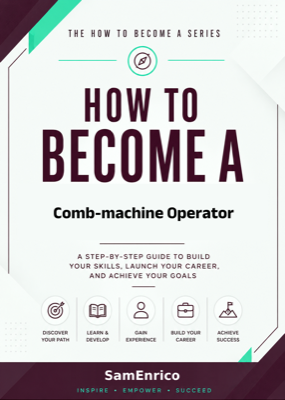
How to Become a Comb-machine Operator eBook
How to Become a Comb-machine Operator
How to Become a Comb-machine Operator
Formats
Free sample
Chapter 1: The Hidden Economy--–- The first time I saw a combing machine up close, I almost walked out. It was 2003, and I had just been hired at a medium-sized textile mill in the southeastern United States—one of the last holdouts in a region that had once been the cotton capital of the world. The machine was easily forty feet long, painted a faded green that had yellowed around the edges, and it was making a sound I can only describe as a mechanical heartbeat crossed with a freight train. My trainer, a woman named Dottie who had been running combing machines since the Carter administration, looked at me over her safety glasses and said, "You gonna stand there with your mouth open, or you gonna learn something that'll feed your family for thirty years?"I learned something.That something is what this book is about. But before we get into nipper timing, noil percentages, and detaching roller settings—before we name a single part or run a single production calculation—I need to tell you why this book exists and why you, right now, holding it or scrolling through it, have stumbled onto one of the most underrated, undersupplied, and overpaid blue-collar careers in modern manufacturing.The combing machine operator is a ghost in the global economy.
Nobody writes songs about us. Nobody makes movies where the hero saves the day by adjusting circular comb penetration. But here is the truth that the top ten textile training books all whisper in their dry, technical language: without combing machine operators, there are no crisp white dress shirts, no high-thread-count hotel sheets, no sewing thread that holds your jeans together, no tire cord that keeps your car on the road at seventy miles per hour, and no medical gauze that stops bleeding in an operating room.Combing is where fiber becomes fabric worth wearing. And combing machine operators are the priests of that transformation.This chapter is not a technical manual. It is a map.
It will show you where combing fits in the vast, humming ecosystem of textile manufacturing. It will clarify who does what on the mill floor—because one of the biggest sources of confusion for new hires is the blurry line between operators, setup technicians, and maintenance crews. And it will lay out, in plain English, exactly what this book will teach you and what it will not.By the end of this chapter, you will understand why a skilled combing machine operator is worth more per hour than many entry-level engineers. And more importantly, you will know whether this path is for you.The Great Invisible Industry Let me start with a number that will shock you: the global textile and apparel industry is worth nearly one trillion dollars annually. That is larger than the GDP of most countries.
It employs more than sixty million people worldwide. And yet, when most people think of textile manufacturing, they picture either a pre-industrial spinning wheel or a sweatshop in a distant country. Neither image is accurate, and both miss the central reality of modern fiber processing.Between the bale of raw cotton—which looks like compacted, slightly dirty pillow stuffing—and the finished bolt of fabric that becomes your bedsheets, there is a chain of machines that most consumers never see. The combing machine is the gatekeeper. It sits roughly in the middle of that chain, and it performs a deceptively simple task: it combs the fiber.Yes, combing is exactly what it sounds like.
But instead of running a plastic comb through wet hair, a textile combing machine uses thousands of fine steel needles to pull short fibers out of a moving sheet of cotton, wool, or synthetic material. The short fibers—called noils, a word you will learn to love and hate—are discarded as waste. The long fibers are aligned, cleaned, and consolidated into a silky, uniform rope called a sliver.That sliver eventually becomes yarn. That yarn becomes fabric. That fabric becomes your life.If you are reading this book, you are probably not a consumer daydreaming about textiles.
You are someone who needs a job, a career, or a second act. You might be fresh out of high school, looking for a trade that does not require student debt. You might be an immigrant with mechanical aptitude and limited English, seeking stable work that rewards hands-on intelligence. You might be a former warehouse worker or truck driver whose body can no longer take the pounding of heavy lifting but whose mind is still sharp. You might be incarcerated in a vocational program, learning a skill that will give you a paycheck and dignity on the outside.Let me speak directly to you: combing machine operation is a career that pays, promotes, and protects.
The pay is better than most unskilled labor because the job is not unskilled. The promotions come fast because mills are chronically short of people who actually understand the machines. And the protection comes from the simple fact that no robot, no artificial intelligence, and no overseas contractor can replace a human who knows why a web is breaking and how to fix it in under three minutes.What Combing Actually Does To understand why combing machine operators are indispensable, you have to understand what combing does to fiber and why that matters.Start with the raw material. Cotton, as it comes from the field, contains seeds, dirt, leaf fragments, and a range of fiber lengths. The shortest fibers are less than half an inch.
The longest can be nearly two inches in premium cotton. Carding—the machine step before combing—does a rough pass. It opens the fiber, removes the largest trash, and lays the fibers in a loose, web-like sheet. Carded yarn is fine for towels, work pants, and cheap T-shirts. But carded yarn is fuzzy, uneven, and weak in comparison to what comes next.Combing is the refinement step.
It does four specific things:First, combing removes short fibers. Anything shorter than a preset length—typically half an inch to five-eighths of an inch, depending on the machine settings—gets pulled out and sucked away. These short fibers are called noils, and they become low-grade waste sold for things like felt, stuffing, or industrial wipes.Second, combing removes neps. Neps are tiny knots of tangled fibers that escaped the carding process. If you have ever seen a cheap cotton shirt with little white specks on a dark background, those are neps.
Combing eliminates most of them.Third, combing removes remaining trash. Dust, tiny seed fragments, and other contaminants that passed through carding are shaken loose by the combing action.Fourth and most important, combing aligns the remaining long fibers so that they lie parallel to one another. This alignment is the secret to strength and smoothness. When fibers are parallel, they twist together into yarn without gaps or lumps. The resulting yarn is stronger, more even, smoother, and shinier than anything carding alone can produce.Here is the practical upshot: combed yarn becomes premium fabric.
High-thread-count sheets, for example, start at three hundred threads per inch and go up to twelve hundred. You cannot make a…
This is the end of the free sample. Get the eBook to keep going. Buy now
About this book
Details
- Author
- Christianson Roxann
- Publisher
- SamEnrico
- Language
- English
- ISBN
- 9781505803693
- Genre
- Non-Fiction, Informative, Educational
- Released
- 2026-05-02
- Pages (approx.)
- 127
- Available as
- eBook, Paperback, Audiobook

Read better in the ZLOADR app
Your eBooks on your phone or tablet. Sign in with your SamEnrico account and start reading.
More by Christianson Roxann
 Divorce and ChildrenChristianson Roxann$11.99
 Meal Timing Before SpeechChristianson Roxann$11.99
 Telehealth MAT Prescribing GuideChristianson Roxann$11.99
 Anger at Unethical Workplace PracticesChristianson Roxann$11.99
 The Magnesium Relaxation MineralChristianson Roxann$11.99
 The Maestro of Movement: How a Luthier Revolutionized Dance with Instruments of the BodyChristianson Roxann$11.99
 Buy Me a Coffee MonetizationChristianson Roxann$11.99
 Travel Spending by Income LevelChristianson Roxann$12.99
 YouTube Educational Content GuideChristianson Roxann$12.99
 Understanding Polyglucosan Body Disease, AdultChristianson Roxann$17.99