
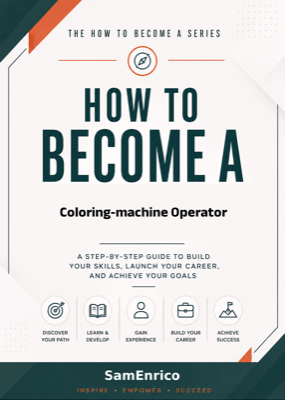
How to Become a Coloring-machine Operator Audiobook
How to Become a Coloring-machine Operator
How to Become a Coloring-machine Operator
Formats
Free sample
Chapter 1: The Invisible Goldmine--–- On a humid Tuesday morning in Spartanburg, South Carolina, a 22-year-old named Marcus walked into a textile plant with no college degree, no technical certifications, and no relevant work experience. He had been stocking shelves at a grocery store for $11 an hour. Eighteen months later, he was making $68,000 annually as a senior coloring-machine operator, with full benefits and a retention bonus. His younger brother, who graduated with a four-year degree in marketing, was earning $45,000 and living in their parents' basement. Marcus is not an anomaly.
He is not exceptionally gifted. He simply discovered what this book calls the Invisible Goldmine: the hidden world of industrial coloring, where skilled operators are retiring faster than they can be replaced, and wages are rising accordingly.This chapter exists to shatter every assumption you have about blue-collar work. If you picked up this book expecting dry technical manuals and mind-numbing safety checklists, put that expectation aside. You are about to discover one of the last great middle-class career paths that does not require a university degree, does not require crushing student debt, and does not require you to sit in a cubicle pretending to be busy for forty hours a week. What it does require is a specific mindset, a willingness to learn systems, and the courage to walk into an industry that most career counselors have never even heard of.The Great Retirement Wave You Haven't Heard About Let me give you a number that should terrify you if you are a plant owner and excite you if you are a job seeker: 53 percent.
According to industry data from the National Council of Textile Organizations, more than half of all experienced coloring-machine operators in the United States are over the age of 48. Within the next ten to fifteen years, they will retire. There is no pipeline of young operators waiting to replace them. Trade schools have largely abandoned textile and printing programs. High school career counselors push four-year degrees.
And the result is a widening skills gap that has already started pushing wages upward.Consider the math. In 2010, a trainee operator in the southeastern United States might start at $12 per hour. In 2025, starting wages for trainees have climbed to $16–$20 per hour in many regions, with senior operators commanding $28–$38 per hour plus overtime. That is not hypothetical. That is current market reality.
Plants are competing for warm bodies with pulse and mechanical inclination. Some offer signing bonuses of $1,000–$3,000 for trainees and…
This is the end of the free sample. Get the Audiobook to keep going. Buy now
About this book
Details
- Author
- Kingsley Tera
- Publisher
- SamEnrico
- Language
- English
- ISBN
- 9781505803433
- Genre
- Non-Fiction, Informative, Educational
- Released
- 2026-04-25
- Pages (approx.)
- 143
- Available as
- eBook, Paperback, Audiobook

Listen in the VoxFlicks app
Audiobooks and audio dramas wherever you go. Sign in with your SamEnrico account and press play.
More by Kingsley Tera
 The Retirement Downsizing Financial WorkbookKingsley Tera$11.99
 Essential Oils for Stage FearKingsley Tera$11.99
 The Teen Assertiveness GuideKingsley Tera$11.99
 Divorce HandbookKingsley Tera$11.99
 Anger Management for ExtrovertsKingsley Tera$11.99
 Baba Yaga's Bone House: The Witch Who Ate the SunKingsley Tera$11.99
 HARO Query Selection GuideKingsley Tera$12.99
 Educational Travel Spending GuideKingsley Tera$12.99
 Understanding Polyneuropathy Mental Retardation Acromicria PremaKingsley Tera$17.99
 Carrollite MiningKingsley Tera$11.99Carrollite MiningKingsley Tera$11.99