
Non-FictionInformativeEducational
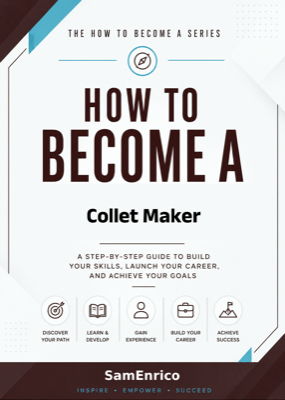
How to Become a Collet Maker
How to Become a Collet Maker
by Krebs Huong
How to Become a Collet Maker
Formats
About this book
Free sample
Chapter 1: The Spring Inside--–- Most machinists never think about the springs hidden inside their toolholders. They buy collets in sets, shove them into spindles, and tighten drawbars without ever asking the fundamental question: What actually happens when that taper slides against the other taper? The answer, as you will discover in this chapter, transforms a simple clamping device into a precision instrument capable of holding a workpiece within millionths of an inch. But to unlock that capability, you must first unlearn everything you thought you knew about workholding.A collet is not a chuck. This seems obvious, yet the confusion between these two workholding methods accounts for more failed collet-making projects than any other single mistake.
A scroll chuck grabs from the outside using three or four jaws that move independently. When you tighten a chuck, the jaws close in a spiral path, each jaw following a curved slot cut into the chuck body. This design works admirably for holding rough stock or for jobs where concentricity within a few thousandths of an inch is acceptable. But a chuck introduces runout – sometimes as much as 0.003 inches at the jaw tips – because the scroll mechanism cannot perfectly center the workpiece. Worse, a chuck pushes the workpiece away from the spindle when tightened.
This forward pressure can cause long, slender parts to wobble or to push back against the tailstock with unpredictable force.A collet operates on an entirely different principle. Instead of pushing inward from the front, a collet uses a wedging action that simultaneously compresses the gripping surface and pulls the workpiece back into the spindle. Imagine sliding a tapered cone into a matching socket. As the cone moves deeper, the socket squeezes the cone's walls inward. Now imagine that cone has been split into three or four flexible fingers.
Those fingers grip whatever is inside them with a force that increases as the cone moves deeper into the socket. That simple mechanical arrangement – a tapered external surface mating with a tapered internal socket – creates what machinists call the "collet effect."The Two Forces That Make a Collet…
This is the end of the free sample. Get the eBook to keep going. Buy now
Contents
- Chapter 1
- Chapter 2
- Chapter 3
- Chapter 4
- Chapter 5
- Chapter 6
- Chapter 7
- Chapter 8
- Chapter 9
- Chapter 10
- Chapter 11
- Chapter 12
Details
- Author
- Krebs Huong
- Publisher
- SamEnrico
- Language
- English
- ISBN
- 9781505803129
- Genre
- Non-Fiction, Informative, Educational
- Released
- 2026-05-18
- Pages (approx.)
- 153
- Available as
- eBook, Paperback, Audiobook

Read better in the ZLOADR app
Your eBooks on your phone or tablet. Sign in with your SamEnrico account and start reading.
More by Krebs Huong
 Clinician Suicide LossKrebs Huong$11.99
 Talent Migration Patterns for AI WorkforceKrebs Huong$11.99
 Blue Zones Menopause ExperienceKrebs Huong$11.99
 The Bra Clasp DNA Evidence DebateKrebs Huong$11.99
 DBT Self Worth Building GuideKrebs Huong$11.99
 Tangaroa’s Fury: The Birth of the PacificKrebs Huong$11.99
 Real Estate Long Term OutlookKrebs Huong$12.99
 B2C One Page Marketing HandbookKrebs Huong$12.99
 Dance InstructorKrebs Huong$11.99
 Understanding Leukoencephalopathy Palmoplantar KeratodermaKrebs Huong$17.99
You may also like
 Hong Kong Handover 1997Dunn Johnnie$11.99
 Zumba For Postnatal Recovery CourseNeal Christian$11.99
 Zumba for BeginnersLadner Nikia$11.99
 YouTube Comment Mining GuideHumes Pandora$12.99
 Worry Box MeditationCarlin Rudy$11.99
 Workplace Stress MeditationNguyen Lynn$11.99
 Workplace Stress and Sleep RepairHawley Ivory$11.99
 Workplace Perfectionism CureDelaney Jeffry$11.99
 Workplace Injustice Anger GuideWallen Isabelle$11.99
 Work Addiction and Burnout LinkGreenwood Ester$11.99
 Women in Yoga and WellnessBeattie Galina$11.99
 Women in Stand Up ComedyChun Evangeline$11.99