
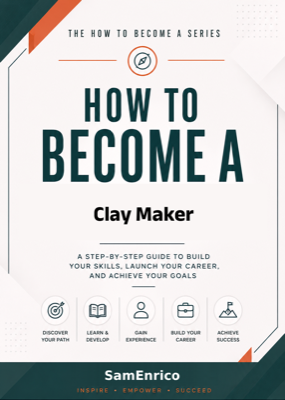
How to Become a Clay Maker Paperback
How to Become a Clay Maker
How to Become a Clay Maker
Formats
Free sample
Chapter 1: The Buried Beginning--–- You have already touched clay. Not the polished, glazed, finished kind that sits on gallery shelves or holds your morning coffee. You have touched the raw, sticky, stubborn kind—probably when you were a child, pressing your thumbs into a cold lump at a county fair or in an elementary school art class. You remember the sensation: earth that was also water, soft but resistant, cool and slightly gritty against your palms. You remember that you made something lopsided and ugly.
And you remember that it felt, for reasons you could not name at the time, like a kind of freedom.That feeling was not nostalgia. It was an instinct.This book exists because that instinct is trying to tell you something. Clay is not a hobby. It is not a side hustle or a distraction or a way to make handmade Christmas gifts that people will feel obligated to keep. Clay is a conversation between your hands and the oldest material on earth.
It has been happening for twenty thousand years—longer than farming, longer than writing, longer than the wheel that potters would eventually claim as their own. The pots of ancient Jomon Japan, the vessels of predynastic Egypt, the coil-built ollas of the American Southwest: all of them were made by people who had no kilns, no glazes, no wheels, and no teachers. They had clay, fire, and the same two hands you have right now.So let us be clear about what this book is not. It is not a collection of flawless projects for you to admire from a distance. It will not show you a perfect mug on page one and then teach you how to replicate it by page fifty.
That is a recipe for disappointment, because your first mug will be ugly. Your fifth mug will be less ugly. Your fiftieth mug might actually be good. And that arc—from frustration to competence to something like grace—is the entire point. This book is a map of that arc.
It will not spare you the failures. It will instead teach you how to read them.Before we talk about tools, techniques, or temperatures, we have to talk about why you are here. Not the surface reason—"I want to learn pottery"—but the deeper one. The one you might not have admitted to yourself yet.The Age of Invisible Labor We live in a world that has forgotten what hands are for. Most of us spend our days tapping screens, clicking mice, and pressing keys.
Our work produces results—emails sent, spreadsheets balanced, meetings attended—but it produces almost nothing we can hold. The things we own arrive in cardboard boxes, delivered by someone else, manufactured somewhere else, designed to be replaced rather than repaired. This is not a moral failing. It is simply the architecture of modern life. But it leaves a hunger that most people cannot name.Clay feeds that hunger.When you wedge a lump of clay—kneading it like bread dough, pushing the heel of your palm through its cold body—you are doing something that your ancestors did.
The motion is ancient. The feedback is immediate. The clay resists or yields. It tells you, in the language of pressure and release, whether you are paying attention. No screen has ever given you that kind of honest feedback.
A screen will let you scroll forever. Clay will let you make a mess, and then it will let you try again.This is not romanticism. This is neuroscience. Repetitive, tactile work with a malleable material…
This is the end of the free sample. Get the Paperback to keep going. Buy now
About this book
Details
- Author
- Burleson Bryon
- Publisher
- SamEnrico
- Language
- English
- ISBN
- 9781505799101
- Genre
- Non-Fiction, Informative, Educational
- Released
- 2026-05-02
- Pages (approx.)
- 138
- Available as
- eBook, Paperback, Audiobook

Read better in the ZLOADR app
Your eBooks on your phone or tablet. Sign in with your SamEnrico account and start reading.
More by Burleson Bryon
 Technology Adoption MapBurleson Bryon$11.99
 Iranian Revolution Overthrow ShahBurleson Bryon$11.99
 Meditation For High Stress ProfessionalsBurleson Bryon$11.99
 GAD Avoidance Reduction GuideBurleson Bryon$11.99
 Team Prioritization Workshop GuideBurleson Bryon$11.99
 The Silent Depths: Diving into the Great Barrier Reef’s Hidden World (1920s)Burleson Bryon$11.99
 System Engineering Manager RadarBurleson Bryon$11.99
 Understanding Guanidinoacetate Methyltransferase DeficiencyBurleson Bryon$17.99
 BPO Performance MetricsBurleson Bryon$12.99
 Real Estate Holding LLC PrimerBurleson Bryon$12.99