
Non-FictionInformativeEducational
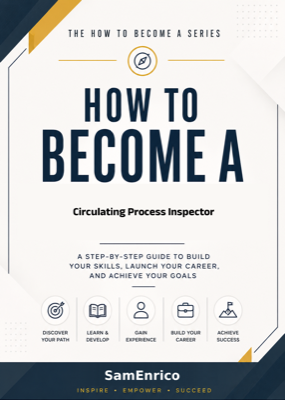
How to Become a Circulating Process Inspector eBook
How to Become a Circulating Process Inspector
How to Become a Circulating Process Inspector
Formats
Free sample
Chapter 1: The Clipboard Prison...--–- Maria had checked 2.4 million parts. She knew this number with the same certainty she knew her birthday, her social security number, and the exact sound her forklift made when the battery was dying. Fourteen years at the same plant. Fourteen years of picking up parts, looking at them, putting them down, and stamping a paper form with a green "ACCEPT" or a red "REJECT." She was proud of her work. Her manager was proud of her work.
The quality department had given her a plaque for "Zero Escapes" – meaning no defective part she had inspected ever reached a customer.And yet, standing in the break room at 2:47 on a Tuesday afternoon, coffee in hand, Maria realized something that would change the rest of her career. She had prevented exactly zero defects.Not one.She had caught thousands of them, sure. She had pulled bad parts off the line, filled out non-conformance reports, attended root cause meetings where engineers nodded seriously and changed nothing. But prevent? No.
The same scratches appeared on the same aluminum housings every Tuesday afternoon when the second-shift setup technician arrived. The same burrs showed up on the same drilled holes every time the coolant pump hit 87% of its maximum flow. The same misaligned brackets came down the line every single time the overnight crew ran the stamping press.Maria was an expert catcher. She was not a preventer. And on that Tuesday afternoon, she realized the system had trained her to be exactly that – a highly skilled, deeply appreciated, completely ineffective firefighter in a factory that was always, always on fire.This book is for Maria.
It is for every inspector who has ever stamped "REJECT" on the same defect for the third time in a week and wondered, quietly, "Why doesn't anyone fix this?" It is for the quality technician who walks 8 miles a shift, checks 400 parts, and goes home with sore feet and the same problems waiting for them tomorrow. It is for the production manager who keeps hiring more inspectors and can't figure out why defects aren't going away.You are about to learn why adding more inspectors is like adding more buckets to a sinking ship. And you are about to learn a completely different way to work – not as a fixed station inspector, not as a random roving auditor, but as a Circulating Process Inspector: a fluid agent of process integrity who moves with the value stream, catches variance before it becomes waste, and gradually, methodically, works themselves out of a job.But first, we have to understand how you got trapped in the Clipboard Prison. And more importantly, how to break out.The Great Lie of End-of-Line Inspection Every manufacturing textbook, every quality certification course, every Lean Six Sigma orientation teaches the same basic model: raw materials come in, work in progress moves through a series of operations, and somewhere near the end – before shipping, before the customer sees anything – an inspector checks the work. Good parts go out.
Bad parts get reworked or scrapped.This model has a name. It is called inspection at the end of the line. And it is a lie.Not a malicious lie, necessarily. Most quality managers genuinely believe they are protecting their customers by adding inspection stations. But the lie is this: the belief that inspection improves quality.
It does not. Inspection identifies quality. It does not create it. And in many cases, inspection actively makes quality worse.Let us explain with a story that Eliyahu Goldratt made famous in his novel The Goal, which has sold over 5 million copies precisely because it exposed this lie.Imagine you have a production line with four machines in sequence. Machine A processes 10 parts per hour.
Machine B processes 8 parts per hour. Machine C processes 12 parts per hour. Machine D processes 9 parts per hour. What is the capacity of the line? Eight parts per hour – the speed of the slowest machine, Machine B.
This is the bottleneck.Now imagine you place an inspector at the end of the line. That inspector checks every part coming off Machine D. They find that 5% of parts are defective. They reject them. The line continues running.
The bottleneck continues restricting flow. The defective parts are caught, but nothing changes upstream.Now imagine you add a second inspector. And a third. Your cost goes up. Your lead time might even increase because parts queue up waiting for inspection.
But your defect rate? It stays exactly the same. Because you have not changed the process. You have only added more people to catch the failures that the process is guaranteed to produce.This is the Clipboard Prison. You are paid to find problems.
But you are not empowered to fix them. Your metrics measure how many parts you check, not how many defects you prevent. Your manager celebrates when you catch a bad part, not when you eliminate the need to catch it. The system rewards you for being a good catcher – and punishes you, subtly, when you ask why the process keeps throwing bad parts in the first place.The Circulating Inspector Defined The Circulating Process Inspector is a fundamentally different role. It is not a job title you will find on a traditional organizational chart, because it represents a synthesis of three existing roles that rarely talk to each other:Roving Quality Assurance (the person who walks the floor)Process Auditing (the person who verifies standard work)Continuous Improvement (the person who fixes root causes)The Circulating Inspector combines all three.
They walk. They audit. They fix. And they do it not at a fixed station, but in motion – moving with the value stream, sampling at strategic points, and feeding data back into the process in real time.The core distinction at the heart of this book is between Inspection and Surveillance.Inspection is a binary event. A part arrives.
You measure it. You say pass or fail. The event is discrete, isolated, and backward-looking. Inspection answers the question: "Is this part good?"Surveillance is a continuous process. You observe conditions.
You track trends. You look for patterns. Surveillance answers the question: "Is this process stable?" Surveillance does not wait for a bad part to arrive. It watches for the conditions that create bad parts – and intervenes before they do.A fixed-station inspector performs Inspection. A Circulating Inspector performs Surveillance.Consider the difference in practice.
A fixed-station inspector catches a scratch on a housing. They reject the part. They fill out a form. The part goes to rework. The scratch appears again on the next shift.
And the next. And the next.A Circulating Inspector notices that scratches appear only on Tuesdays. They ask why. They discover that the Tuesday setup technician adjusts the conveyor speed differently than the Monday technician. They document the standard speed.
They train both technicians. The scratches disappear. The inspector never catches that scratch again – because the scratch no longer exists.This is not magic. This is the difference between treating symptoms and treating causes. Between fighting fires and fireproofing the building.The Flow State: Where Quality Lives Every process has a natural rhythm.
When materials move without interruption, when information flows without distortion, when work proceeds without rework, the process is in a…
This is the end of the free sample. Get the eBook to keep going. Buy now
About this book
Details
- Author
- Lovelace Gabriele
- Publisher
- SamEnrico
- Language
- English
- ISBN
- 9781505798296
- Genre
- Non-Fiction, Informative, Educational
- Released
- 2026-05-18
- Pages (approx.)
- 145
- Available as
- eBook, Paperback, Audiobook

Read better in the ZLOADR app
Your eBooks on your phone or tablet. Sign in with your SamEnrico account and start reading.
More by Lovelace Gabriele
 Trans Siberian Off RoadLovelace Gabriele$11.99
 Antwerp Heist Book vs RealityLovelace Gabriele$11.99
 EQ Self Awareness Training CourseLovelace Gabriele$11.99
 Environmental Toxins And AutoimmunityLovelace Gabriele$11.99
 Stress and Derealization GuideLovelace Gabriele$11.99
 The Viking Reawakening: Rediscovering the Forgotten Canoe Routes of EuropeLovelace Gabriele$11.99
 Silk & Sabotage: The Unseen War of Fashion’s Golden AgeLovelace Gabriele$11.99
 Remote Conflict CoachingLovelace Gabriele$12.99
 Low Income Product Fit WorkbookLovelace Gabriele$12.99
 Understanding Fetal Iodine SyndromeLovelace Gabriele$17.99
 Software Test SpecialistLovelace Gabriele$11.99
You may also like
 Hong Kong Handover 1997Dunn Johnnie$11.99
 Zumba For Postnatal Recovery CourseNeal Christian$11.99
 Zumba for BeginnersLadner Nikia$11.99
 YouTube Comment Mining GuideHumes Pandora$12.99
 Worry Box MeditationCarlin Rudy$11.99
 Workplace Stress MeditationNguyen Lynn$11.99
 Workplace Stress and Sleep RepairHawley Ivory$11.99
 Workplace Perfectionism CureDelaney Jeffry$11.99
 Workplace Injustice Anger GuideWallen Isabelle$11.99
 Work Addiction and Burnout LinkGreenwood Ester$11.99
 Women in Yoga and WellnessBeattie Galina$11.99
 Women in Stand Up ComedyChun Evangeline$11.99