
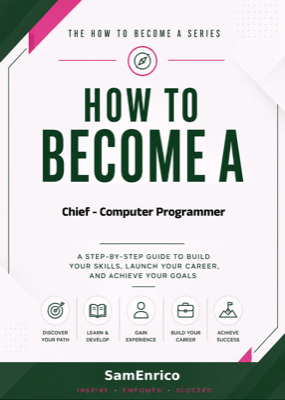
How to Become a Chief - Computer Programmer eBook
How to Become a Chief - Computer Programmer
How to Become a Chief - Computer Programmer
Formats
Free sample
Chapter 1: The Map Is Not The Mountain--The first and most dangerous lie you will ever hear in software engineering is this: To become a chief, you must be the best coder on the team.It sounds reasonable, doesn't it? After all, how can you lead what you do not master? How can you chart a course through unknown technical terrain if you cannot write the most elegant parser, the most optimized query, or the most cleverly abstracted service? The industry has spent decades romanticizing the "10x engineer"—the hoodie-wearing, keyboard-smashing virtuoso who descends from the mountain at 3 AM, types furiously for forty-five minutes, and rescues the project from certain doom.That person is not a chief. That person is a liability.The mountain of software development is not climbed by the strongest individual climber.
It is climbed by the team that chooses the safest route, packs the right supplies, communicates through the storm, and—most importantly—makes sure that when one climber falls, the rope holds and the rest keep moving. The map of that mountain is not the same as the mountain itself. And the role of the Chief Computer Programmer is not to be the fastest or strongest climber. It is to hold the map, to read the weather, and to ensure that every member of the expedition comes home.This chapter dismantles the myth of the heroic coder, defines what the Chief actually is, and draws a clear line between the four critical roles that every engineering organization needs—but that ambitious programmers constantly confuse. By the end of this chapter, you will understand why your obsession with being the smartest person in the room is actively preventing you from becoming the leader your team actually needs.
More importantly, you will see the first major shift that this entire book demands: moving your focus from how to solve problems and toward why those problems are being solved in the first place, and how to ensure they never need solving again.The Four Roles You Must Distinguish Before you can become a Chief, you must recognize what you are not. The software industry has a habit of conflating four very different functions, and ambitious engineers often mistake movement in one direction for progress toward the summit. Let us separate them clearly.Senior Engineer.This is the first destination on most technical career paths, and it is a worthy one. The Senior Engineer independently delivers complex features. Give them a well-defined problem with some ambiguity, and they will return a working, testable, maintainable solution.
Their focus is on how—how to implement this API endpoint, how to refactor that legacy module, how to optimize this database query. They mentor junior engineers. They unblock themselves. They are the reliable workhorses of any healthy engineering organization.But here is what the Senior Engineer does not do: They do not set technical direction across multiple teams. They do not handle extreme ambiguity where the problem itself is undefined.
They do not weigh business strategy against architectural purity. And crucially, they do not lead laterally—because they have not yet learned to influence people who do not report to them.Lead Engineer.The Lead Engineer sits in a tricky hybrid space. They coordinate the technical work of a small team—usually three to eight people. They break down projects, assign tasks, review code, and keep the trains running on time. Their focus is on we—how the team works together, where dependencies lie, and how to deliver the next milestone.The Lead Engineer is often the first person promoted from Senior, and it is here that the confusion begins.
Many organizations call this role "Tech Lead" or "Team Lead," and it is the most common source of imposter syndrome and burnout. Why? Because the Lead Engineer has responsibility for delivery but rarely has authority over hiring, firing, or compensation. They are the person the manager turns to when something is late, but they cannot give raises or reassign people they cannot work with.The Lead Engineer is not the Chief. The Chief operates at a different scale entirely.Chief Engineer (Staff Engineer).Now we arrive at the destination of this book.
The Chief Engineer—used interchangeably with "Staff Engineer" throughout this text—works across teams, sets technical direction for a domain or product area, and handles high ambiguity. Their focus is on why and when. Why are we building this system at all? When should we start? When should we stop?
When is the cost of continuing higher than the cost of stopping?The Chief Engineer does not manage people. They do not have direct reports. They do not write performance reviews (except as peer feedback). But their influence spans ten, twenty, or fifty engineers across multiple teams. They make technical decisions that impact quarterly roadmaps and annual strategy.
They are the person who says, "We are not adopting that database yet" or "We need to pause feature work for two weeks and fix our error budget."The Chief Engineer is the focus of every chapter in this book. But to understand the Chief, you must also understand the final role—the one most commonly confused with the Chief but fundamentally different.Engineering Manager.The Engineering Manager manages people, careers, process, and culture. Their focus is on who and culture. Who is underperforming? Who is ready for promotion?
Who is burned out? What is the health of the team? How do we hire the next five engineers?The Manager has hard power: they hire, fire, promote, and set compensation. They run one-on-one meetings. They manage budgets and headcount.
Most importantly, they are accountable for the people outcomes of the organization, not the technical outcomes directly.Here is where the confusion becomes dangerous: Many companies have a single person playing both Lead Engineer and Engineering Manager. That person is usually miserable. They code all day, then do performance reviews at midnight. They lead architecture discussions, then mediate interpersonal conflicts back-to-back. This hybrid role is a recipe for burnout precisely because it asks one person to serve two masters: the code and the people.The Chief Engineer does neither.
The Chief does not manage people and does not write production code (much—we will discuss the 20% rule in Chapter 12). The Chief influences. The Chief architects. The Chief prevents fires rather than fighting them.The Ball of Mud: What Happens When No One Owns the Architecture Imagine a software project that has been running for three years. No Chief Engineer has ever been assigned.
The original Senior Engineers have come and gone. New features were added in a hurry. Dead code was never removed. Two different teams built overlapping authentication systems because no one knew the first one existed.This is the Ball of Mud—the most common software architecture in the world, and the most expensive.The Ball of Mud is not a failure of individual talent. It is a failure of structural ownership.
When no single person or small group is accountable for the technical health of a system across team boundaries, entropy always wins. Every engineer acts in rational self-interest: they deliver their feature as quickly as possible, because that is how they…
This is the end of the free sample. Get the eBook to keep going. Buy now
About this book
Details
- Author
- Dubose Virgilio
- Publisher
- SamEnrico
- Language
- English
- ISBN
- 9781505795806
- Genre
- Non-Fiction, Informative, Educational
- Released
- 2026-05-02
- Pages (approx.)
- 146
- Available as
- eBook, Paperback, Audiobook

Read better in the ZLOADR app
Your eBooks on your phone or tablet. Sign in with your SamEnrico account and start reading.
More by Dubose Virgilio
 Road Rage Trigger IdentificationDubose Virgilio$11.99
 Anger And Sleep Deprivation GuideDubose Virgilio$11.99
 PT Pain Neuroscience TrainingDubose Virgilio$11.99
 Financial Stress and Clutter GuideDubose Virgilio$11.99
 The Forbidden Affair: Queen Victoria and Her Scottish LairdDubose Virgilio$11.99
 The Merlin Files: Camelot's Shadow WarDubose Virgilio$11.99
 Post Acute Telehealth OutlookDubose Virgilio$12.99
 Nonprofit Board Service PrimerDubose Virgilio$12.99
 Understanding HyperekplexiaDubose Virgilio$17.99
 Rose HarvestingDubose Virgilio$11.99