
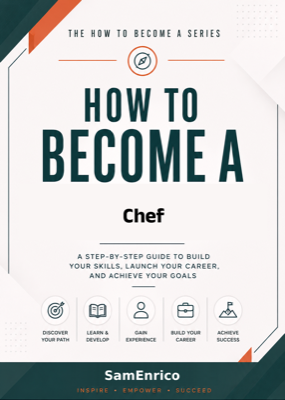
Non-FictionInformativeEducational
How to Become a Chef eBook
How to Become a Chef
How to Become a Chef
Formats
Free sample
Chapter 1: The Heat Illusion...–- The first time I saw a chef cry, it wasn’t over a broken sauce or a burned risotto. It was 1:47 AM on a Saturday, the last ticket had been fired fifteen minutes ago, and the walk-in freezer had died sometime around midnight. Thirty thousand dollars of product—forty-eight cases of prime beef, fifty pounds of scallops, a month’s worth of house-made ice cream—was slowly approaching room temperature. The chef, a forty-two-year-old veteran with two Michelin stars and a forearm covered in burn scars that looked like a topographical map, sat down on a milk crate behind the dumpster and wept. Not dramatically.
Not for sympathy. Just silent, exhausted tears while he waited for the repair technician who wouldn’t arrive until 6 AM.I was twenty-three years old, six months out of culinary school, and I had no idea what to say to him. I had spent two years and seventy-three thousand dollars learning how to make the perfect hollandaise, how to tourné potatoes into identical football shapes, how to butcher a whole lamb into sixteen pristine cuts. Nobody had taught me what to do when your chef cried behind a dumpster. Nobody had told me that the man with the stars and the reputation and the cookbook deal hadn’t slept more than four hours a night in a decade.
Nobody had warned me that the restaurant’s profit margin was so thin that this single equipment failure might wipe out the entire quarter’s earnings and that the chef had personally guaranteed the line of credit used to buy that beef.That was the moment I understood that everything I thought I knew about becoming a chef was wrong. Or, more precisely, it was incomplete. I had fallen for what I now call the Heat Illusion—the belief that becoming a chef is primarily about learning to cook.The Myth You’ve Been Sold Let’s be honest about how you got here. You probably watched Chef’s Table and felt something stir in your chest when Dan Barber talked about terroir. You binged The Bear and thought, “I could handle that chaos.
I thrive under pressure.” You followed twenty-seven food accounts on Instagram and saved every video of a perfect pasta swirl or a cascading chocolate waterfall. You’ve been told, explicitly or implicitly, that the path to becoming a chef is paved with passion, creativity, and a few years of hard work.This is a lie. Not a malicious lie, necessarily, but a dangerous one. The culinary industry has spent decades selling a fantasy—that cooking is an art form, that chefs are temperamental geniuses, and that the kitchen is a place where raw talent will always rise to the top. The reality is far grimmer and far more mundane.Becoming a chef is not primarily about cooking.
Cooking is the entry ticket, the baseline requirement, the thing you must be able to do in your sleep before the real education begins. Becoming a chef is about stamina, logistics, economics, psychology, and, most of all, the ability to tolerate a level of physical and emotional discomfort that would break most people in any other industry.I want to be very clear about what this chapter is not. It is not here to scare you away from the profession. I have spent fifteen years in kitchens, from dishwasher at a diner in rural Ohio to executive chef at a farm-to-table restaurant in Portland, and I genuinely love what I do. But love is not enough.
Love won’t get you through the fourth double shift in a row. Love won’t pay the rent when your stage at a Michelin-starred restaurant turns out to be three months of unpaid peeling carrots. Love won’t save your marriage when you miss another anniversary because the holiday tasting menu sold out.This chapter is a sieve. Its purpose is to separate the people who love the idea of being a chef from the people who are capable of surviving the reality of becoming one. By the time you finish reading, you will know which category you fall into.The Physical Reality Nobody Talks About Let’s start with your body, because the kitchen will destroy it if you let it.A typical dinner shift lasts anywhere from ten to fourteen hours.
During that time, you will stand on a rubber mat that might as well be concrete. You will not sit down. You will not lean against a wall for more than thirty seconds. You will not take a break longer than five minutes to smoke a cigarette or shove a protein bar into your mouth. You will move constantly, pivoting between your station, the reach-in cooler, the stove, the pass.
By the end of the night, your feet will feel like they’ve been beaten with a rolling pin. Your lower back will ache with a dull, persistent throb that you will learn to ignore. Your hands, which you use as tools—grabbing hot pans without towels because there’s no time to find one, opening jar lids with a twist that would make a rock climber wince—will be covered in small cuts and burns that you don’t even notice anymore.Here is a partial list of physical injuries I have personally sustained or witnessed in kitchens: third-degree burns from spilled fryer oil, severed tendons from a falling knife, slipped discs from lifting fifty-pound bags of flour, stress fractures in feet from standing on concrete for years, hearing loss from the constant roar of hood vents and clattering pans, and at least four cases of carpal tunnel syndrome that required surgery. I have superglued my own finger shut after a mandoline accident because the line was too busy to go to urgent care. I have watched a line cook finish a twelve-hour shift with a fever of 102 because there was nobody to cover his station.This is not hazing.
This is not some outdated macho culture that will magically disappear with the next generation. This is the physical reality of a job that requires you to be on your feet, handling hot and sharp objects, for hours on end, in an environment that is deliberately kept hot (health codes require commercial kitchens to be at least 68 degrees, but most run closer to 90 near the line). Your body will pay a price. The only question is whether you are willing to pay it.I once asked a sixty-year-old chef how he had lasted four decades in the industry. He laughed and showed me his knees—both had been replaced.
His hands were gnarled with arthritis. He had a permanent limp from a fall on a greasy floor that had torn his ACL. “I’m not the best chef I know,” he said. “I’m just the one who didn’t quit.”The Emotional Toll: Anger, Ego, and the Walk-In Cry The physical damage is visible, measurable, and somewhat predictable. The emotional damage is sneakier.Professional kitchens have historically been built on a model of fear and humiliation.
The classic brigade system, invented by Auguste Escoffier in the late nineteenth century, borrowed its structure from the military. Chefs…
This is the end of the free sample. Get the eBook to keep going. Buy now
About this book
Details
- Author
- Crutchfield Flavia
- Publisher
- SamEnrico
- Language
- English
- ISBN
- 9781505795189
- Genre
- Non-Fiction, Informative, Educational
- Released
- 2026-05-23
- Pages (approx.)
- 146
- Available as
- eBook, Paperback, Audiobook

Read better in the ZLOADR app
Your eBooks on your phone or tablet. Sign in with your SamEnrico account and start reading.
More by Crutchfield Flavia
 Cheat Meal Calorie AccountingCrutchfield Flavia$11.99
 Urgent vs Important FrameworkCrutchfield Flavia$11.99
 Night Stalker Unsolved MurdersCrutchfield Flavia$11.99
 Franchising Your Local Brand Across Borders Master Franchise ModelCrutchfield Flavia$11.99
 Email Signature StandardCrutchfield Flavia$11.99
 The Black Abyss: The Deadly Secrets of the Atlantic's Hidden CavesCrutchfield Flavia$11.99
 Midnight Reset: The Forgotten Y2K Blackout of 1999Crutchfield Flavia$11.99
 Understanding Cystic Adenomatoid Malformation of LungCrutchfield Flavia$17.99
 Campaign Operations ManagerCrutchfield Flavia$11.99
 Retail Marketing One PagerCrutchfield Flavia$12.99
 Energy Star Appliance RebateCrutchfield Flavia$12.99
You may also like
 Hong Kong Handover 1997Dunn Johnnie$11.99
 Zumba For Postnatal Recovery CourseNeal Christian$11.99
 Zumba for BeginnersLadner Nikia$11.99
 YouTube Comment Mining GuideHumes Pandora$12.99
 Worry Box MeditationCarlin Rudy$11.99
 Workplace Stress MeditationNguyen Lynn$11.99
 Workplace Stress and Sleep RepairHawley Ivory$11.99
 Workplace Perfectionism CureDelaney Jeffry$11.99
 Workplace Injustice Anger GuideWallen Isabelle$11.99
 Work Addiction and Burnout LinkGreenwood Ester$11.99
 Women in Yoga and WellnessBeattie Galina$11.99
 Women in Stand Up ComedyChun Evangeline$11.99