
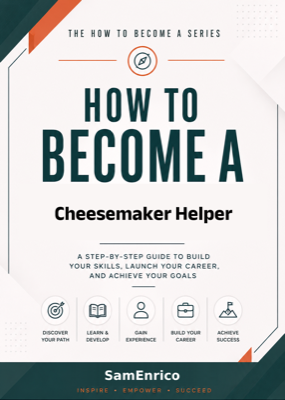
How to Become a Cheesemaker Helper Paperback
How to Become a Cheesemaker Helper
How to Become a Cheesemaker Helper
Formats
Free sample
Chapter 1: The Language of Milk...--– Before you ever touch a curd knife, before you step foot inside a cheese cave, before you even think about pressing a wheel, you must learn to listen. Not to people, not to instructions, but to milk. Milk speaks. It has a voice, a grammar, a syntax of fat and protein and microbial life that tells you everything you need to know about what it will become. The great cheesemakers are not technicians who follow recipes; they are translators who interpret what the milk is saying on any given day.
And as a Cheesemaker Helper, your first and most sacred duty is to become fluent in that language before you are ever allowed to touch a vat.This is not poetry. This is practical, commercial reality. In a working creamery, milk changes by the season, by the breed, by the weather on any particular morning. The milk that arrives on Tuesday from a herd of Jerseys who grazed on wet spring grass will behave entirely differently from the milk that arrives on Friday from Holsteins who have been eating dry hay in a winter barn. A helper who does not understand these differences is not a helper; they are a liability.
A helper who can read a milk delivery receipt, interpret somatic cell counts, and adjust their expectations before the first culture is added is a treasure worth training.Understanding the Grammar of Milk Milk is not a white uniform liquid. It is an emulsion of fat globules suspended in a water-based solution containing proteins (primarily casein), lactose (milk sugar), minerals, and vitamins. Under a microscope, raw milk looks like a chaotic solar system—fat globules of varying sizes floating in a sea of protein micelles. When we add rennet and culture, we are not "making" cheese; we are convincing this complex system to reorganize itself into a solid matrix. The milk does the work.
We merely set the conditions.The single most important concept you will learn in this chapter is the fat-to-protein ratio (F:P). This is the North Star of cheesemaking. Everything—yield, texture, flavor development, aging potential—flows from this ratio. Fat provides richness, flavor, and mouthfeel. Protein (specifically casein) provides the structural network that holds the cheese together.
A milk with a F:P ratio of approximately 1:1 (meaning 4% fat and 4% protein, for example) will produce a balanced, high-yield cheese. A milk with a ratio leaning toward protein (say, 3% fat and 4.5% protein) will produce a firmer, lower-moisture cheese that ages well. A milk with a ratio leaning toward fat (5% fat and 3.5% protein) will produce a soft, decadent cheese that may be prone to splitting or oil-off if not handled carefully.You will hear lead cheesemakers talk about "rich milk" or "thin milk" or "spring milk" or "fall milk." They are not being vague. They are referring to measurable, predictable shifts in the F:P ratio that occur with the changing seasons, the lactation cycle of the animals, and their diet. Your job as a helper is to learn to see these shifts before they become problems.The Three Faces of Milk: Raw, Pasteurized, and Everything In Between Before we go further, we must address the single most contentious question in cheesemaking: raw or pasteurized?
You will encounter passionate advocates on both sides. Your job as a helper is not to take a side but to understand what each treatment does to the milk and how that affects your work.Raw milk is exactly what it sounds like: milk that has not been heated above the animal's body temperature. It arrives at…
This is the end of the free sample. Get the Paperback to keep going. Buy now
About this book
Details
- Author
- Pennington Gigi
- Publisher
- SamEnrico
- Language
- English
- ISBN
- 9781505795165
- Genre
- Non-Fiction, Informative, Educational
- Released
- 2026-05-02
- Pages (approx.)
- 137
- Available as
- eBook, Paperback, Audiobook

Read better in the ZLOADR app
Your eBooks on your phone or tablet. Sign in with your SamEnrico account and start reading.
More by Pennington Gigi
 Virtual Meeting Facilitation GuidePennington Gigi$11.99
 Ramirez Mental Health EvaluationPennington Gigi$11.99
 Meeting Size Limit GuidePennington Gigi$11.99
 John Kennedy Camelot GuidePennington Gigi$11.99
 Calorie Tracking App ComparisonPennington Gigi$11.99
 The Enigma of the Voynich Manuscript: A Linguistic LabyrinthPennington Gigi$11.99
 Operation Midnight Sun: The Untold Story of the 1986 Reykjavik SummitPennington Gigi$11.99
 Window Insulation Tax CreditPennington Gigi$12.99
 Event Marketing One PagerPennington Gigi$12.99
 Understanding Cystic Angiomatosis of Bone, DiffusePennington Gigi$17.99