
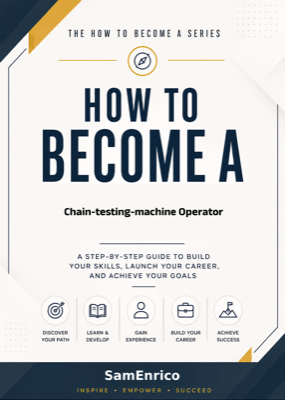
How to Become a Chain-testing-machine Operator eBook
How to Become a Chain-testing-machine Operator
How to Become a Chain-testing-machine Operator
Formats
Free sample
Chapter 1: The Last Checkpoint--The crane operator's hands hovered over the controls. Below him, suspended two hundred feet in the air, a twenty-ton steel beam swung gently in the morning breeze. The beam was destined for the forty-second floor of a downtown high-rise, where ironworkers waited to bolt it into place. Between the crane hook and the beam hung a single chain—four feet of alloy steel, Grade 80, rated for twenty-two tons. It had been proof tested at the factory three years ago.
It had been visually inspected before every lift since then. It had never failed.But chains do fail. Not often. Not without warning. But when they do, the math is unforgiving.
A twenty-ton beam falling two hundred feet generates approximately four million foot-pounds of kinetic energy. That is enough to punch through a concrete deck, shear through steel columns, and erase anything in its path. The chain tester does not stand under that beam. The chain tester stands in a laboratory or a testing bay, hours or days or weeks before the lift, looking at that same chain and asking one question: will it hold?This chapter is about why that question matters. It is about the industries that depend on tested chains, the safety standards that govern those industries, the human consequences of chain failure, and the career pathways available to those who choose to stand at the last checkpoint.
By the end of this chapter, you will understand not just what chain testers do, but why their work is essential to modern industrial society—and whether you have what it takes to join their ranks.The Invisible Safety Net Every day, millions of chains are at work across the global economy. They lift shipping containers off cargo ships in Rotterdam and Los Angeles. They secure steel coils on flatbed trucks crossing the Australian outback. They hold drilling platforms in place in the North Sea. They raise engines out of aircraft for maintenance at maintenance depots.
They lower rescue swimmers into storm surges from helicopter hoists. They anchor rides at amusement parks, lift bridge beams on highway projects, and position pipeline sections on energy megaprojects.Each of these chains is a potential failure point. Each is subject to wear, corrosion, fatigue, and manufacturing defects. Each operates in a different environment—saltwater offshore, freezing temperatures in mountain construction, abrasive dust in mining, high heat in foundries. Each is asked to perform a slightly different job: lifting, pulling, securing, holding, positioning.
But every chain shares one thing in common. Before it enters service, before it is trusted with human lives, it must be tested.The chain-testing-machine operator is the last checkpoint. You are not the designer. You are not the manufacturer. You are not the inspector who will check the chain again next month.
You are the one who applies the proof load—typically 125% of the chain's rated capacity—and watches to see if it holds. You are the one who measures elongation, looking for that critical 3% stretch that signals the chain is worn out. You are the one who performs hardness tests, tensile pulls, and visual inspections. You are the one who says yes or no. Pass or fail.
Safe or scrap.That authority comes with weight. A false pass—approving a chain that should have been rejected—can kill someone. A false fail—rejecting a chain that is perfectly safe—costs the company money and wastes good equipment. The chain tester must be accurate, not just careful. The margin for error is zero.Industries That Depend on Tested Chains The chain tester's work touches nearly every sector of the industrial economy.
Let us walk through them.Construction is the most visible application. Tower cranes, mobile cranes, and overhead hoists all use chains for load attachment and positioning. A single high-rise project might use dozens of chains, from small Grade 30 tie-downs to massive Grade 100 lifting slings. Testing requirements vary by jurisdiction and application, but the standard is clear: any chain used for overhead lifting must be proof tested before initial use and periodically thereafter. In construction, the consequences of chain failure are immediate and catastrophic.
A dropped beam does not bounce. It craters.Manufacturing is less visible but equally dependent on tested chains. Assembly lines use chains for material transfer, moving components between stations. Machine shops use chains for loading raw stock into CNC machines. Forges use chains to handle hot billets direct from the furnace.
Each application has its own hazards. In manufacturing, chain failure might not kill anyone—but it will stop production, damage equipment, and injure workers. The chain tester in a manufacturing plant is as much a production partner as a safety professional.Shipping and logistics operate on a different scale. Container ships carry thousands of containers, each secured with chains and lashings. Port cranes lift those containers using chain slings.
Rail yards use chains to secure cargo on flatcars. Intermodal facilities transfer containers between ship, rail, and truck, with chains at every transfer point. In shipping, chain failure can drop a container onto a dock worker, crush a truck cab, or send cargo into the harbor. The environmental and financial consequences are staggering. A single container can hold a million dollars of electronics or pharmaceuticals.Energy includes oil and gas drilling, pipelines, wind turbines, and power plants.
Offshore platforms use chains for everything from lifting equipment to securing the platform itself. Pipeline construction uses chains for positioning pipe sections. Wind turbine maintenance requires lifting heavy components hundreds of feet in the air. In energy, chain failure can spill oil, ignite gas, drop turbine blades, or shut down power generation. The safety stakes are high.
The regulatory scrutiny is intense.Aviation is the most demanding application. Engine removal and replacement require chains rated for precise loads, with zero tolerance for failure. A dropped engine destroys itself and endangers everyone nearby. Maintenance facilities typically require proof testing before every critical lift—not just annually, not just quarterly, but every single time the chain is used. In aviation, the chain tester is part of an ecosystem of safety that includes pilots, mechanics, air traffic controllers, and design engineers.
Everyone depends on everyone else. The chain cannot be the weak link.The Human Cost of Chain Failure It is easy to talk about chain failure in engineering terms. Load ratings. Elongation thresholds. Safety factors.
These numbers matter, but they obscure the human reality. When a chain fails, someone gets hurt. Sometimes someone dies.In 2007, a steel plant in Pennsylvania was moving a five-ton beam across the shop floor. The chain had been in service for years. It had been visually inspected regularly.
It showed no obvious defects. But it was worn—stretched beyond the 3% threshold, though no one had measured it. When the beam shifted, the chain snapped. The beam fell. Two workers were crushed.
One died at the scene. The other lost both legs.The investigation revealed a familiar pattern: the chain had not been proof tested since it left the factory. The visual inspections had missed the elongation because no one used a wear gauge. The operators had assumed that if the chain looked okay, it was okay. They were wrong.
A simple elongation measurement would have caught the defect. A proof test would have failed the chain. Two lives would…
This is the end of the free sample. Get the eBook to keep going. Buy now
About this book
Details
- Author
- Traylor Johnathon
- Publisher
- SamEnrico
- Language
- English
- ISBN
- 9781505793956
- Genre
- Non-Fiction, Informative, Educational
- Released
- 2026-04-26
- Pages (approx.)
- 122
- Available as
- eBook, Paperback, Audiobook

Read better in the ZLOADR app
Your eBooks on your phone or tablet. Sign in with your SamEnrico account and start reading.
More by Traylor Johnathon
 Hal Sutton Challenger MemoirTraylor Johnathon$11.99
 TM Siddhi Program BasicsTraylor Johnathon$11.99
 Mayor of the Tech HubTraylor Johnathon$11.99
 Remote Feedback FrameworkTraylor Johnathon$11.99
 Small Talk for ReunionsTraylor Johnathon$11.99
 Crowns & Consequences: The Royal Scandals That Shook the 21st CenturyTraylor Johnathon$11.99
 The Bone Hunters of the Dordogne: Uncovering Europe's First AncestorsTraylor Johnathon$11.99
 Takt Time Scheduling GuideTraylor Johnathon$12.99
 Kuda Bank YC Application TipsTraylor Johnathon$12.99
 Spacecraft Telemetry AnalysisTraylor Johnathon$11.99
 Understanding Cleft Palate Colobomata Radial Synostosis DeafnessTraylor Johnathon$17.99