
Non-FictionInformativeEducational
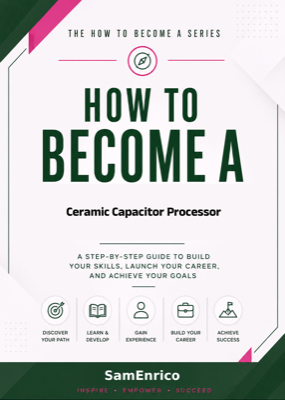
How to Become a Ceramic Capacitor Processor eBook
How to Become a Ceramic Capacitor Processor
by Slade Pearly
How to Become a Ceramic Capacitor Processor
Formats
Free sample
Chapter 1: The Invisible Universe...–- Every smartphone in your pocket contains between 500 and 1,000 ceramic capacitors. Every electric vehicle on the road carries roughly 10,000 of them. A single Boeing 787 Dreamliner? Over 30,000. And yet, almost no one outside a small, secretive corner of manufacturing has ever heard of the people who make them possible.
You are about to become one of those people.This is not a story about components. This is a story about the invisible architecture of modern life—and the skilled hands and sharp eyes that build it, layer by microscopic layer.The Most Important Part You’ve Never Noticed Walk into any electronics factory, any repair shop, any engineering lab. Open any circuit board—from a 2children’stoytoa2 children’s toy to a 2children’stoytoa50 million satellite. What do you see? A forest of tiny, rectangular, beige or brown blocks.
No moving parts. No logos worth remembering. No drama. Just silence.Those blocks are multilayer ceramic capacitors—MLCCs for short. And they are the lungs of the electronic age.Every time a microprocessor demands a sudden gulp of current, ceramic capacitors exhale it.
Every time a power supply switches on or off, they smooth the voltage. Every time a signal travels from one chip to another, they filter out the noise. Without them, your phone would reset every time you touched the screen. Your car’s anti-lock brakes would trigger randomly. Your pacemaker would interpret muscle twitches as heart attacks.The world runs on ceramic capacitors.
And ceramic capacitors run on processors.Not computer processors—human processors. The men and women standing in front of mixing tanks, tape casters, lamination presses, kilns, and electrical testers. The people who take raw, gray barium titanate powder and turn it into chips smaller than a grain of sand, with internal layers thinner than a red blood cell.That is what this book is for. That is what you are here to become.The Three Numbers That Rule Your Life Before you touch a single machine, you need to understand three numbers. Every ceramic capacitor processor lives and breathes these numbers.
They are the language of the trade.Number One: Capacitance Capacitance is the amount of electrical charge a capacitor can store. Think of it as the size of a bucket. A small bucket holds a little water; a big bucket holds a lot. The unit of capacitance is the farad (F)—named after the English scientist Michael Faraday, who probably never imagined that one day, people would build farad-sized capacitors the size of a sugar cube.In practice, a farad is enormous. Most ceramic capacitors are measured in:Microfarads (µF) : one millionth of a farad.
Written as "10µF" on a datasheet.Nanofarads (n F) : one billionth of a farad. "100n F" is the most common value in digital electronics—so common that engineers call it "a hundred nan."Picofarads (p F) : one trillionth of a farad. "10p F" is typical for high-frequency tuning circuits.Here is your first processor rule: Capacitance is determined by three physical factors—plate area, plate separation, and dielectric constant. And you control all of them.A capacitor is just two conductive plates separated by an insulator (the dielectric). In an MLCC, the plates are internal nickel electrodes.
The dielectric is barium titanate ceramic. Make the plates larger, capacitance goes up. Move the plates closer together, capacitance goes up. Use a material with a higher dielectric constant, capacitance goes up.Your factory will ask you to hit a target capacitance: "We need 1.0µF, plus or minus 10 percent, in an 0603 case size." Achieving that target is a dance between tape thickness, number of layers, electrode pattern, and firing temperature. You will learn all of those dances in the chapters ahead.
For now, just know this: capacitance is the why.Number Two: Voltage Rating (Breakdown Voltage)A capacitor can only store so much energy before the dielectric gives up. When that happens, the insulator becomes a conductor. Current punches a hole straight through the ceramic. The part is dead. Sometimes it catches fire.
Sometimes it explodes—not with Hollywood fireballs, but with a sharp pop and a puff of smoke.The voltage rating (also called rated voltage, working voltage, or breakdown voltage) is the maximum continuous DC voltage that the manufacturer guarantees the part can withstand without failing. Common ratings for ceramic capacitors: 4V, 6.3V, 10V, 16V, 25V, 50V, 100V, 200V, 500V, 1000V, and even 3000V for special high-voltage parts.Important distinction: There is a difference between the voltage rating (a material property) and the Dielectric Withstanding Voltage test (a quality check). The DWV test applies a higher voltage—typically 2.5 times the rated voltage—for a short time (1 to 60 seconds) to verify that the manufacturing process didn't create hidden defects. A part can have a 50V rating but pass a 125V DWV test. You will run these tests in Chapter 9.
For now, remember: voltage rating is the limit. DWV is the proof.Your job as a processor is to ensure that every chip leaving your line can handle its rated voltage, plus a safety margin. That means no pinholes, no cracks, no delaminations, no internal shorts. One bad batch can destroy a customer’s entire production run. A single defective capacitor in an automotive braking module can kill people.That is not dramatic.
That is the job.Number Three: Dielectric Constant (K)The dielectric constant (symbol: K, or εᵣ) is a material’s ability to store electrical energy compared to a vacuum. A vacuum has a K of exactly 1. Air is about 1.0006. Paper is around 3. Barium titanate—the heart of your ceramic capacitor—has a K between 1,000 and 10,000, depending on its crystal structure and how it was processed.Here is the magic: pure barium titanate at room temperature has a K of roughly 1,500.
But when you dope it with additives like calcium zirconate or rare earth oxides, and when you sinter it at precisely the right temperature (see Chapter 7), the crystal lattice distorts into a tetragonal shape. That distortion creates electric dipoles—tiny internal compass needles that all align when you apply a voltage. Aligned dipoles store enormous energy.A high-K dielectric lets you build a 10µF capacitor in a 0402 case (1.0mm × 0.5mm). Without high-K materials, that same capacitor would be the size of your thumb.But there is a catch. High-K ceramics are temperature-sensitive.
They are piezoelectric (they change shape when you apply voltage, and produce voltage when you bend them). They age over time, losing capacitance logarithmically. They exhibit a phenomenon called "DC bias"—applying a voltage actually reduces the dielectric constant.You will learn to work with these imperfections. They are not bugs. They are features of the physics.
Every processor must understand them, anticipate them, and design them into the process.The Big Three: Ceramic vs. Electrolytic vs. Film Why do we use ceramic capacitors at all? Why not just use the other types? A short comparison will help you appreciate what you are building.Aluminum Electrolytic Capacitors:Very high capacitance (100µF to 1F)Inexpensive Polarized – they explode violently if connected backwards (the "pop" you hear when a power supply is miswired)High leakage current Short lifetime (2,000–10,000 hours)Large physical size Film Capacitors:Excellent stability and very low loss Long lifetime…
This is the end of the free sample. Get the eBook to keep going. Buy now
About this book
Details
- Author
- Slade Pearly
- Publisher
- SamEnrico
- Language
- English
- ISBN
- 9781505793659
- Genre
- Non-Fiction, Informative, Educational
- Released
- 2026-05-18
- Pages (approx.)
- 152
- Available as
- eBook, Paperback, Audiobook

Read better in the ZLOADR app
Your eBooks on your phone or tablet. Sign in with your SamEnrico account and start reading.
More by Slade Pearly
 Shopping Addiction And Loneliness ManualSlade Pearly$11.99
 Dream Journal for Spiritual GrowthSlade Pearly$11.99
 The Group Sitting GuideSlade Pearly$11.99
 Sugar Addiction and Chronic PainSlade Pearly$11.99
 The Forgotten Plague: How Smallpox Erased a NationSlade Pearly$11.99
 The Ice Age Healers: How Prehistoric Nomads Mastered Survival Medicine in Central AsiaSlade Pearly$11.99
 Marketing Operation SupervisorSlade Pearly$11.99
 Social Capital Leverage GuideSlade Pearly$12.99
 HSK Requirements for ChinaSlade Pearly$12.99
 Understanding Congenital CSlade Pearly$17.99
You may also like
 Hong Kong Handover 1997Dunn Johnnie$11.99
 Zumba For Postnatal Recovery CourseNeal Christian$11.99
 Zumba for BeginnersLadner Nikia$11.99
 YouTube Comment Mining GuideHumes Pandora$12.99
 Worry Box MeditationCarlin Rudy$11.99
 Workplace Stress MeditationNguyen Lynn$11.99
 Workplace Stress and Sleep RepairHawley Ivory$11.99
 Workplace Perfectionism CureDelaney Jeffry$11.99
 Workplace Injustice Anger GuideWallen Isabelle$11.99
 Work Addiction and Burnout LinkGreenwood Ester$11.99
 Women in Yoga and WellnessBeattie Galina$11.99
 Women in Stand Up ComedyChun Evangeline$11.99