
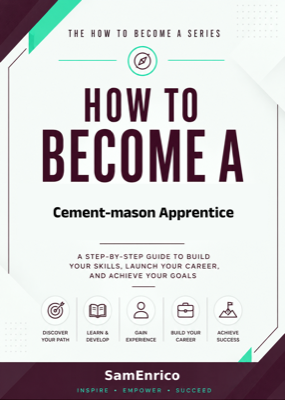
How to Become a Cement-mason Apprentice eBook
How to Become a Cement-mason Apprentice
by Casimir Gena
How to Become a Cement-mason Apprentice
Formats
Free sample
Chapter 1: The Gray Gold Rush--– In a sprawling warehouse on the outskirts of Phoenix, Arizona, a fifty-seven-year-old journeyman cement mason named Frank Castellano knelt on a rubber pad and ran his magnesium float across six thousand square feet of freshly poured industrial slab. The concrete was exactly forty-five minutes old—right in the pocket of its finishing window. The bleed water had evaporated. The surface was stiff enough to hold a footprint but plastic enough to move under his float. Frank wasn't thinking about chemistry or timing.
He was thinking about his apprentice, a twenty-two-year-old former grocery store stocker who had walked onto the job site six months earlier knowing nothing about concrete. That apprentice was now pulling his own edger along the perimeter, cutting a clean radius, and not once looking up for approval. Frank smiled behind his dust mask. That kid was going to make journeyman before thirty. That kid was going to own a house.
That kid was going to have a pension.Frank himself had started the same way—zero experience, calloused hands from a different trade, and a desperate need for something that paid better than minimum wage and didn't require a college degree he couldn't afford. Thirty-eight years later, he had bought two houses, raised three children, and never once worried about being replaced by automation. You cannot automate finishing concrete. You cannot outsource a slab to India. The work stays where the building is, and the buildings are everywhere.This book exists because of a single, undeniable fact about the American economy: we have a catastrophic shortage of skilled tradespeople, and cement masons are among the rarest and most valuable of them all.
The Associated General Contractors of America reported in 2024 that over ninety percent of construction firms were having difficulty finding qualified craft workers. The National Association of Home Builders estimated that the industry needed to attract more than half a million new tradespeople annually just to keep pace with retirements and infrastructure demand. And yet, high school guidance counselors continue to push four-year degrees toward students who will graduate with an average of thirty-seven thousand dollars in student debt and a degree in a field that may not exist in its current form a decade from now. Meanwhile, a first-year cement mason apprentice in a major metropolitan area earns more than the median college graduate's starting salary—without the debt, without the four years of tuition, and without the soul-crushing uncertainty of whether their major will still be relevant.If you are reading this book, you have already taken the first step. You have identified that there is something worth knowing about cement masonry.
You have sensed, perhaps without being able to articulate it, that the construction trades represent one of the last true ladders of opportunity in an economy that has become hostile to anyone without a four-year degree. You are right. And what follows is the complete, unvarnished, step-by-step guide to climbing that ladder.The Most Misunderstood Trade in Construction Here is the problem that this book solves: most people have no idea what a cement mason actually does, how to become one, or why they should want to be one. The confusion starts with the name itself. Ask ten people on the street what a cement mason does, and eight of them will say something like "pours cement" or "lays bricks." Both answers are wrong.
Cement is an ingredient—the gray powder that reacts with water to act as a binder. Concrete is the finished product: cement, water, aggregates (sand and stone), and often chemical admixtures that modify its behavior. A cement mason does not pour cement. A cement mason places, spreads, screeds, floats, edges, joints, and trowels concrete. That person is the final artist on a pour, the one whose skill determines whether a floor is flat enough for robotics, whether a driveway will crack within a year or last thirty, whether a hospital floor will harbor bacteria in microscopic crevices or provide a seamless, cleanable surface that saves lives.And a cement mason is emphatically not a bricklayer.
Bricklayers lay individual units—bricks, blocks, stones—with mortar. General masons work with stone, brick, and block in structural applications. Cement masons work exclusively with concrete in its plastic, fresh, and green states, transforming a gray, soupy, unremarkable mixture into a surface that humans will walk, drive, work, and live on for generations. The distinction matters because the training is different, the tools are different, the job sites are different, and the wages are often different. A bricklayer and a cement mason both work with masonry materials, but their crafts are as distinct as those of a carpenter and a cabinetmaker.The Economic Reality That Changes Everything Let us talk about money, because money is an honest starting point for any career decision.
According to the United States Bureau of Labor Statistics Occupational Outlook Handbook, cement masons and concrete finishers earn a median annual wage of approximately fifty-three thousand dollars nationally. That median, however, hides the real story. In high-cost, high-union-density states like California, Illinois, New York, and Massachusetts, journeymen cement masons routinely earn between seventy and one hundred thousand dollars annually, with overtime and prevailing wage jobs pushing experienced finishers well into six figures. Apprentices start between sixty and seventy percent of journeyman scale—typically eighteen to twenty-eight dollars per hour—and receive scheduled raises every six to twelve months until they reach full scale. That means a hardworking apprentice can go from zero experience to earning more than the national median household income within two to three years.But there is a second number that matters more than the hourly wage: the debt number.
The average four-year college graduate in the United States leaves school with thirty-seven thousand dollars in student loan debt. The average cement mason apprentice leaves their apprenticeship with zero dollars in debt, a full set of tools, and an offer letter from a contractor who has already invested three to four years training them. That difference compounds over a lifetime. The college graduate makes loan payments for ten to twenty years, accruing interest, deferring homeownership, delaying retirement savings. The cement mason, by contrast, starts earning journeyman scale at age twenty-two or twenty-three, buys a house with a conventional mortgage, and begins contributing to a pension or retirement account a full decade before many of their college-educated peers.
The math is not subtle. The math is brutal. And the math favors the trades.Consider a concrete example. Two eighteen-year-olds, Alex and Jordan. Alex goes to a state university for four years, graduates with thirty-seven thousand dollars in student loans at five percent interest, and gets a job paying fifty thousand dollars per year.
Jordan becomes a cement mason apprentice, earns twenty-two dollars per hour starting out (forty-five thousand dollars per year), and receives scheduled raises every year. By age twenty-two, Alex is making fifty thousand dollars but paying five thousand dollars per year in student loan interest. Jordan is making fifty-five thousand dollars as a second-year apprentice with zero debt. By age twenty-six, Alex has finally paid off the loans and is making sixty thousand dollars. Jordan is a journeyman making seventy-five thousand…
This is the end of the free sample. Get the eBook to keep going. Buy now
About this book
Details
- Author
- Casimir Gena
- Publisher
- SamEnrico
- Language
- English
- ISBN
- 9781505804812
- Genre
- Non-Fiction, Informative, Educational
- Released
- 2026-05-02
- Pages (approx.)
- 137
- Available as
- eBook, Paperback, Audiobook

Read better in the ZLOADR app
Your eBooks on your phone or tablet. Sign in with your SamEnrico account and start reading.
More by Casimir Gena
 Technical Difficulty Anxiety ProtocolCasimir Gena$11.99
 Performance Review Self EsteemCasimir Gena$11.99
 Instagram Reels MasteryCasimir Gena$11.99
 The Teen Assertiveness Roleplay GuideCasimir Gena$11.99
 Yaka Mask Initiation GuideCasimir Gena$11.99
 The Grand Jeté: How Black Ballerinas Conquered the World StageCasimir Gena$11.99
 Understanding Post-infectious MyocarditisCasimir Gena$17.99
 HARO Social Proof BuildingCasimir Gena$12.99
 Software License GuideCasimir Gena$12.99
 Clinical ResearcherCasimir Gena$11.99