
Non-FictionInformativeEducational
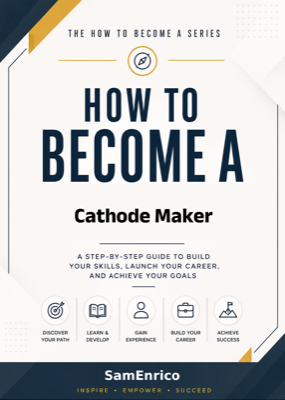
How to Become a Cathode Maker Paperback
How to Become a Cathode Maker
How to Become a Cathode Maker
Formats
Free sample
Chapter 1: The $100 Million Gram--You are about to make a material so valuable that a single metric ton can cost more than a house, so reactive that mishandling it can start a fire, and so precise that a 0.1% impurity can render an entire batch worthless. You are about to become a cathode maker.Before you mix your first slurry or fire your first kiln, you need to understand one uncomfortable truth: the cathode is not just another component in a lithium-ion battery. It is the battery. Everything else—the anode, the electrolyte, the separator, the current collectors—exists to serve the cathode. When an electric vehicle fails to reach its promised range, the cathode is usually to blame.
When a smartphone battery swells, the cathode started the reaction. When a grid storage system catches fire, the cathode's instability likely lit the match.And yet, despite its critical importance, the cathode remains the least understood and most poorly taught subject in battery manufacturing. Chemists learn about intercalation in abstract terms. Engineers learn about electrode coating without understanding the powder that goes into the slurry. Technicians learn how to operate furnaces without knowing why a five-degree temperature change doubles the cycle life.
This book closes those gaps.This chapter answers three foundational questions: What exactly is a cathode? Why does it determine battery performance more than any other component? And—most importantly—why should you, the reader, invest your career in making them?The Cathode's Secret: It's a Host, Not a Reactant Most people imagine batteries working like a chemical explosion—fuel and oxidizer reacting violently, releasing energy until one runs out. That is a great description of a firework or a rocket engine, but a terrible description of a lithium-ion battery.A lithium-ion battery works more like a hotel. The cathode is the check-in desk.
Lithium ions arrive from the anode (the check-out desk), move through the electrolyte (the hallway), and find available rooms—empty lattice sites—within the cathode's crystal structure. The more rooms available, the higher the capacity. The higher the voltage of those rooms (their energy level), the more energy each lithium ion releases when it checks out during discharge.This hotel analogy is not just cute; it is structurally accurate. Every cathode material is defined by three architectural features:The room layout (crystal structure): Layered (NMC, NCA), olivine (LFP), or spinel (LMO, LMNO). Each layout has different room sizes, hallway widths (lithium diffusion pathways), and structural stability.The number of rooms (reversible lithium content): Measured in milliampere-hours per gram (m Ah/g).
More rooms mean higher capacity, but too many rooms and the walls collapse.The room's energy level (voltage vs. Li/Li⁺): Determined by the redox potential of the transition metal. Higher voltage means more energy per ion, but higher voltage also means more aggressive reactions with the electrolyte.This last point deserves emphasis because it explains the single most important trade-off in cathode engineering. A 0.1 volt increase in voltage yields approximately 5% more energy at the cell level. That is enormous—the difference between a 300-mile EV and a 315-mile EV from the exact same pack size.
But that 0.1 volt increase also accelerates degradation reactions at the cathode-electrolyte interface by a factor of two to three. The electrolyte oxidizes. Transition metals dissolve. Oxygen evolves from the lattice. The hotel walls crumble.Your job as a cathode maker is not to maximize voltage or maximize capacity in isolation.
Your job is to find the intersection where all three properties—capacity, voltage, and lifetime—meet the customer's requirements. An EV needs moderate voltage, high capacity, and long cycle life. A grid…
This is the end of the free sample. Get the Paperback to keep going. Buy now
About this book
Details
- Author
- Centeno Tristan
- Publisher
- SamEnrico
- Language
- English
- ISBN
- 9781505793123
- Genre
- Non-Fiction, Informative, Educational
- Released
- 2026-06-02
- Pages (approx.)
- 128
- Available as
- eBook, Paperback, Audiobook

Read better in the ZLOADR app
Your eBooks on your phone or tablet. Sign in with your SamEnrico account and start reading.
More by Centeno Tristan
 Senate Floor Debate TacticsCenteno Tristan$11.99
 The Complete Body Scan GuideCenteno Tristan$11.99
 High-Risk Region Executive Protection HandbookCenteno Tristan$11.99
 Tariff Engineering for ImportersCenteno Tristan$11.99
 Self Hypnosis Fibromyalgia ReliefCenteno Tristan$11.99
 The Silent Witness: How a Forgotten Fingerprint Solved a 50-Year-Old MurderCenteno Tristan$11.99
 The Forgotten Cartographer: Juan de la Cruz’s Lost Andes ExpeditionCenteno Tristan$11.99
 Multi Sourcing Risk ReductionCenteno Tristan$12.99
 China Student Health InsuranceCenteno Tristan$12.99
 Understanding Congenital Heart Septum DefectCenteno Tristan$17.99
 Pollucite MiningCenteno Tristan$11.99
You may also like
 Hong Kong Handover 1997Dunn Johnnie$11.99
 Zumba For Postnatal Recovery CourseNeal Christian$11.99
 Zumba for BeginnersLadner Nikia$11.99
 YouTube Comment Mining GuideHumes Pandora$12.99
 Worry Box MeditationCarlin Rudy$11.99
 Workplace Stress MeditationNguyen Lynn$11.99
 Workplace Stress and Sleep RepairHawley Ivory$11.99
 Workplace Perfectionism CureDelaney Jeffry$11.99
 Workplace Injustice Anger GuideWallen Isabelle$11.99
 Work Addiction and Burnout LinkGreenwood Ester$11.99
 Women in Yoga and WellnessBeattie Galina$11.99
 Women in Stand Up ComedyChun Evangeline$11.99