
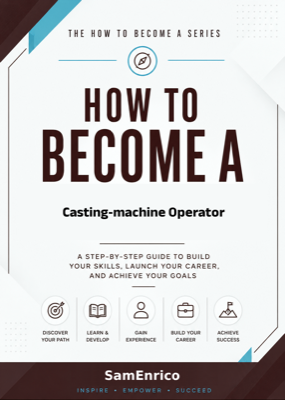
How to Become a Casting-machine Operator eBook
How to Become a Casting-machine Operator
by Glynn Telma
How to Become a Casting-machine Operator
Formats
Free sample
Chapter 1: The Oldest Secret--–- Before you touch a lever, before you step onto a shop floor, before you even fill out an application, you need to understand one thing: the machine is not the secret. The metal is not the secret. The secret is that this trade has been passed down in fragments for five thousand years—half remembered, half guessed, and never written down in one place. Until now.You are about to enter a profession that built civilization. Every bridge you have crossed, every car you have driven, every surgical instrument that has ever touched a human body—all of them contain cast metal.
The engine block in your car was poured into a die. The valve bodies in your plumbing were cast in sand. The aluminum chassis of the airplane that took you on vacation was born as molten metal in a foundry. Without casting, the modern world stops. Not slows down.
Stops.And yet, most people have no idea what a casting-machine operator actually does. They imagine a dimly lit factory, a man with a ladle, sweat dripping into a puddle of molten metal. That image is fifty years out of date. Today’s foundries are filled with robots, sensors, and computers. The modern casting-machine operator is part mechanic, part chemist, part data analyst, and part safety inspector.
You will read thermal imaging cameras. You will interpret statistical process control charts. You will troubleshoot hydraulic systems. You will work alongside six-axis robots. And you will do all of this while standing a few feet away from metal that is hot enough to turn steel into a puddle.Here is the truth that no trade school will tell you and that no engineering textbook will admit: the most valuable skill in a foundry cannot be taught in a classroom.
It is the ability to listen. To feel. To know by the sound of a hydraulic pump whether the oil is too hot. To see a casting and know instantly that the cold shut you are looking at came from a die that is fifty degrees too low. To put your hand on a tie bar during a shot and feel the stretch that tells you the die is dying.
This is not magic. It is not intuition. It is pattern recognition built on knowledge. And that knowledge is what this book delivers.This chapter grounds you in two essential foundations. First, you will learn the history of casting—not because history is required for pulling a lever, but because understanding why things are done a certain way helps you remember how to do them when something goes wrong.
Second, you will learn the language of the foundry. Words matter. When you walk onto a shop floor, the first thing the old-timers will judge is whether you speak their language. Call a die a “mold” and they will know you are green. Call slag “dirt” and they will never trust you.
This chapter gives you the vocabulary you need to survive the first ninety days.By the end of this chapter, you will understand where this ancient trade came from, where it is going, and exactly where you fit into that story. You will know the difference between ferrous and non-ferrous foundries, between captive and jobbing shops, and between the role of an operator and the role of an engineer. Most importantly, you will understand that becoming a skilled casting-machine operator is not about brute strength or years of hazing. It is about systematic observation, unbreakable safety discipline, and something the author calls mechanical empathy—the ability to feel what a machine is doing through the vibrations in your boots, the rhythm of the cycle, and the language of the metal.Let us begin where all casting begins: with fire and dirt.The Five-Thousand-Year-Old Trade The first cast metal object that archaeologists have definitively identified is a copper frog from Mesopotamia, dated to approximately 3200 BCE. It is small, crude, and lopsided.
But it represents a leap in human capability that is difficult to overstate. Before casting, the only way to shape metal was by hammering—a slow, laborious process that could only produce simple shapes. Casting allowed humans to create complex, three-dimensional forms by pouring liquid metal into a cavity and letting it freeze. The frog is not beautiful, but it proved a concept: liquid metal takes the shape of whatever container holds it.For the next three thousand years, casting remained a slow, artisanal craft. The Chinese cast bronze bells that weighed several tons.
The Romans cast lead pipes that carried water across their empire. The Indian subcontinent cast the Iron Pillar of Delhi—a seven-meter column that has resisted rust for sixteen centuries. In each case, the process was essentially the same: a pattern was pressed into sand, the sand was removed, and molten metal was poured into the void. The operator worked with simple tools: a ladle, a crucible, a pair of tongs, and a strong back.The Industrial Revolution changed everything. In 1709, Abraham Darby discovered how to cast iron using coke instead of charcoal, making iron affordable for the first time in history.
Cast iron bridges spanned rivers. Cast iron wheels rolled on railroads. Cast iron pots hung in every kitchen. The foundry became the heart of the industrial city—hot, dangerous, and filled with men who worked twelve-hour shifts for pennies a day.The next revolution came in the mid-nineteenth century with the invention of the die casting machine. Instead of pouring metal into a single-use sand mold, die casting injected molten metal into a permanent steel die under high pressure.
The first patent for a die casting machine was filed in 1849 by a man named Sturges. It was a hand-operated plunger that forced type metal into a steel mold to produce printing type. Within fifty years, die casting machines were producing everything from carburetor bodies to toy cars.Today, the largest high-pressure die casting machines weigh over a thousand tons and exert clamping forces of five thousand tons or more. They can produce an engine block in under sixty seconds. They are fed by automated ladles, cooled by computer-controlled water lines, and unloaded by robots.
The operator sits in a control room with a computer screen, monitoring temperatures, pressures, and cycle times. The old dungeon is gone. But the fundamental physics—the way metal flows, freezes, and shrinks—has not changed at all.Why does this history matter to you, the new operator? Because it teaches you humility and confidence in equal measure. Humility, because the problems you will face today—porosity, cold shuts, soldering—have been faced by every casting operator for five thousand years.
You are not the first person to curse a die that will not release. Confidence, because if those problems have been solved for five millennia, they can be solved by you. The tools are better now, but the principles are ancient. Respect the principles, and the principles will serve you.The Language of the Shop Floor Before you can operate a machine, you must speak the language of the trade. This is not about showing off.
It is about safety, efficiency, and credibility. When a supervisor shouts “Check the parting line!” you need to know exactly…
This is the end of the free sample. Get the eBook to keep going. Buy now
About this book
Details
- Author
- Glynn Telma
- Publisher
- SamEnrico
- Language
- English
- ISBN
- 9781505792843
- Genre
- Non-Fiction, Informative, Educational
- Released
- 2026-04-25
- Pages (approx.)
- 145
- Available as
- eBook, Paperback, Audiobook

Read better in the ZLOADR app
Your eBooks on your phone or tablet. Sign in with your SamEnrico account and start reading.
More by Glynn Telma
 Shift Work Sleep Study PreparationGlynn Telma$11.99
 Self Esteem and Kink DynamicsGlynn Telma$11.99
 Body Image for Mast Cell Disease GuideGlynn Telma$11.99
 Downsizing Rental HistoryGlynn Telma$11.99
 The Customer Success ConnectorGlynn Telma$11.99
 Whispers in the Silk Road: The Unseen War of the Han DynastyGlynn Telma$11.99
 The Silent Alchemist: Dmitri Mendeleev and the Quest for the Periodic Table in Central AsiaGlynn Telma$11.99
 Understanding Extrapyramidal DisorderGlynn Telma$17.99
 Maverick Spend ReductionGlynn Telma$12.99
 Executive Summary Samples Across Seven IndustriesGlynn Telma$12.99
 Opium HarvestingGlynn Telma$11.99