
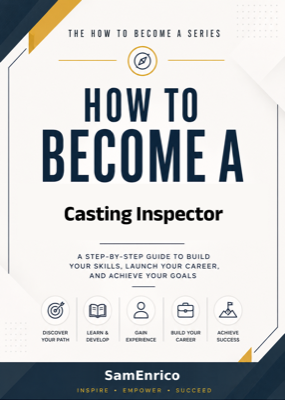
How to Become a Casting Inspector eBook
How to Become a Casting Inspector
How to Become a Casting Inspector
Formats
Free sample
Chapter 1: The Sixty-Thousand-Dollar Look--It begins not with a certification, not with a classroom, and certainly not with a six-figure salary. It begins with a single glance. A casting inspector walks onto a foundry floor, picks up a rough, sand-covered piece of metal that weighs maybe forty pounds, turns it once under a bare bulb, and sets it down in the reject pile. The production manager rushes over. “What did you see?” The inspector points to a faint line no longer than a fingernail.
“Cold shut. Grind it and you’ll find it goes deep. This one fails.” Three hours later, a metallurgist confirms the call. That single look saved an aerospace customer from a catastrophic in-flight failure. And that inspector, with no college degree and only two years of on-the-job training, earned $68,000 that year.This is the story this book exists to tell.
Casting inspection is one of the most overlooked, most accessible, and most consistently well-paying blue-collar careers in modern manufacturing. It requires no four-year degree. It does not demand extraordinary physical strength or years of unpaid apprenticeship. What it does demand is a sharp eye, a systematic mind, and the willingness to learn a set of skills that most people do not even know exist. This chapter is the roadmap.
By the time you finish it, you will understand exactly what a casting inspector does, why companies are desperate to hire them, how much money you can expect to make at each step of your career, and which certifications actually matter. More importantly, you will know whether this career fits you.The Hidden Demand That Nobody Talks About Every metal part that cannot be cut from a solid block of material—and some that can—starts as a casting. Engine blocks, transmission housings, valve bodies, turbine blades, pump casings, landing gear components, artillery shells, surgical instrument handles, and thousands of other parts are poured as liquid metal into a mold and solidified. Casting is the oldest metalworking process after forging, dating back more than six thousand years. But modern castings are not simple.
They are complex, thin-walled, heavily cored, and often made from exotic alloys that behave unpredictably as they cool.Here is the problem that creates the demand for inspectors. Every single casting contains defects. That statement surprises most newcomers, but it is the absolute foundation of the trade. No casting emerges from its mold perfectly sound. The physics of solidification guarantees shrinkage.
The chemistry of molten metal guarantees gas porosity. The interaction between liquid metal and sand molds guarantees inclusions. The question is never “Is this casting perfect?” The question is always “Are the defects within acceptable limits?” Someone has to answer that question. That someone is the casting inspector.Industries that cannot tolerate unplanned failures employ the most inspectors. Aerospace leads the list.
A casting failure at thirty thousand feet is not an inconvenience; it is a catastrophe. The Federal Aviation Administration and its international counterparts mandate rigorous inspection of every critical casting that goes into an aircraft. Next is the oil and gas industry, where a failed valve body can release high-pressure hydrocarbons with explosive force. Then automotive, particularly for safety-critical components like brake calipers and steering knuckles. Defense, medical devices, nuclear power—all of them require casting inspectors.The demand has grown faster than the supply of qualified inspectors for two decades.
The average age of a certified NDT (non-destructive testing) inspector in the United States is fifty-seven years. Thousands are retiring every year. Young people are not entering the trade because they do not know it exists. High schools push four-year degrees. Trade schools focus on welding and machining.
Casting inspection falls into a crack between metallurgy, quality control, and NDT. That crack is where you will find opportunity.If you search job boards today for “casting inspector” or “NDT inspector foundry,” you will find hundreds of open positions. Many go unfilled for months. Employers routinely offer signing bonuses, relocation assistance, and tuition reimbursement for certification courses. In the Midwest foundry belt—Ohio, Indiana, Wisconsin, Michigan—starting wages for a trainee with no experience and no certifications often begin at 22to22 to 22to28 per hour.
That is 45,000to45,000 to 45,000to58,000 per year before overtime. With overtime, which is plentiful in production foundries, first-year earnings frequently exceed $70,000.Three Ways to Work: Foundry, Third-Party, or Resident The career path splits into three distinct models. Each has different advantages, different stresses, and different earning potential. You should understand all three before you decide which direction to pursue.The first and most common model is the foundry-based QC inspector. You work directly for a casting producer.
Your job is to inspect the castings that come out of that foundry before they ship to customers. Your authority comes from the foundry’s own quality manual and from customer purchase orders. The advantage of this model is stability. You report to the same building every day. You learn that foundry’s processes intimately.
You build relationships with the production team, the metallurgist, and the plant manager. The disadvantage is pressure. When production is behind schedule—and it often is—the same people you work beside every day will ask you to “help them out” by accepting borderline parts. Saying no to a colleague is harder than saying no to a stranger. The salary range for foundry-based inspectors is typically 50,000to50,000 to 50,000to85,000, with senior leads reaching $100,000.The second model is the third-party inspection agency.
Companies like SGS, Bureau Veritas, Applied Technical Services, and dozens of smaller firms contract with casting buyers to perform independent inspections. You do not work for the foundry. You do not work for the customer. You work for the agency, and the agency’s only product is impartial judgment. You travel to foundries, often driving from one to another in a single week.
Your authority comes from the purchase order and the governing standard, not from any relationship. The advantage is independence. When you reject a part, nobody can claim you are protecting your own employer. The disadvantage is travel and unpredictability. You might inspect aluminum die castings in Illinois on Monday, steel sand castings in Indiana on Wednesday, and investment castings in Ohio on Friday.
You need to be adaptable, organized, and comfortable living out of a suitcase. The salary range is broader: 55,000to55,000 to 55,000to110,000, with per-diem payments and mileage reimbursements adding significant value.The third model is the resident customer inspector. Large casting buyers—think Caterpillar, John Deere, Ford, Boeing—sometimes embed their own inspectors inside a supplier’s foundry. You work for the customer but you live at the foundry. Your job is to inspect every casting before it ships to your employer.
The advantage is authority. You represent the customer. When you reject a part, you are not asking permission; you are enforcing a contract. The disadvantage is isolation. You are not part of the foundry team, but you are not part of the home office team either.
You sit in the middle, often resented by both sides. Salaries for resident inspectors are the highest of the three models, typically 70,000to70,000 to 70,000to130,000, because the customer demands experienced personnel who can make autonomous decisions.The Career Ladder: From Helper to…
This is the end of the free sample. Get the eBook to keep going. Buy now
About this book
Details
- Author
- Donald Britta
- Publisher
- SamEnrico
- Language
- English
- ISBN
- 9781505792706
- Genre
- Non-Fiction, Informative, Educational
- Released
- 2026-05-02
- Pages (approx.)
- 128
- Available as
- eBook, Paperback, Audiobook

Read better in the ZLOADR app
Your eBooks on your phone or tablet. Sign in with your SamEnrico account and start reading.
More by Donald Britta
 Property Manager RetirementDonald Britta$11.99
 Pablo Escobar Robin Hood MythDonald Britta$11.99
 Creative Sleep And Shower GuideDonald Britta$11.99
 Social Entrepreneur Media RelationsDonald Britta$11.99
 Call Center Escalation GuideDonald Britta$11.99
 The Last Oracle of DelphiDonald Britta$11.99
 The First Crossing: The Prehistoric Voyagers of the Indian OceanDonald Britta$11.99
 Registered Respiratory TherapistDonald Britta$11.99
 Strategy Meeting Facilitation FormulaDonald Britta$12.99
 EU VAT Rates by CountryDonald Britta$12.99
 Understanding Familial Symmetric LipomatosisDonald Britta$17.99