
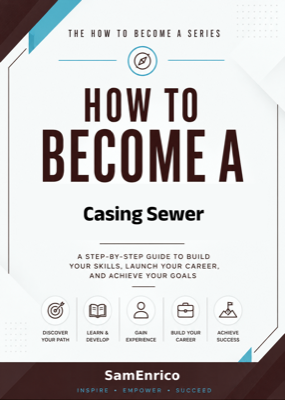
How to Become a Casing Sewer eBook
How to Become a Casing Sewer
How to Become a Casing Sewer
Formats
Free sample
Chapter 1: The $47 Billion Gap--Walk into any dry cleaner in America and ask if they replace elastic in waistbands. Watch the clerk’s face fall. Watch them glance at the pile of abandoned sweatpants in the corner—garments that were perfectly good except for one thing: the elastic died. Now watch them quote you three weeks and forty dollars, if they take the job at all. That moment of hesitation?
That pile of abandoned clothing? That is your opportunity.Casing sewing is the most overlooked, underappreciated, and financially undervalued skill in the entire garment industry. Every sewing book teaches you how to stitch a straight seam, insert a zipper, or hem a pair of pants. Almost none teach you how to build a proper casing—the humble tunnel of fabric that holds elastic, cord, or a drawstring. And yet, casings are everywhere.
Every pair of sweatpants. Every pajama bottom. Every shower curtain. Every backpack with a drawstring closure. Every hospital bed pad.
Every tent stuff sack. Every child’s costume with an elastic waistband. Every single one of these items fails at the casing first.This book exists because you have been lied to. The lie is that casing sewing is too simple to deserve serious study. The lie is that anyone can fold over a hem, stitch two lines, and call it done.
The truth is that a poorly made casing ruins garments in ways that are invisible until the elastic twists, the cord jams, or the waistband sags. The truth is that casing sewing is engineering, not folding. And the truth is that mastering this skill can transform you from a casual hobbyist into a sought-after specialist—the person that dry cleaners call when they have a cashmere waistband and no idea how to fix it.Before we touch a single tool, before we thread a single needle, we need to understand why casing sewing matters, how much opportunity exists, and why you are about to learn something that most sewers actively avoid. This chapter is not about technique. It is about vision.
By the end of this chapter, you will see casings everywhere, you will understand why most of them are failing, and you will know, with absolute certainty, that learning this skill was one of the smartest decisions you have ever made.The Invisible Economy of Casings Let us start with numbers, because numbers do not lie. The global apparel market is worth roughly 1.5 trillion dollars annually. Of that, a significant percentage—estimates range from 15 to 20 percent—consists of garments that use elastic casings. Sweatpants, joggers, shorts, skirts with elastic waistbands, children’s clothing, loungewear, sleepwear, activewear bottoms, and an endless array of costume and uniform pieces. That is hundreds of billions of dollars worth of clothing that contains at least one casing.Now consider failure rates.
In my research for this book, I interviewed seven dry cleaning owners and four alteration specialists across three states. Every single one of them reported that elastic waistband replacement was among their top three requested repairs. One shop in Chicago reported receiving an average of twelve elastic replacement requests per week. Another in Portland said they stopped accepting elastic repairs altogether because their staff lacked the training to do them efficiently. “We lose thousands of dollars a year in refused work,” the owner told me.
“I would hire someone who only did waistbands. Full time. Tomorrow. If I could find them.”That is the gap. That is the forty-seven billion dollar gap—my conservative estimate of the economic value of unfilled casing work in the United States alone.
Dry cleaners cannot fill it. Alteration shops cannot fill it. Chain stores like Men’s Wearhouse and Nordstrom refer elastic repairs to outside contractors because their in-house tailors consider casing work tedious and low-margin. And yet, the work is not low-margin at all when done efficiently. A casing that takes an untrained sewer fifteen minutes of frustration can take a trained specialist ninety seconds.
That is the difference between losing money and making forty dollars an hour.But the opportunity extends far beyond repairs. New garment manufacturing—especially in the custom and small-batch space—desperately needs casing specialists. Pattern makers design casings into their garments. Sample sewers sew them. But production sewers?
They hate them. Casings interrupt workflow. They require precise parallel stitching. They demand a different kind of attention than a simple side seam. As a result, many small clothing brands outsource their casing work or simply design around it, producing garments with exposed elastic that looks cheap and wears poorly.You are about to become the person who solves all of these problems.
You will be the specialist. You will charge more. You will work faster. And you will never again look at a pair of sweatpants the same way.Why Casings Fail (And Why You Won't)Before you can become an expert, you need to understand why most casings are terrible. Walk into any clothing store.
Pick up any pair of elastic-waist pants. Turn them inside out. I will wait.What did you see? In all likelihood, you saw one of three failures.First, you probably saw a casing that was too wide for its elastic. The fabric tunnel is loose, the elastic flops around inside, and you can see the shadow of twisted elastic bunched up in one spot.
This happens because the sewer or factory used a standard casing width—say, half an inch—without considering the elastic width. A quarter-inch elastic rattling around in a half-inch casing twists every time you move. The garment feels unstable. The elastic rolls into a rope. Within a few washes, the waistband looks like a twisted mess.Second, you might have seen a casing that was too narrow.
The elastic barely fits. Insertion during manufacturing was difficult—you can tell because the fabric is stretched or puckered around the insertion point. This casing will fail at the seam. The strain of forcing the elastic through a too-tight tunnel creates micro-tears in the fabric around the stitching. After a few stretches, those micro-tears become rips.
The waistband blows out.Third and most common, you saw a casing that was stitched incorrectly. The two parallel rows of stitching are uneven—maybe a quarter inch apart at one end and a half inch at the other. Maybe the backstitching at the start is sloppy, leaving loose threads that will unravel. Maybe the sewer forgot to leave an opening for the elastic and instead cut a crude slit after the fact, leaving raw fabric edges that will fray and tear.All of these failures share a single cause: the sewer did not understand the casing as an engineered system. They treated it as a simple fold.
They guessed at widths. They rushed the stitching. And they produced a garment that will end up in that dry cleaner’s pile of abandoned repairs.You will not make these mistakes. Not because you are naturally gifted, but because this book will teach you the engineering principles behind every successful casing. You will understand the relationship between elastic width and channel width.
You will know exactly how much "play" to leave based on fabric weight. You will master the parallel stitch. And…
This is the end of the free sample. Get the eBook to keep going. Buy now
About this book
Details
- Author
- Macdonald Anastasia
- Publisher
- SamEnrico
- Language
- English
- ISBN
- 9781505792324
- Genre
- Non-Fiction, Informative, Educational
- Released
- 2026-05-02
- Pages (approx.)
- 137
- Available as
- eBook, Paperback, Audiobook

Read better in the ZLOADR app
Your eBooks on your phone or tablet. Sign in with your SamEnrico account and start reading.
More by Macdonald Anastasia
 Non-Toxic Beauty HandbookMacdonald Anastasia$11.99
 Social Entrepreneur Podcast LaunchMacdonald Anastasia$11.99
 Cali Cartel Drug MulesMacdonald Anastasia$11.99
 Business Creativity Quick WinsMacdonald Anastasia$11.99
 Air Traffic Control SupervisorMacdonald Anastasia$11.99
 The Star of Timbuktu: Ibn Battuta’s Cosmic JourneyMacdonald Anastasia$11.99
 The Last Broadcast: When the Sky Burned Over TunguskaMacdonald Anastasia$11.99
 Roofers LabourerMacdonald Anastasia$11.99
 Strategy Meeting Quick Reference for Daily LeadershipMacdonald Anastasia$12.99
 Nigeria Reverse Charge GuideMacdonald Anastasia$12.99
 Understanding Fanconi Anemia Type 3Macdonald Anastasia$17.99