

Non-FictionInformativeEducational
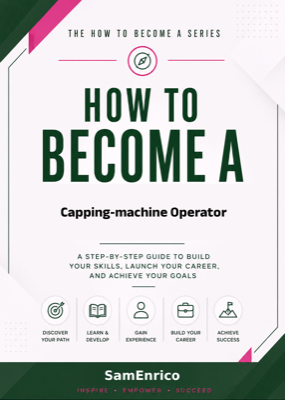
How to Become a Capping-machine Operator eBook
How to Become a Capping-machine Operator
How to Become a Capping-machine Operator
Formats
Free sample
Chapter 1: The Last Line--The first time a cap failed on my watch, I didn't even know it had happened. I was eighteen years old, three weeks into my first manufacturing job at a regional soda bottling plant, and I thought I had mastered the capping machine in about forty-five minutes. That was my first mistake. The second was assuming that because the machine was running, it was running correctly. Twelve thousand bottles of lemon-lime soda later, I stood on a sticky floor while my supervisor—a woman named Dottie who had been capping bottles since before I was born—drew a single wet finger across a pallet of stacked cases.
She didn't say a word. She just held up her finger, glistening with leaked soda, and looked at me. That look said everything: You missed it. You missed all of it.The Job Nobody Sees Let me tell you something about the role of a capping machine operator that most people never understand. When you tell someone you work in manufacturing, they picture assembly lines and robots.
When you say you run a capping machine, they smile blankly and change the subject. The cap is invisible. It is the smallest component on the package, the last thing anyone thinks about, and the first thing that fails when no one is paying attention.But here is the truth that separates a career from a dead-end job: the capping machine operator is the single most important quality control position on any packaging line. Not the lab technicians with their clipboards. Not the quality assurance manager in the air-conditioned office.
Not the $50,000 vision system that checks every bottle for cap presence. You. The person standing in front of the machine, with your hands on the controls, your eyes on the bottles, and your name on the batch record.I learned this the hard way, standing in that puddle of soda while Dottie silently showed me the evidence of my failure. She didn't yell. She didn't write me up.
She just said, "You're the last line, kid. The machine doesn't care. The caps don't care. You have to care for all of them." Then she walked me back to the capper and spent the next hour teaching me how to feel the difference between a cap that was tight enough and one that was just pretending.That was fifteen years ago. I have run cappers in three industries—beverage, pharmaceutical, and food—and I have trained dozens of operators.
Some of them became supervisors. Some became maintenance technicians. A few became plant managers. The ones who washed out? They never understood the fundamental truth of this job: you are not a button-pusher.
You are a guardian.The Industries That Depend on You Before we go any further, let me show you where capping machine operators actually work. This isn't a narrow career. Every sealed container in the modern world passed through a capping machine, and someone was standing next to it.Food and Beverage is where most operators start. This includes everything from the soda line where I learned my lesson to peanut butter jars, pickle jars (which use a specialized lug cap that only turns a quarter of the way), cooking oil bottles, juice cartons with tamper-evident bands, and yogurt drinks with foil seals. In food, your enemy is leakage.
A single loose cap on a salad dressing line doesn't just ruin that bottle—it drips onto the conveyor, contaminates the next fifty bottles, attracts pests, and triggers a full sanitation shutdown. I have seen a two-ounce drip cost a plant $30,000 in lost production.Pharmaceuticals are a different world entirely. Here, the cap is not just a lid—it is a drug safety device. Child-resistant closures (CRCs) require a specific push-and-turn motion that adults can manage but children cannot. Tamper-evident bands must break away visibly the first time the bottle is opened.
The torque specifications are measured in Newton-centimeters with tolerances so tight that a variation of five percent means the entire batch is rejected. In pharma, your failure doesn't cause a spill. It causes a recall. And a recall can cost a company millions, trigger FDA investigations, and, in the worst cases, lead to patient harm. I have stood next to operators who discovered a capping error that would have affected ten thousand prescription bottles.
The look on their faces was not panic. It was something closer to awe—the sudden understanding that their hands held the line between safety and disaster.Cosmetics and personal care bring their own challenges. Lotion pumps, spray bottles, and crimped aerosol seals are nothing like screw caps. A pump must be seated at exactly the right depth—too shallow and it won't dispense; too deep and it cracks the bottle neck. Crimp seals for aerosol cans require a specific deformation pattern; if the crimp is off by even a millimeter, the can loses pressure and becomes a useless, expensive paperweight.
Cosmetic companies run high-speed lines with decorative caps that scratch easily, so your torque settings have to be perfect twice: tight enough to seal, gentle enough not to mar the finish.Chemicals and industrial products round out the industries. Here, the stakes are often about safety and compliance. A loose cap on a jug of industrial cleaner can leak hazardous material onto a warehouse floor. A missing liner in a solvent bottle can allow fumes to escape. The operators in this space tend to be the most experienced because the consequences of failure include environmental fines and workplace injuries.Each of these industries has its own language, its own regulations, and its own quirky machine requirements.
But they share one thing: a capping machine operator who knows what they are doing is worth their weight in gold. I have seen plants hold up production for an hour waiting for a specific operator to come back from lunch because no one else could get the torque right on a tricky bottle. That is job security. That is career leverage.The Anatomy of Failure (And Why It's Never Just One Bottle)Let me walk you through what actually happens when a cap fails. Most people imagine a single bottle leaking on a store shelf.
That is the best-case scenario. The worst-case scenarios are far more expensive.The Soda Line Disaster (My Story, In Full Detail): On my third day as an operator, I performed a changeover from 20-ounce bottles to 2-liter bottles. I adjusted the guide rails. I swapped the capping chuck. I set the torque to what I thought was the right number.
What I did not do was a proper first-article inspection. I ran five bottles, saw that caps were on, and hit the start button. What I didn't see was that the capping head was contacting the bottles at a slight angle—less than two degrees off perpendicular. That tiny angle meant that every cap was being seated crookedly. The threads caught, so the cap felt tight when I twisted it by hand.
But the seal wasn't complete. Two hours later, the first pallet of finished product was leaking from the bottom cases. Soda had dripped through the cardboard, soaked the pallet, and caused the…
This is the end of the free sample. Get the eBook to keep going. Buy now
About this book
Details
- Author
- Peace Cleveland
- Publisher
- SamEnrico
- Language
- English
- ISBN
- 9781505789690
- Genre
- Non-Fiction, Informative, Educational
- Released
- 2026-06-02
- Pages (approx.)
- 134
- Available as
- eBook, Paperback, Audiobook

Read better in the ZLOADR app
Your eBooks on your phone or tablet. Sign in with your SamEnrico account and start reading.
More by Peace Cleveland
 Uber Driver Insurance HandbookPeace Cleveland$11.99
 90s Nickelodeon GenerationPeace Cleveland$11.99
 Microbreak Strategy GuidePeace Cleveland$11.99
 Career Transition After DisabilityPeace Cleveland$11.99
 Indian GST HSN Code Classification HandbookPeace Cleveland$11.99
 Scott Peterson Warehouse RentalPeace Cleveland$11.99
 Citation Rules for APSA Political SciencePeace Cleveland$11.99
 F16 Viper Pilot MemoirPeace Cleveland$11.99
 Rockefeller CenterPeace Cleveland$11.99
 The Midnight Code: Harriet Tubman’s Secret MapsPeace Cleveland$11.99
 Shadows Over the Aegean: The Sicilian Expedition's Doomed GambitPeace Cleveland$11.99
 The Vanishing of the Golden Skies: The Untold Story of the 1971 Air France HijackingPeace Cleveland$11.99
You may also like
 Hong Kong Handover 1997Dunn Johnnie$11.99
 Zumba For Postnatal Recovery CourseNeal Christian$11.99
 Zumba for BeginnersLadner Nikia$11.99
 YouTube Comment Mining GuideHumes Pandora$12.99
 Worry Box MeditationCarlin Rudy$11.99
 Workplace Stress MeditationNguyen Lynn$11.99
 Workplace Stress and Sleep RepairHawley Ivory$11.99
 Workplace Perfectionism CureDelaney Jeffry$11.99
 Workplace Injustice Anger GuideWallen Isabelle$11.99
 Work Addiction and Burnout LinkGreenwood Ester$11.99
 Women in Yoga and WellnessBeattie Galina$11.99
 Women in Stand Up ComedyChun Evangeline$11.99