
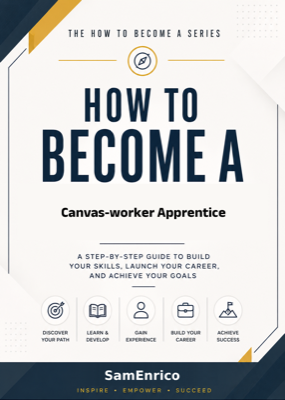
How to Become a Canvas-worker Apprentice eBook
How to Become a Canvas-worker Apprentice
by Larue Lera
How to Become a Canvas-worker Apprentice
Formats
Free sample
Chapter 1: The Hidden Trade—–- Most people walk past a canvas shop every day without ever noticing it. Tucked between a tire retailer and a laundromat, or hidden down a side street near the marina, the building has no flashy signage. The windows are frosted with dust from the cutting table. Inside, the air smells of vinyl, thread wax, and coffee that has been reheated three times. This is where the hidden trade lives—and it is one of the last skilled manual professions where a person with no college degree, no family connections, and no inheritance can build a middle-class life from nothing but willingness to learn.The term “canvas worker” sounds narrow, even old-fashioned.
It conjures images of shipwrights in wool caps hand-stitching sails for clipper ships, or circus hands repairing tent walls with a palm and needle by lantern light. But the modern canvas trade has exploded far beyond those origins. Today’s canvas worker—often called a marine fabricator, awning maker, industrial textile technician, or upholstery specialist—works with materials that did not exist twenty years ago. They sew fabrics that resist UV degradation for a decade. They weld vinyl seams with hot air guns.
They engineer three-dimensional shapes that shed wind loads measured in tons. They repair the cover that protects a million-dollar fishing boat, the awning that shades a hospital entrance, the tarp that secures a truckload of hazardous materials on the interstate.This book exists because the hidden trade is also a hidden opportunity. Across North America, the average age of a journeyman canvas worker is fifty-four years old. One-third of the workforce is expected to retire within the next decade. Meanwhile, trade schools have gutted their industrial sewing programs.
High school guidance counselors do not mention canvas work as a career path. The result is a severe shortage of skilled apprentices—and that shortage translates directly into bargaining power for anyone willing to learn.This chapter will show you exactly what the canvas trade encompasses, what your life will look like as an apprentice versus a journeyman, why formal apprenticeship crushes DIY learning in every measurable way, and how much money you can realistically expect to earn across the arc of your career. By the end, you will understand why abandoning the word “just” in front of “canvas worker” is the first step toward a profession that offers autonomy, creativity, and financial security.What the Canvas Trade Actually Encompasses The old definition of canvas work meant cutting and stitching heavy cotton duck fabric—hence the name “canvas.” Cotton duck is still used for historical restoration, painter’s drop cloths, and some traditional awnings. But the modern trade has branched into six major sectors, each with its own techniques, tools, and clientele.Marine canvas is the largest and most prestigious sector. It includes boat covers (storage covers that protect vessels during winter layup), cockpit enclosures (clear vinyl panels with zippers that turn an open fishing boat into an enclosed cabin), sail covers (fitted sleeves that protect folded sails from UV damage), dinghy chaps (abrasion-resistant skins that wrap around inflatable boats), and T-tops (rigid frames with fabric roofs over boat helms).
Marine canvas demands precision because boat shapes are compound curves—no straight lines, no right angles. A cover that is off by half an inch will flap in the wind and destroy itself in one season. Marine fabricators typically earn the highest wages in the trade because the margin for error is merciless.Truck tarps and industrial fabrics form the blue-collar backbone of the trade. Every flatbed trailer on the highway carries a lumber tarps, steel hauler tarp, or coil protector made by a canvas worker. These tarps must withstand highway speeds (70 mph wind loads), chemical exposure (road salt, diesel fuel), and extreme temperatures (-20°F to 120°F).
The materials are heavy vinyl-laminates and polyester mesh, sewn with specialized walking-foot machines that punch through half-inch stacks of fabric. Industrial fabricators also make grain bin tarps, dump truck covers, construction site debris netting, and containment booms for oil spills. This sector prioritizes durability and speed over fine craftsmanship, but it offers steady year-round work.Awnings and architectural fabric straddles the line between construction and craft. Awning makers fabricate retractable patio awnings, storefront canopies, entryway canopies for hotels, and shade sails for school playgrounds. The fabrics are predominantly acrylic (Sunbrella is the dominant brand) because acrylic breathes, resists mold, and holds vibrant colors for years.
Awning work requires knowledge of aluminum framing, attachment hardware, and wind load calculations. Many awning shops also install the products they sew, which means ladder work, roof access, and working directly with general contractors.Upholstery and interior marine focuses on the soft surfaces inside boats, RVs, and aircraft. This includes reupholstering helm seats, bench cushions, V-berth mattresses, and dinette settees. Marine upholstery uses closed-cell foam that does not absorb water, vinyls treated with mildew inhibitors, and stainless steel or Monel staples that do not rust. Interior work is cleaner and temperature-controlled compared to outdoor fabrication, but it requires pattern-making skills and attention to cosmetic detail because clients sit directly on your work.Tent and event structure fabrication serves the wedding, festival, and emergency response markets.
High-peak tents, frame tents, and clearspan structures are all sewn from vinyl-laminate polyester with welded seams and reinforced webbing at tension points. Tent makers also produce sidewalls, flooring systems, and accessory bags. This sector has seasonal peaks (summer wedding season) but can be lucrative for shops that contract with rental companies.Historical restoration and specialty work is the smallest sector but the most satisfying for craftspeople with artistic inclinations. Restorers reproduce canvas covers for antique carriages, recreate military tentage for living history museums, repair historic circus wagons, and conserve antique sails for maritime museums. This work often requires hand-sewing with linen thread, replicating obsolete seam types, and researching historical construction methods.
It pays inconsistently but offers unparalleled creative fulfillment.The common thread across all six sectors—pun intended—is that every job begins with a problem. Someone’s boat cover ripped, their awning faded, their truck tarp tore, their tent leaked, their cushion mildewed. The canvas worker provides the solution. That problem-solving role is why the trade survives automation and offshoring. A machine cannot measure a warped boat deck and cut a cover to fit its asymmetrical shape.
A factory in China cannot install an awning on a brick building with uneven masonry. The canvas worker is the last line of defense between weather and valuable property.Daily Life: Apprentice vs. Journeyman The gap between apprentice and journeyman is not just about skill—it is about responsibility, autonomy, and the kind of thinking you do all day. Understanding this gap helps you set realistic expectations for your first years in the trade.The apprentice’s daily reality is repetitive, physical, and observational. You will arrive at the shop fifteen minutes before the posted start time (never exactly on time; early is on time, on time is late).
Your first task is to sweep the cutting table, empty the scrap bins, check oil levels on all sewing machines, and brew coffee for the shop. These chores are not hazing; they teach you the rhythm of the…
This is the end of the free sample. Get the eBook to keep going. Buy now
About this book
Details
- Author
- Larue Lera
- Publisher
- SamEnrico
- Language
- English
- ISBN
- 9781505789645
- Genre
- Non-Fiction, Informative, Educational
- Released
- 2026-05-02
- Pages (approx.)
- 137
- Available as
- eBook, Paperback, Audiobook

Read better in the ZLOADR app
Your eBooks on your phone or tablet. Sign in with your SamEnrico account and start reading.
More by Larue Lera
 Interleaved Studying PracticeLarue Lera$11.99
 Fiverr Video Intro CourseLarue Lera$11.99
 Resentment For CaregiversLarue Lera$11.99
 Aggressive Communication Red FlagsLarue Lera$11.99
 Career Pacing For LongevityLarue Lera$11.99
 Prosecution Forensic TeamLarue Lera$11.99
 Citation Rules for Harvard Style GuideLarue Lera$11.99
 UK VAT Registration for Charities and Non Profits GuideLarue Lera$11.99
 Bomber Pilot MemoirLarue Lera$11.99
 The Last Voyage of the Great Aurora: A Whaling Ship's Epic 1871 SurvivalLarue Lera$11.99
 The Green Mountain Boys: Guerrilla Warfare in the WildernessLarue Lera$11.99
 The Hedge Fund Heist: How Billionaires Played the Market Like a CasinoLarue Lera$11.99